Core Capabilities of Modern Sales and Marketing Analytics Tools
To truly understand performance, we must move past vanity metrics like impressions or simple link clicks. A clear digital marketing analytics definition centers on capturing first-party data across every single touchpoint and connecting it directly to bottom-line revenue. When data sits isolated inside separate tools, tracking the real buyer journey becomes nearly impossible.
Modern platforms resolve this fragmentation through person-level tracking. Instead of looking at anonymized, isolated session data, advanced engines build a continuous timeline for every prospective buyer. They record when a lead clicks an ad, reads a blog post, schedules a discovery call, opens a nurture email, and finally completes a checkout.
By tying CRM records directly to payment processor events and marketing interactions, robust sales and marketing analytics eliminate reporting blindspots. We no longer have to guess which campaigns influenced a sale that closed three months after the initial touchpoint. Every transaction is matched back to the specific creative, campaign, and channel responsible for initiating and nurturing that relationship.
Full-Funnel Attribution and Multi-Channel Data Reconciliation
Tracking attribution across fragmented channels is one of the most persistent headaches in modern growth operations. Ad platforms love taking full credit for conversions; Meta might report 50 purchases while Google Ads claims 40 for the exact same cohort, even if your payment processor only recorded 60 sales in total.
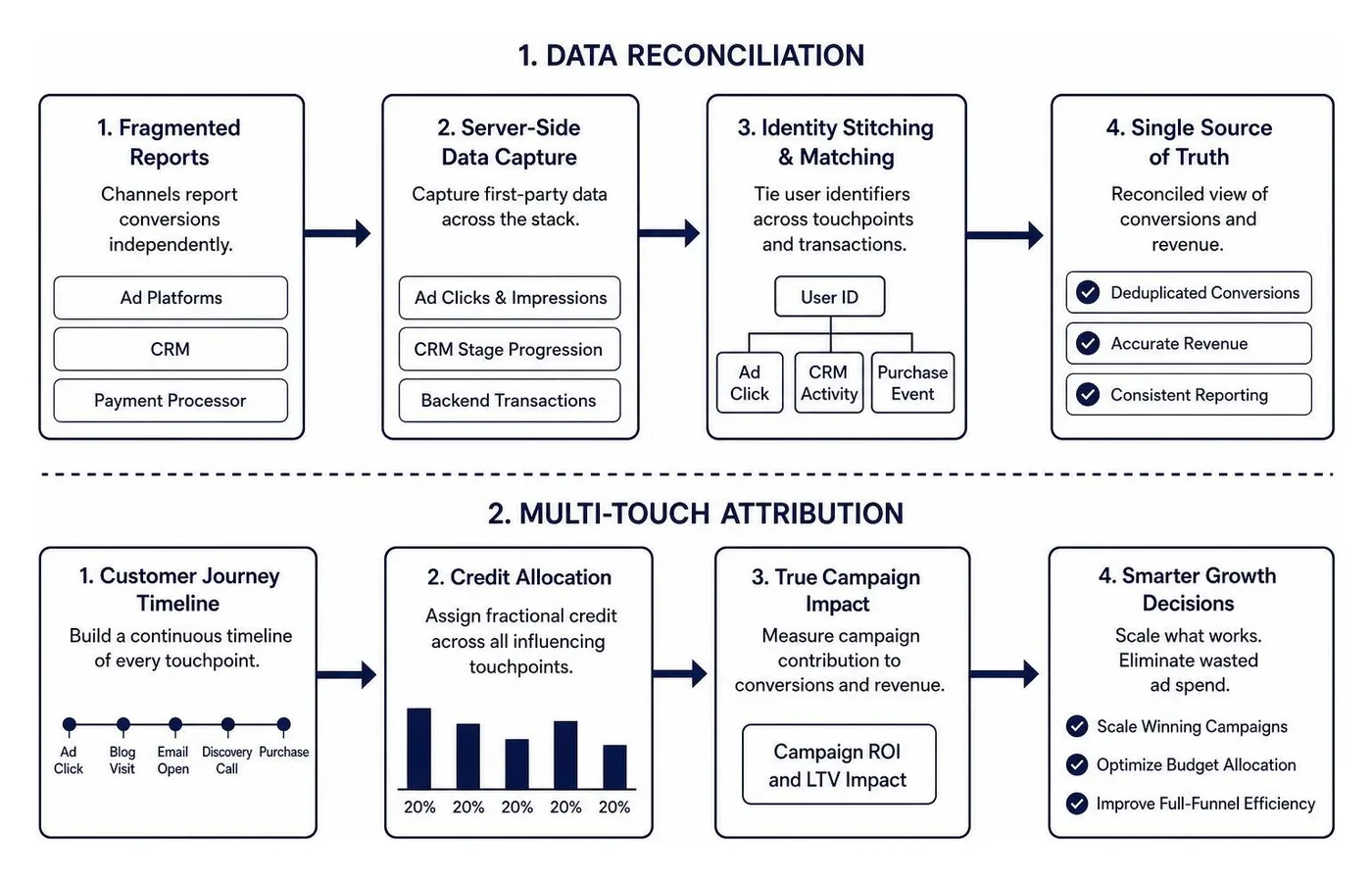
This reconciliation breakdown happens because ad networks rely on self-serving attribution windows and client-side cookies that get blocked by modern browser privacy protections. Multi-touch attribution engines resolve these conflicts by capturing server-side first-party data. By stitching together user identifiers across ad clicks, CRM stage progressions, and backend transactions, these platforms establish a single source of truth.
Accurate attribution allows growth teams to uncover true campaign-level ROI. Offline sales, phone orders, and long-cycle B2B deals can be linked back to the exact top-of-funnel interactions that generated them. When evaluating full-funnel efficiency, robust lead generation analytics give operators the clarity needed to scale winning campaigns and eliminate wasted ad spend with absolute confidence.
Profit-First Metrics and Lifetime Value Measurement
Standard conversion rates only tell a fraction of the story. A marketing channel might generate hundreds of low-friction purchases, but if those buyers heavily utilize discount codes, return items frequently, or never purchase again, that channel could be actively draining your operating capital.
Forward-thinking organizations rely on profit-first metrics, evaluating profit per visitor (PPV) rather than top-line revenue alone. Profit per visitor calculates the true net yield of incoming traffic by systematically subtracting essential costs:
Cost of Goods Sold (COGS)
Gateway processing and merchant fees
Variable fulfillment and shipping costs
Applied discounts and promotional vouchers
Analyzing unit economics at this level transforms decision-making. By leveraging advanced data analytics for sales and marketing, teams can measure true Customer Lifetime Value (LTV) across 30, 60, 90, and 365-day windows.
Account-wide averages often mask vital truths; for example, an average lead value might sit at $100, but granular segmentation might reveal that one professional sub-segment generates $275 in lifetime value while another yields barely $20. Identifying these high-margin segments allows businesses to focus their acquisition budgets exclusively on acquiring the most profitable customer profiles.
Essential Categories of Analytics Software
Building a high-performing tech stack requires understanding the functional categories of modern data platforms. Rather than accumulating disconnected point solutions that create new data silos, organizations are adopting unified architectures that bring tracking, modeling, and operational execution under one roof.
Choosing the right foundation depends heavily on your team's technical capacity. While custom data engineering works well for massive organizations with dedicated database administrators, fast-growing companies generally benefit far more from an all-in-one analytics operating framework that automates data pipelines out of the box.
Deploying an integrated analytics platform for marketing also simplifies data governance and compliance. As regional privacy frameworks and international digital sovereignty standards evolve, centralizing data collection ensures full control over customer records, retention policies, and cross-border data handling.
Enterprise Business Intelligence and Sales and Marketing Analytics Tools
Enterprise Business Intelligence (BI) platforms are designed to ingest massive volumes of raw event data from multiple enterprise properties. These systems connect to cloud data warehouses—such as Snowflake, Google BigQuery, or Amazon S3—transforming unstructured event streams into customized reporting dashboards.
These systems excel at rigorous statistical evaluation. When split-testing landing pages, pricing models, or checkout flows, enterprise platforms deploy Bayesian and frequentist statistical modeling to confirm whether conversion lifts are statistically valid before scaling spend.
However, enterprise BI tools demand specialized technical talent to build pipelines, write SQL models, and maintain infrastructure. This technical barrier has driven a massive surge in hiring for marketing analytics roles across major business hubs like Fort Lauderdale and Miami, FL, as brands compete for specialists capable of translating raw data tables into commercial growth strategies.
AI-Driven Analytics and Predictive Conversion Platforms
Artificial intelligence has shifted analytics from passive historical reporting to proactive revenue optimization. Modern predictive conversion platforms utilize machine learning models to analyze thousands of behavioral signals across the customer lifecycle, forecasting which leads are most likely to convert before a sales rep even reaches out.
One of the most powerful applications of AI in this space is automated conversion feeding. Instead of waiting for ad networks to optimize based on generic click signals, conversion feeder systems push real transaction and margin data directly back to ad platform APIs on a daily basis.
When Google, Meta, and TikTok receive real-time, verified customer purchase values, their machine learning bidding algorithms automatically target lookalike audiences matching your highest-margin buyers. Pairing predictive attribution with automated marketing automation services creates an autonomous growth loop: data informs targeting, algorithms refine delivery, and automated sequences nurture leads into high-value clients.
Implementation Strategies: Data Integration, AI Agents, and Role-Based Dashboards
Deploying an effective analytics architecture requires moving away from fragmented single-purpose tools. When teams rely on separate platforms for web tracking, email metrics, CRM pipelines, and payment processing, critical insights inevitably fall through the cracks.
Capability / Feature | Standalone Point Solutions | Integrated Growth Operating Systems |
|---|---|---|
Data Ingestion | Siloed API connections with manual sync | Native, real-time bidirectional data flow |
Attribution Modeling | First-click or single-channel estimates | Full-funnel, multi-touch person-level tracking |
Implementation Effort | High technical maintenance & custom API glue | Turnkey setup with pre-configured schemas |
Margin & Profit Tracking | Surface-level revenue reporting only | Automated profit-per-visitor & COGS deduction |
Operational Execution | Reporting only; requires external tools | Unified analytics, CRM, and sales automation |
Bridging the gap between marketing initiatives and closed revenue is essential for scaling businesses. Successfully using analytics to align sales and marketing teams ensures that marketing teams are incentivized by pipeline value and closed revenue rather than arbitrary lead counts. Combining these insights directly with dedicated sales automation services ensures high-intent prospects receive instant, tailored follow-ups the moment they meet qualified conversion thresholds.
Key Integrations Required for Sales and Marketing Analytics Tools
A truly unified analytics stack depends on seamless, bidirectional data flow between every customer-facing system. If any channel operates in isolation, your attribution model breaks down.
To build a reliable single source of truth, ensure your platform includes native integrations for:
CRM & Pipeline Engines: Complete CRM setup automation to sync deal stages, pipeline values, sales call outcomes, and lead statuses instantly.
Paid Advertising Networks: Direct server-side API connections to Meta, Google Ads, TikTok, YouTube, and programmatic ad exchanges for spend aggregation and bidirectional conversion feeding.
Payment Gateways & Processors: Live synchronization with Stripe, PayPal, Authorize.net, and merchant merchant accounts to verify authentic revenue and handle refund deductions.
Email & Communication Systems: Continuous syncing of open rates, click paths, automated sequence triggers, and conversational responses.
eCommerce & Cart Software: Granular tracking of cart additions, abandoned checkouts, coupon usage, and shipping tier selections.
Leveraging AI Agents and Natural Language Querying
The integration of AI agents is transforming how marketing and executive teams interact with performance metrics. Rather than manually configuring complex pivot tables, operators can use natural language interfaces to query their datasets directly, asking questions like, "Which ad creatives drove the highest margin over the last 60 days?"
The development of the open-source Model Context Protocol (MCP) has accelerated this shift. MCP functions like an open standard connector for artificial intelligence, allowing language models—such as Claude, ChatGPT, and Gemini—to securely connect directly to your analytics databases, CRMs, and operational tools without custom coding.
While AI querying delivers immense speed, organizations must implement safeguards against hallucinations. AI agents should always sit on top of unified, strictly validated data schemas. By pairing natural language querying with verified database calculations, teams can securely extract instant insights while maintaining absolute reporting accuracy.
Frequently Asked Questions About Sales and Marketing Analytics
How do analytics platforms resolve data discrepancies between ad networks and CRMs?
Data discrepancies occur because ad networks rely on client-side tracking pixels, browser cookies, and generous attribution windows that inevitably double-count conversions. Modern analytics platforms resolve this by implementing server-side event tracking and first-party identity stitching.
When a user visits your web properties, the platform generates a persistent person-level identifier that tracks their actions across sessions. When a conversion occurs in your CRM or payment gateway, that transaction is tied back to the unique person record.
Deduplication algorithms then match the real transaction against incoming ad network data, verifying which campaign legitimately drove the initial interaction and eliminating inflated self-reported figures from the ad channels.
What is profit-per-visitor and why does it matter over standard conversion rate?
Profit-per-visitor (PPV) is an advanced metric that calculates the exact net profit generated by every visitor arriving at your website or landing pages. Unlike traditional conversion rate—which merely measures the percentage of visitors who complete an action—PPV accounts for the complete financial reality of every order.
$$\text{Profit Per Visitor} = \frac{\text{Total Revenue} - (\text{COGS} + \text{Discounts} + \text{Gateway Fees} + \text{Shipping})}{\text{Total Unique Visitors}}$$
Evaluating traffic through PPV prevents marketing teams from scaling campaigns that drive high sales volume at razor-thin or negative operating margins. It provides clear visibility into unit economics, allowing media buyers to calibrate their bids based on actual net profitability rather than surface-level revenue.
Can historical data be imported to get immediate analytics insights?
Yes. Leading analytics platforms feature historical data ingestion engines that backfill records from your existing tech stack. By connecting your CRM, email tools, and payment gateways via historical CSV uploads or native API backfills, the platform can retroactively reconstruct customer journeys.
This eliminates the need to wait months to accumulate fresh data before generating actionable insights. Teams can immediately run retroactive cohort analyses, establish baseline performance benchmarks, and evaluate the long-term lifetime value of customer cohorts acquired months or years prior.
Conclusion

Scaling a modern business without unified analytics is like flying through a storm without instruments. Relying on disconnected dashboards, surface-level click metrics, and inflated ad platform reports leads to misallocated budgets, missed revenue targets, and blind operational decisions.
True growth requires absolute clarity across every dollar invested, every lead generated, and every closed deal. Instead of wrestling with a dozen disconnected point solutions and trying to manage complex technical integrations yourself, you can deploy a single, unified growth engine.
At RewardLion, we provide an AI-powered all-in-one operating system that unifies your marketing, sales automation, CRM, and full-funnel analytics into one seamless command center. Backed by our dedicated in-house fractional marketing agency team, we don't just hand you software—we implement, optimize, and manage your entire growth infrastructure from end to end.
Ready to eliminate blind spots and scale your revenue with complete confidence? Discover how the RewardLion complete growth operating system transforms your sales and marketing performance today.