Why Lead Generation Analytics Is the Engine Behind B2B Revenue Growth
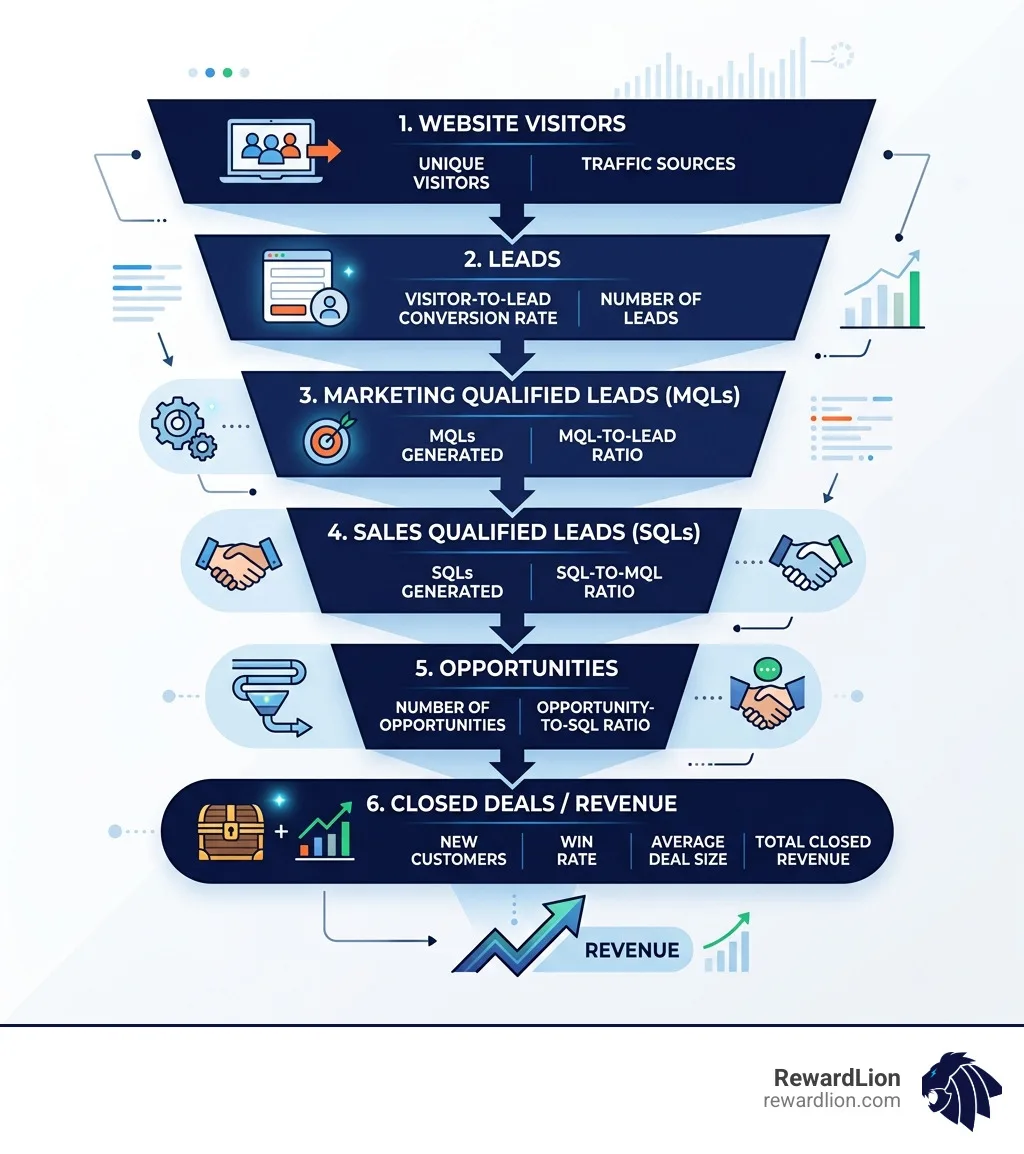
Lead generation analytics is the practice of tracking, measuring, and optimizing every step of your lead pipeline — from the first website visit to a closed deal.
Here's a quick breakdown of what it covers:
What It Tracks Why It Matters Where leads come from Identifies your best-performing channels How leads behave on your site Reveals buying intent and interest level How leads move through the funnel Spots drop-off points and bottlenecks Which leads convert to revenue Shows true ROI, not just volume Cost per qualified lead Helps cut waste and scale what works
The numbers tell a clear story. Around 91% of marketers rank lead generation as their top goal — yet 80% of leads never convert to revenue. That gap exists because most teams track the wrong things. They focus on traffic and MQL counts instead of the metrics that actually predict closed deals.
The fix isn't more leads. It's smarter tracking.
When you connect your lead data to real revenue outcomes, you stop guessing and start making decisions that grow your business.
I'm Mike Ibrahim, Founder and CEO of RewardLion and Marketing Director for several companies, with over a decade of experience building data-driven systems around lead generation analytics that turn fragmented marketing efforts into predictable revenue engines. In this guide, I'll walk you through exactly how to do the same for your business.
The Strategic Framework for Lead Generation Analytics
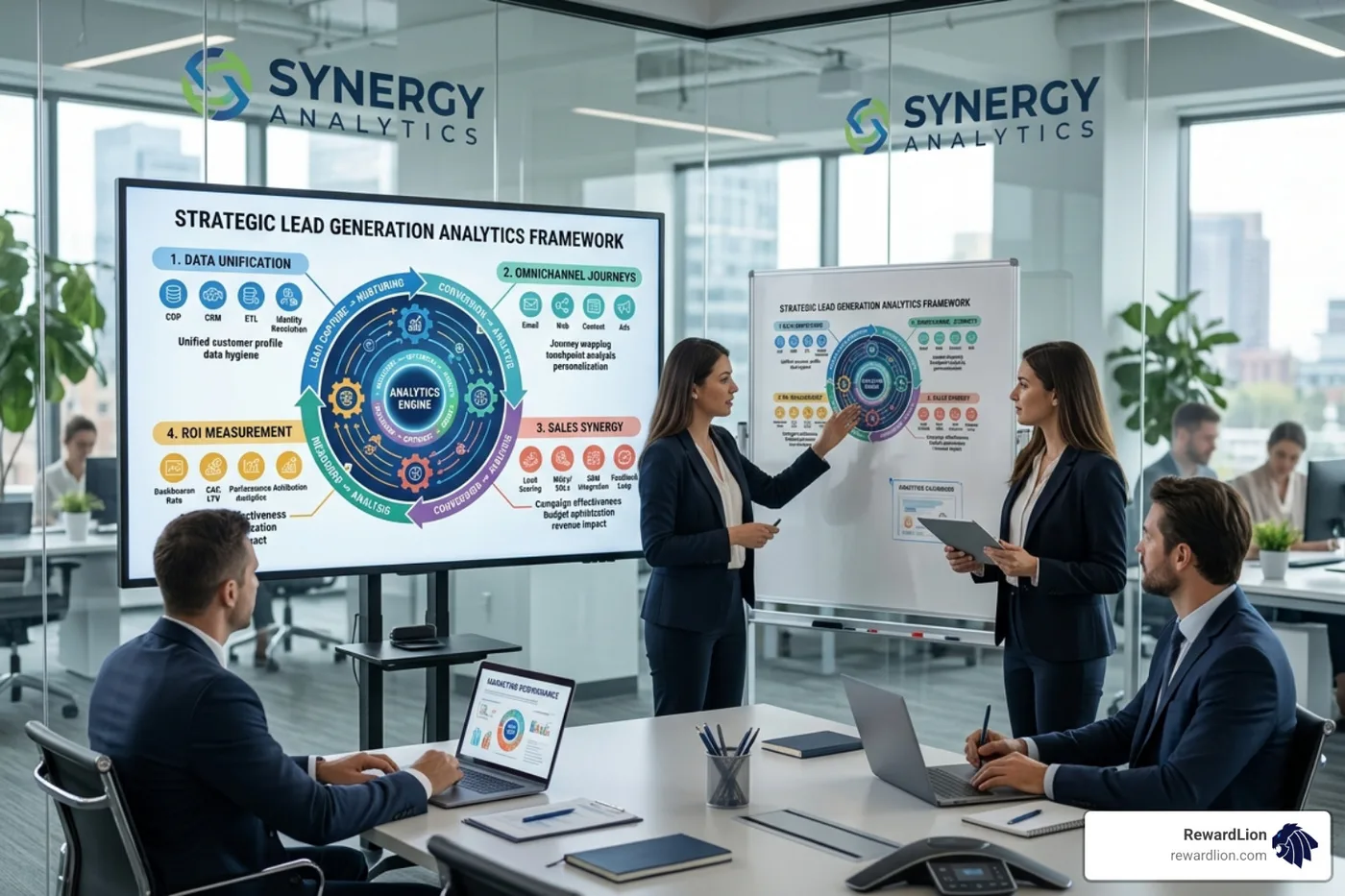
To drive predictable B2B revenue, you can't just throw spaghetti at the wall and see what sticks. You need a strategic framework. We view this as a four-pillar engine: actionable profiles, omnichannel journeys, sales-marketing synergy, and rigorous ROI measurement.
Modern B2B buyers are self-educators. They interact with an average of 11.4 touchpoints before they ever talk to a salesperson. If your lead generation analytics aren't capturing those early signals, you are flying blind. A strategic framework moves you away from "random acts of marketing" and toward a predictable revenue engine where every dollar spent is accounted for. For a practical overview of proven tactics, see this lead generation guide.
Unifying Lead Data and Buyer Profiles
The biggest hurdle to effective analytics is siloed data. If your website tracking doesn't talk to your CRM, and your CRM doesn't talk to your ad platforms, you have a broken picture. We focus on creating a "Single Source of Truth."
By unifying demographic, firmographic (company size, industry, revenue), and behavioral data (pages visited, content downloaded), we create actionable buyer profiles. This allows us to see not just who is visiting, but why they are there. For businesses in Fort Lauderdale or Miami looking to scale, this level of detail is what separates the market leaders from the noise. This is also where branding and identity play a role - consistent messaging ensures that the data you collect is coming from the right Ideal Customer Profile (ICP).
Aligning Sales and Marketing Teams
Revenue is often lost in the "gap" between marketing and sales. Marketing thinks they delivered great leads; Sales thinks the leads are junk. Lead generation analytics acts as the bridge.
By using shared insights and real-time alerts, both teams stay on the same page. When a high-intent lead from a target account visits a pricing page, Sales should know instantly. We implement feedback loops where Sales validates lead quality, allowing Marketing to adjust campaigns in real-time. This "Revenue Operations" approach ensures that the "busy work" of prospecting is replaced by high-value conversations.
Tracking Performance: Metrics, Dashboards, and Reports
In 2026, vanity metrics like "impressions" or "likes" are dead. If a metric doesn't lead to a dollar, it’s probably not worth your time. We focus on revenue-based analytics that tell us exactly how much it costs to acquire a customer and how fast they move through the funnel.
Our marketing services prioritize the metrics that matter for growth. For example, tracking "Lead Velocity"—the speed at which leads are moving through your pipeline—can be a better predictor of future revenue than current total lead volume.
Vanity Metric Revenue-Based Metric Why the Switch Matters Total Website Traffic ICP Visitor Rate Traffic is useless if it's not your target buyers. Total Leads Generated Cost Per Qualified Lead (CPQL) Focuses on quality and budget efficiency. Email Open Rates Sales-Accepted Lead (SAL) Rate Measures if Sales actually finds the leads useful. Form Submissions MQL-to-SQL Conversion Rate Tracks the handoff efficiency between teams.
Visualizing Data with Lead Generation Analytics
Data is only useful if you can understand it at a glance. We use automated dashboards to visualize the multi-source acquisition funnel. This includes tracking lead source analysis to see which platforms—be it Google Ads, LinkedIn, or organic search—are driving the most valuable conversions.
By using detailed UTM parameters, we can track a lead down to the specific keyword or ad creative they clicked. This level of transparency allows us to see which landing pages are converting at 20% and which are failing at 2%, enabling instant optimization.
Key Reports for Funnel Transparency
To maintain a healthy pipeline, you need three specific reports in your arsenal:
Campaign Performance Report: Which specific ads are driving the highest ROI?
Lead Demographics Report: Are we attracting the right job titles and company sizes?
Attribution Report: Which touchpoints actually triggered the sale?
Our software services integrate these reports directly into your operating system, providing a real-time view of your funnel's health.
Leveraging AI for Lead Scoring and Prioritization
The days of manual lead scoring are over. AI-powered tools now use machine learning to assign "propensity scores" based on thousands of data points. Instead of a salesperson guessing who to call, AI lead scoring tells them exactly who is most likely to buy today.
AI can analyze "intent data"—signals that a company is in an active buying cycle—and prioritize those leads in your CRM. This ensures your sales team spends 80% of their time on the 20% of leads most likely to close.
Multi-Touch Attribution and the Buyer's Journey
B2B sales cycles are rarely a straight line. A prospect might see a LinkedIn ad, read a blog post, attend a webinar, and then finally search for your brand on Google. If you only use "last-click" attribution, you’d give all the credit to Google Search and stop funding your LinkedIn ads—a move that would eventually kill your pipeline.
We use multi-touch attribution models (like linear or time-decay) to give credit to every touchpoint. This provides a clear map of the buyer’s journey, allowing you to see which content pieces are "assisting" the sale even if they aren't the final click.
Turning Website Visitors into Qualified Leads
Did you know that up to 98% of your website visitors leave without filling out a form? Lead generation analytics tools can now identify the companies those anonymous visitors work for using IP-to-company mapping.
By unmasking this "dark funnel," we can identify high-intent accounts that are researching your solution but haven't raised their hand yet. This allows for proactive outreach and retargeting that can increase your qualified leads by over 50%. It’s like having a caller ID for your website.
A 9-Step Process for Executing Campaigns
Building a high-performing campaign requires a repeatable process. At RewardLion, we follow a 9-step cycle to ensure every campaign is optimized for maximum ROI:
Analyze and Plan: Define clear revenue goals and KPIs.
Research: Identify your ICP and where they hang out online.
Create Message: Develop content that solves specific pain points.
Promote Content: Deploy across omnichannel platforms (Ads, SEO, Social).
Landing Pages: Drive traffic to high-converting, optimized pages.
Lead Capture: Use automated forms and AI chatbots to engage.
Lead Scoring: Automatically qualify leads based on behavior and fit.
Evaluate Results: Use lead generation analytics to see what worked.
Iterate: Double down on the winners and cut the losers.
Scaling Growth via Lead Generation Analytics
Once you have the data, scaling becomes a math problem. If you know that every $1,000 spent on LinkedIn generates $5,000 in pipeline, you can confidently increase your budget. Analytics allow you to reallocate funds from underperforming channels to high-growth ones, effectively reducing your overall Cost Per Lead (CPL) while increasing your win rates.
Explore how RewardLion solutions can automate this scaling process for you, managing the technical heavy lifting while you focus on closing deals.
Real-World Success and Benchmarks
The impact of implementing these systems is often dramatic. Research shows that companies using advanced visitor identification can identify up to 45% of their anonymous traffic. Furthermore, businesses that align their sales and marketing through shared analytics often see:
75% increase in MQL-to-SQL conversion rates.
35% reduction in cost per qualified lead.
70% reduction in manual research time for sales teams.
These aren't just numbers; they represent hundreds of thousands of dollars in "hidden" pipeline that most companies simply ignore.
Frequently Asked Questions about Lead Generation
How can I reduce my cost per lead using analytics?
The fastest way to reduce CPL is to stop spending money on "dead air." By using lead generation analytics to identify which channels produce leads that actually close, you can cut the bottom 20% of your underperforming ad spend. Additionally, using AI lead scoring ensures you aren't wasting sales resources on low-intent leads, which lowers the "total cost" of acquisition.
What are the most important lead generation metrics to track in 2026?
Focus on "Bottom of Funnel" metrics:
Cost Per Qualified Lead (CPQL)
MQL-to-SQL Conversion Rate
Sales Velocity (How fast a lead goes from "hello" to "closed")
Customer Acquisition Cost (CAC) vs. Lifetime Value (LTV)
How does AI-powered lead scoring improve conversion rates?
AI lead scoring improves conversion by ensuring "speed to lead." By identifying high-propensity prospects in real-time, your sales team can reach out while the prospect is still on your website. Studies show that reaching out within 5 minutes of an interaction increases the chance of conversion by up to 9x.
Conclusion
Lead generation analytics is no longer a luxury for B2B companies; it is the foundation of survival in a competitive market. By moving away from vanity metrics and building a system focused on revenue-based insights, you transform your marketing from a "cost center" into a "profit engine."
At RewardLion, we don't just give you the tools; we provide the expert team to manage them for you. From Fort Lauderdale to Miami and across the United States, we help businesses install one fully connected growth system powered by AI and optimized by humans.
Ready to stop guessing and start growing? Explore the RewardLion platform and see how we can turn your data into a predictable revenue stream.