The Rise of Online Marketing Automation Software (And Why It Matters in 2026)
Online marketing automation software helps businesses automatically handle repetitive marketing tasks — like sending emails, scoring leads, and nurturing prospects — so your team can focus on strategy and growth.
Here's what the top platforms typically do:
Email & SMS automation — send the right message at the right time, automatically
Lead scoring — rank prospects based on behavior so sales knows who to call first
Audience segmentation — group contacts by actions, demographics, or purchase history
CRM integration — sync marketing and sales data in one place
Analytics & reporting — track what's working and cut what isn't
Marketing is getting harder to manage manually. Campaigns span email, SMS, social, ads, and more. Juggling separate tools for each channel creates gaps, wasted budget, and missed leads.
The numbers back this up. The marketing automation industry is on track to hit $6.4 billion in 2026 — and is projected to nearly double to $14 billion by 2030. That kind of growth doesn't happen unless businesses are seeing real results.
And yet, many small and medium-sized businesses are still stitching together five or six disconnected tools, losing time and leads in the process.
That's exactly the problem automation software is built to solve.
I'm Mike Ibrahim, Founder and CEO of RewardLion and Marketing Director for several companies, with over a decade of hands-on experience implementing and scaling online marketing automation software across diverse industries. In this guide, I'll walk you through everything you need to choose the right platform and actually put it to work.
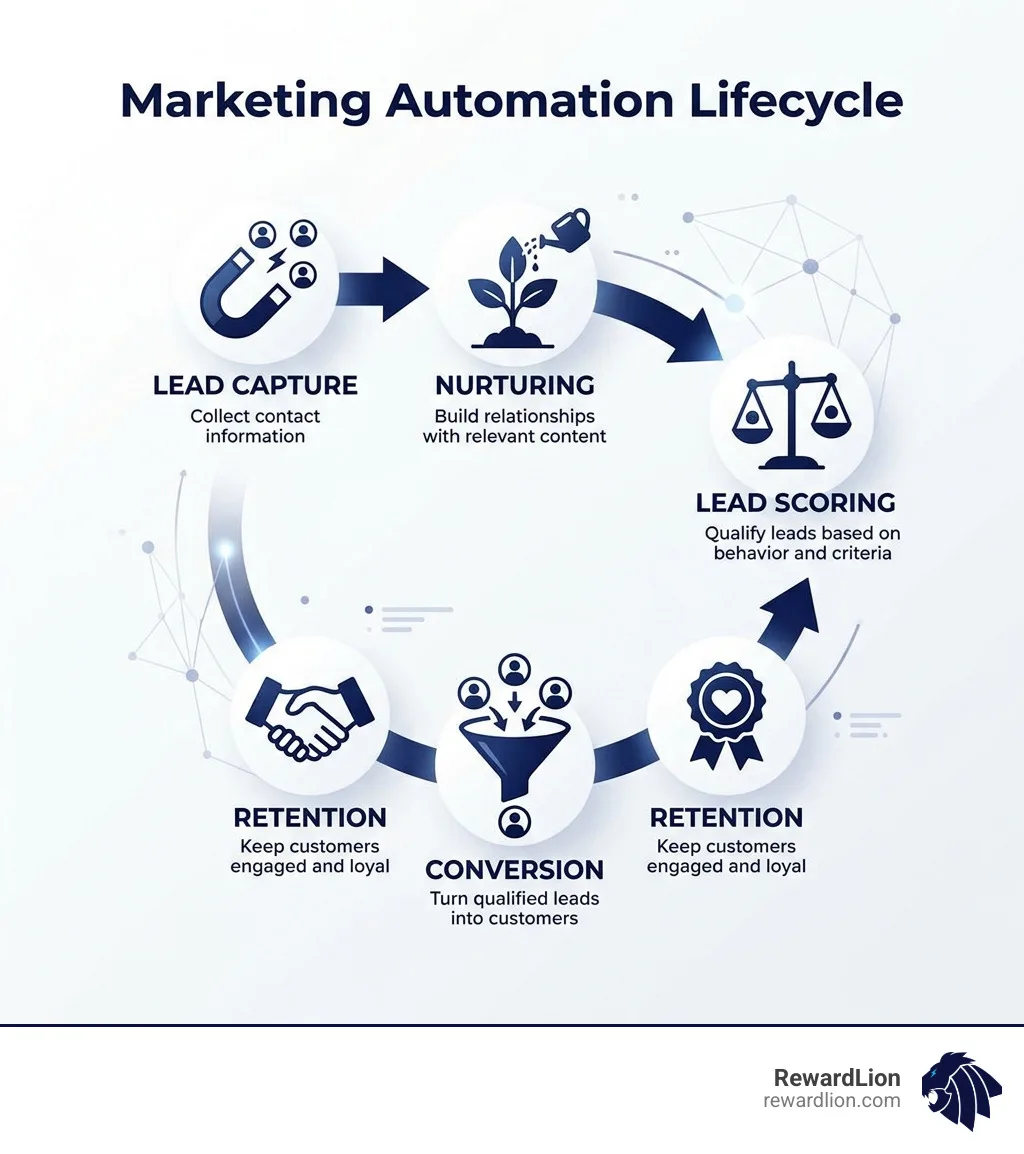
Understanding Online Marketing Automation Software and Its Business Value
When we talk about online marketing automation software, we aren't just talking about a tool that sends "blasts" to your email list. We are talking about a sophisticated engine that drives scalability. For businesses in Miami, Boca Raton, and throughout Florida, the ability to grow without linearly increasing headcount is the ultimate competitive advantage.
The primary value lies in lead nurturing. Research shows that most leads aren't ready to buy the moment they first interact with your brand. Without automation, these leads often fall through the cracks because manual follow-up is exhausting and inconsistent. Automation ensures that every lead is greeted, educated, and nudged toward a purchase through Lead Capture Software.
By automating repetitive tasks, your team regains hours of productivity. In fact, some businesses report saving up to 13 hours per week just by automating their basic workflows. This is particularly vital for Small Business Automation Software users who often wear multiple hats and can't afford to spend all day manually updating spreadsheets.
Key Differences Between CRM and Online Marketing Automation Software
It is a common point of confusion: "Do I need a CRM or marketing automation?" The answer for most modern businesses is both, but they serve different roles in the customer lifecycle.
Marketing Automation: This is the "top of the funnel" workhorse. Its job is to generate leads, track website behavior, and nurture prospects until they are "sales-ready." It focuses on efficiency in campaigns and early-stage engagement.
CRM (Customer Relationship Management): This is the "bottom of the funnel" and "post-sale" record-keeper. It tracks detailed interactions, manages the sales pipeline, and helps sales teams close deals.
While they are distinct, the lines are blurring. Many platforms now offer hybrid solutions. However, understanding the core difference helps you ensure you aren't missing the lead-generation power of a Lead Generation Software Complete Guide.
Why Businesses Need Automation in 2026
In 2026, automation isn't a luxury; it's a survival trait. With the industry skyrocketing to a $6.4bn valuation this year, your competitors are likely already using these tools to out-pace you.
Statistics show that 45% of companies now list automation as the #1 feature they want in their business tools. Why? Because it drives revenue growth through precision. Instead of guessing who might buy, automation uses behavioral data to trigger messages. If a user visits your pricing page three times in two days, the software knows to send an invite for a demo or a limited-time discount. This level of Demand Generation Software capability is what separates the market leaders from the rest.
Essential Features of Modern Automation Platforms
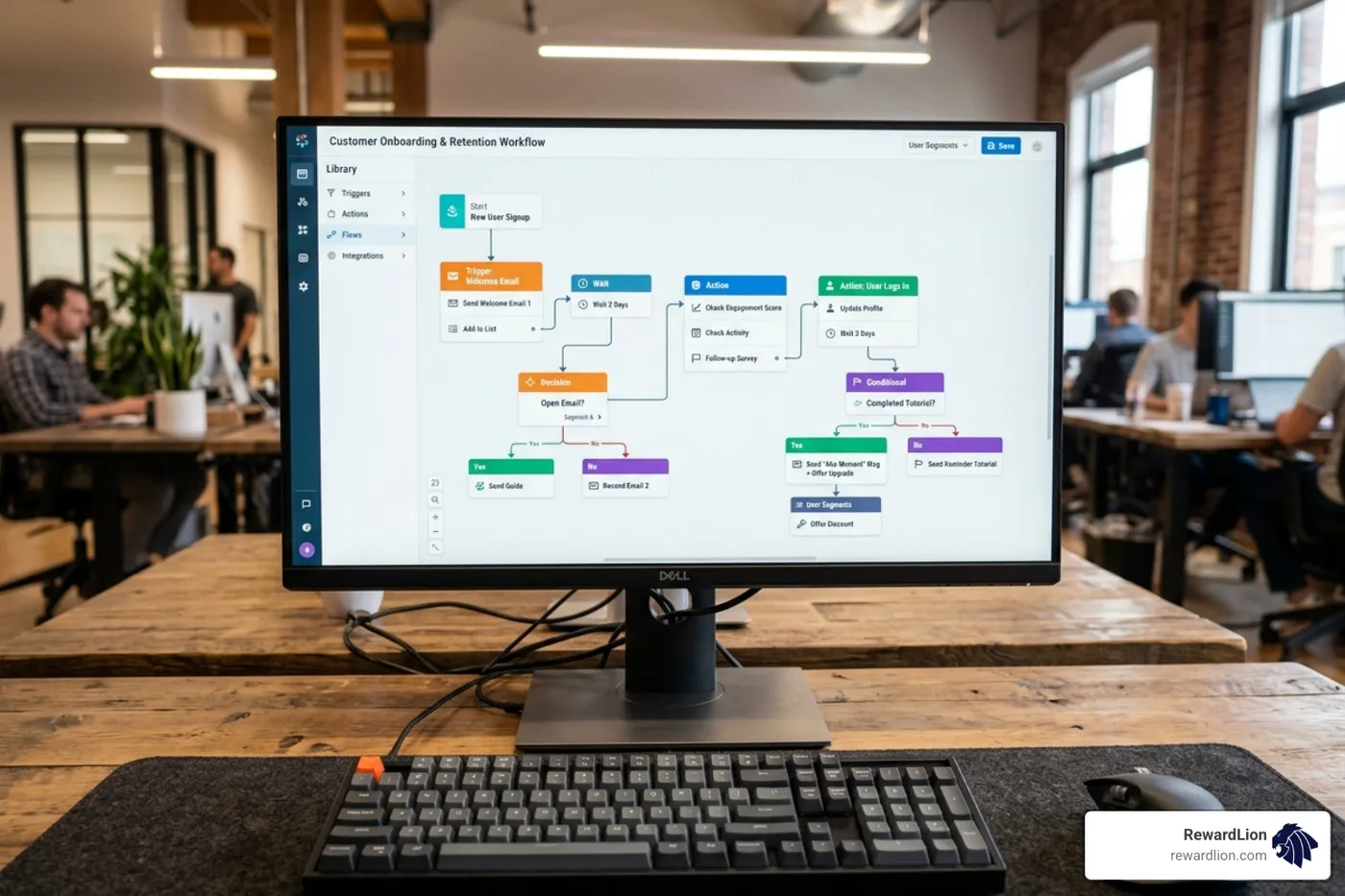
The "Modern Age" of online marketing automation software is defined by its usability and intelligence. We've moved past the days of needing a computer science degree to build an email sequence.
Visual Workflow Builders: These drag-and-drop interfaces allow you to map out the customer journey. You can see exactly what happens when a lead signs up, clicks a link, or abandons a cart.
Predictive Sending: Using AI, the software analyzes when an individual contact is most likely to open an email and sends it at that exact moment, often increasing click-through rates by up to 17%.
Omnichannel Support: Modern platforms don't stop at email. They integrate Sms Automation Software and Drip Email Marketing Software to reach customers wherever they are.
AI Agents: We are seeing the rise of autonomous agents that can resolve over 65% of customer inquiries autonomously or even suggest the best next step for a marketing campaign.
Integrating Online Marketing Automation Software with Your Tech Stack
Your automation platform should be the "brain" of your marketing, but it needs to talk to your other organs. Integration is key. Whether you are using specialized niche tools or custom internal apps, your data must flow freely. For a broader industry overview of how these platforms are evolving, see marketing automation on Wikipedia.
A seamless CRM sync ensures that when a lead becomes "hot" in your marketing software, it instantly appears in your sales team's dashboard. This maintains data hygiene and prevents the "silo effect" where marketing doesn't know what sales is doing. For B2B companies, Sales Automation Software Saas integrations are essential for keeping the pipeline moving without manual data entry.
Advanced Analytics and Reporting Capabilities
If you can't measure it, you can't improve it. Modern platforms offer All In One Analytics that go far beyond open rates. We now look at:
Attribution Modeling: Which specific ad or email actually led to the sale?
ROI Measurement: Exactly how many dollars did this campaign generate versus what it cost?
Real-time Insights: Dashboards that update as actions happen, allowing for instant campaign optimization.
Using a dedicated Analytics Platform For Marketing allows you to stop the guesswork and start making decisions based on hard data.
Evaluating Costs and Choosing the Right Provider
Choosing online marketing automation software is a significant investment, both in money and time. Pricing models vary wildly, and it's easy to get caught in a plan that scales faster than your revenue.
Pricing Comparison Overview (Estimated 2026 Market Rates)
Business Size Typical Monthly Cost Key Features Small Business $50 - $200 Email, basic workflows, up to 2,500 contacts Mid-Market $300 - $1,000 Omnichannel, advanced AI, up to 10,000 contacts Enterprise $2,000+ Full custom stack, ABM, unlimited scaling
Note: Many legacy providers may also charge significant onboarding fees (sometimes $3,000+) to get you started.
When evaluating costs, look for "hidden" factors. Some platforms charge based on every contact in your database, while others only charge for "active" contacts you actually market to. It is important to evaluate how your database size will impact your monthly bill as you grow.
Common Deal-Breakers and Selection Criteria
Through our work in Fort Lauderdale and Miami, we’ve seen businesses abandon software within 30 days because they ignored these deal-breakers:
Usability: If it takes three weeks to train a new employee on the software, it's too complex. Look for intuitive builders.
Integration Depth: Does it actually connect to your CRM, or is it a "buggy" workaround?
Customer Support: When your automation breaks on Black Friday, do you get a chatbot or a human?
Security & Compliance: In 2026, GDPR and CCPA compliance are non-negotiable. Ensure your provider prioritizes data privacy.
For mobile-first businesses, a Lead Generation App Complete Guide can help you determine if you need a platform with a robust mobile management interface.
Best Online Marketing Automation Software for Specific Use Cases
E-commerce: Look for tools that specialize in cart abandonment and product recommendations.
B2B Sales: Platforms that excel at Account-Based Marketing (ABM) and complex lead scoring are essential for high-ticket sales.
Content Creators: Simple, high-deliverability tools are often the best fit for newsletter-focused growth.
Hyper-Growth Startups: Use Lead Gen Software that scales its pricing tiers gradually rather than jumping from $50 to $500 overnight.
The Future of Automation: AI and Autonomous Marketing
The most exciting shift in 2026 is the move from "automation" to "autonomy." Traditional automation follows rules you set (If THIS, then THAT). Autonomous marketing uses Ai Driven Sales Platform technology to decide what "THAT" should be.
Instead of you building a roadmap, the AI looks at your goal (e.g., "Increase revenue by 20%") and builds the strategy for you. It writes the copy, selects the audience segments, and optimizes the send times based on real-time machine learning.
We are entering the era of Agentic Workflows, where AI agents act as virtual teammates. They don't just send the email; they research the lead, enrich the data, and personalize the message in a way that feels human.
Frequently Asked Questions about Marketing Automation
Which tool is best for small businesses?
For most small businesses, an all-in-one platform is a top choice because it balances advanced features with an affordable entry point. Solopreneurs should look for tools that offer robust free tiers to get started without upfront investment.
How much does marketing automation software typically cost?
Costs range from free (for very basic tiers) to several thousand dollars a month. A typical mid-sized business in Florida should expect to spend between $150 and $500 per month for a robust platform that handles email, SMS, and basic AI features.
What are the main disadvantages of automation?
The biggest "con" is the "set it and forget it" trap. Automation requires regular audits to ensure your messaging stays relevant. Additionally, if not configured correctly, you risk sending the wrong message to the wrong person, which can damage your brand reputation.
Conclusion
The "Modern Age" of marketing demands a level of speed and personalization that humans simply cannot achieve alone. Online marketing automation software is the bridge between a small local shop and a global brand.
At RewardLion, we believe you shouldn't have to manage a dozen disconnected tools or spend your weekends building workflows. Our AI-powered all-in-one OS unifies your marketing, sales, and analytics into one cohesive system.
Based in Fort Lauderdale, we provide a unique "Hybrid SaaS" model. You get the power of our cutting-edge platform, but you also get our dedicated CAPSS team — your fractional in-house agency — to implement, optimize, and manage it for you. We don't just give you the software; we give you the results.
Ready to stop managing tools and start growing your business? More info about our platform