What is Small Business Automation Software and Why is it Essential for Growth?
At its core, small business automation software refers to technology that executes repetitive tasks or complex business processes with minimal human intervention. Think of it as a digital nervous system that connects your marketing, sales, and operations. Instead of you manually copying lead data from an email into a spreadsheet, the software does it instantly. Instead of a team member spending hours chasing unpaid invoices, the system sends polite, automated reminders until the balance is cleared.
Why is this essential for growth? Because manual labor doesn't scale. If your business relies on manual processes, doubling your customer base usually means doubling your workload or doubling your headcount. Automation breaks that linear relationship. It allows you to increase your output and revenue without a proportional increase in stress or costs.
For founders in areas like Fort Lauderdale or Miami, leveraging advanced AI for operations means your business stays "open" 24/7. While you sleep, your software is nurturing leads, qualifying prospects, and even closing sales. This transition from manual to automated isn't just about convenience; it's about reclaiming the 16 hours a week the average entrepreneur loses to "busywork."
Core Features to Look for in Small Business Automation Software
When shopping for the right tools, don't get blinded by "feature bloat." Focus on these high-impact capabilities:
Visual Workflow Builders: You shouldn't need a computer science degree to automate. Look for drag-and-drop interfaces where you can map out "If This, Then That" scenarios visually.
Deep App Integrations: Your software must play nice with others. Whether it's connecting your CRM to your Gmail or your Slack to your accounting software, seamless data syncing is non-negotiable.
Lead Scoring and Nurturing: Not all leads are created equal. Great automation tools can "score" a lead based on their actions (like opening an email or visiting a pricing page) and trigger specific follow-ups based on that interest.
Centralized Analytics: You can't manage what you don't measure. Your platform should provide a "single source of truth" for your data so you can see exactly where your growth is coming from.
Scaling with Small Business Automation Software
Scaling is often the "danger zone" for small businesses. Rapid growth can lead to human error, missed follow-ups, and team burnout. Automation acts as a stabilizer. By implementing custom-tailored software solutions, businesses can eliminate the "bottlenecks" unique to their industry.
Furthermore, automation allows for a "headcount-light" growth model. You can manage a multi-million dollar operation with a small, elite team because the software handles the high-volume, low-value tasks. This ensures that every customer journey is consistent, whether you have ten clients or ten thousand.
Top Benefits of Using Automation Tools for Small Businesses

The benefits of small business automation software extend far beyond just "saving time." It fundamentally changes the DNA of your company culture and its bottom line. For instance, research shows that 51% of IT teams spend a significant portion of their time just on employee onboarding and offboarding. Automating these administrative hurdles allows your most talented people to focus on innovation rather than paperwork.
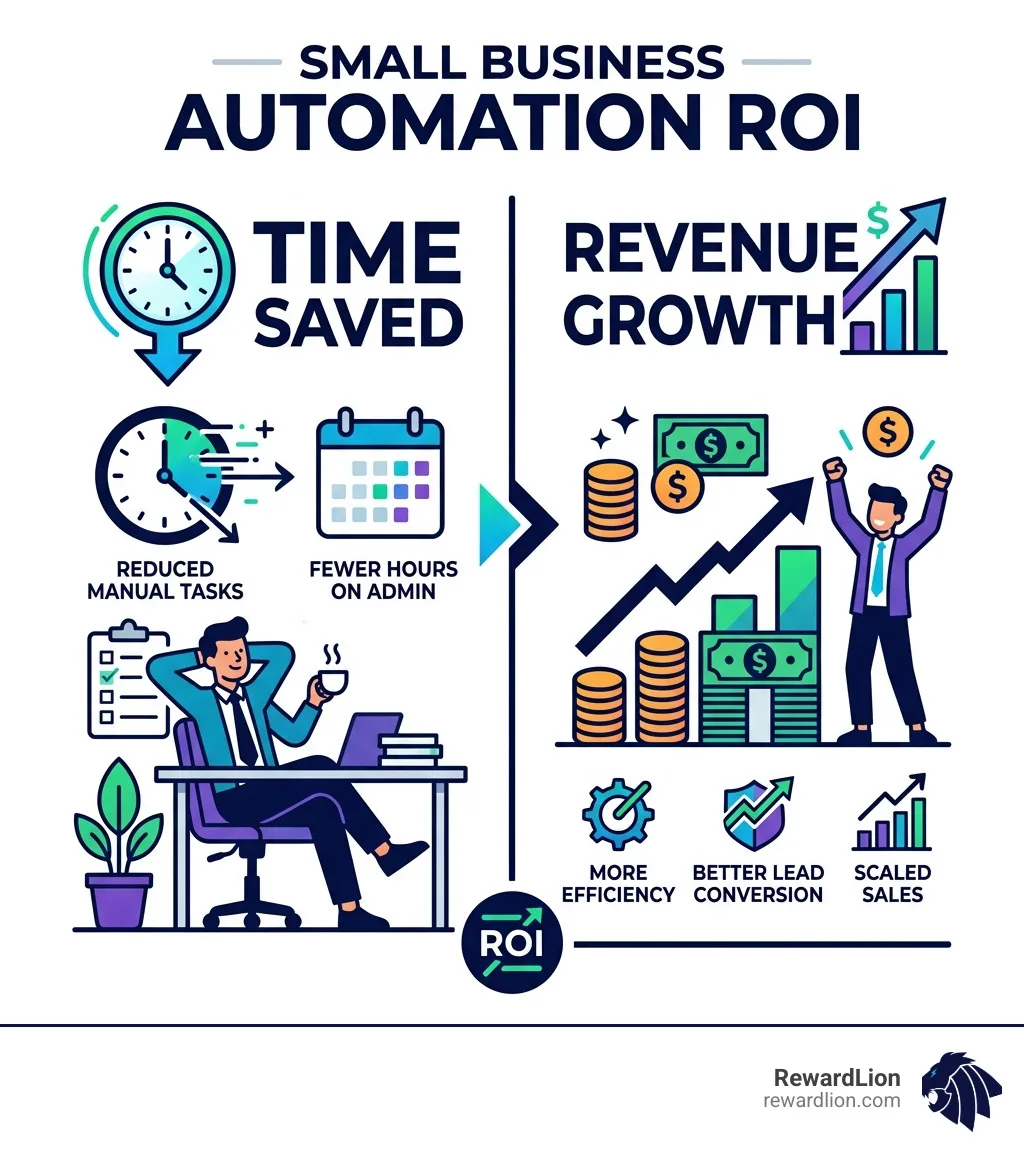
By utilizing professional process automation services, businesses can transform chaotic manual workflows into predictable, high-speed engines. This shift doesn't just make life easier; it provides a massive Return on Investment (ROI). When you quantify the value of the hours saved and the errors avoided, the software often pays for itself within the first quarter of implementation. For a broader overview of how business process automation improves efficiency across departments, it helps to think of automation as a long-term operating model rather than a single tool.
Financial Impact and Time Savings
Let's talk numbers. Imagine saving 10 hours a week per employee. For a small team of five, that’s 2,600 hours a year reclaimed. If your average billable or internal cost per hour is $50, you’ve just "found" $130,000 in value.
Beyond time, there is the direct revenue impact. Automated follow-ups ensure that no lead "falls through the cracks." Since 33% of top-performing sellers now use AI to track deal progress, businesses without these tools are essentially competing with one hand tied behind their backs. Even mundane tasks like payroll can be revolutionized; some modern platforms allow you to run an entire company's payroll in as little as 90 seconds.
Enhancing Customer Experience
In 2026, customers expect instant gratification. If a prospect reaches out to you via your website, they don't want to wait 24 hours for a response. Automation allows for:
Instant Responses: AI chatbots can handle 24/7 inquiries, answering FAQs and booking appointments while your team is offline.
Personalization at Scale: Automation allows you to send "personalized" emails based on a customer's specific purchase history or interests, making them feel like a person rather than a number.
Reputation Management: Software can automatically trigger a review request the moment a service is completed, helping you dominate local search rankings by building a steady stream of positive social proof.
Essential Types of Automation for Modern Small Businesses
One of the biggest mistakes founders make is "app hoarding"—buying ten different tools that don't talk to each other. This creates "data silos" where your marketing team doesn't know what the sales team is doing. The modern solution is a unified Operating System (OS).
Feature Disconnected Point Solutions All-in-One OS (e.g., RewardLion) Data Sync Requires manual exports or complex Zapier setups Built-in; data flows naturally across apps Cost 10+ subscriptions ($500 - $1,500/mo) One flat monthly fee User Experience Team must learn 10 different interfaces One unified dashboard and login Support Call 10 different help desks One dedicated team for everything
Marketing and Sales Automation
This is where the most immediate revenue growth happens. By building advanced workflow automation, you can create "set and forget" lead generation systems. This includes:
Sales Funnels: Automated paths that take a stranger from "curious" to "customer."
Omnichannel Presence: Ensuring your brand is consistent across Meta, Google, TikTok, and even programmatic billboards.
Email Sequences: Nurturing prospects over weeks or months until they are ready to buy.
Operational and Administrative Automation
While marketing brings in the money, operational automation keeps it.
Invoicing: Automated systems can generate invoices the moment a contract is signed and follow up on late payments.
Expense Tracking: Using AI to categorize expenses from bank feeds (via tools like Plaid) saves hours of manual data entry.
Inventory Alerts: Never run out of stock again with automated alerts that trigger when levels hit a certain threshold.
How to Choose the Right Small Business Automation Software for Your Industry
Choosing the right small business automation software depends heavily on your industry and your technical comfort level. A local retail shop in Miami has very different needs than a specialized medical practice in Boca Raton.
When evaluating tools, consider the "Integration Depth." Does it connect to the specific tools you already use, like QuickBooks or Square? Also, look at scalability. You want a platform that is affordable today but powerful enough to handle your business when it's five times its current size.
Evaluating No-Code Platforms for Non-Technical Owners
The "no-code" revolution is a game-changer for founders. You no longer need to hire a developer to build complex workflows. Many modern platforms now allow you to build automations using "Plain English" prompts. You simply tell the AI, "When someone fills out my contact form, send them a welcome email and add them to my 'Active Leads' pipeline," and the software builds the logic for you.
Security and Reliability Considerations
As you automate, you are trusting the software with your most precious asset: your data.
SOC 2 Compliance: Ensure the platform follows industry-standard security protocols.
Uptime: Look for a "99.9% uptime" guarantee. If your automation goes down, your business stops.
User Permissions: As your team grows, you need the ability to limit who can see sensitive financial data or customer records.
Frequently Asked Questions about Small Business Automation
How much does small business automation software cost?
Pricing varies wildly. Basic "point solutions" might start at $20/month, but costs quickly spiral as you add more tools. All-in-one platforms typically range from $200 to $500/month. While this seems higher upfront, it usually replaces $1,500+ in disconnected subscriptions and saves thousands in labor costs.
Is coding knowledge necessary to implement these tools?
In 2026, absolutely not. The best small business automation software is built for "drag-and-drop" use. If you can use a smartphone, you can likely set up a basic automation workflow. For more complex systems, many founders opt for "Done-for-You" services where experts handle the heavy lifting.
What are the risks of automating business processes?
The biggest risk is "automating a mess." If your current manual process is broken, automating it will just make it break faster. Always map out your workflow on paper first. Another risk is losing the "human touch," so ensure your automated communications still sound warm and authentic.
Conclusion
The era of the "overwhelmed founder" is coming to an end. By embracing small business automation software, you aren't just buying a tool; you're buying back your time and your sanity.
At RewardLion, we believe you shouldn't have to choose between powerful software and expert help. Our AI-powered OS unifies your marketing, sales, and operations into one "Single Truth" engine. But we don't just give you the keys and wish you luck. Our dedicated CAPSS team (your fractional in-house marketing agency) implements, optimizes, and manages the system for you.
Whether you are looking to dominate local search in Fort Lauderdale or scale an e-commerce brand internationally, we provide the hybrid "SaaS + Expert" model that guarantees hands-off growth.
Start your journey with the RewardLion Platform today and turn your business into a self-running growth engine.