Why Manual Lead Generation Is Costing You More Than You Think
Automatic lead generation is the process of using software and AI to capture, score, and nurture potential customers — without manual effort at every step.
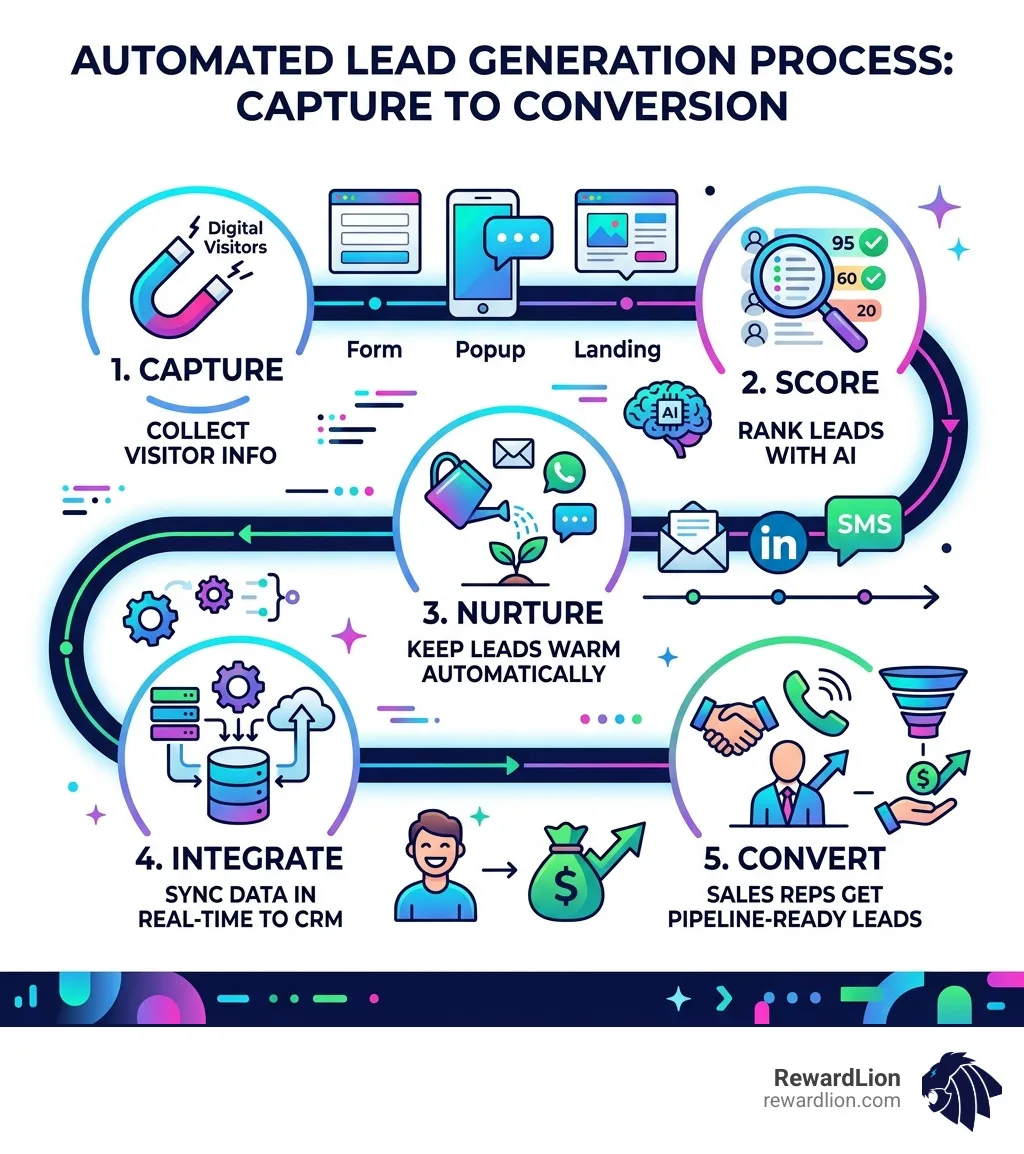
Here's how it works in five steps:
Capture — Collect visitor info using popups, forms, chatbots, and landing pages
Score — AI ranks leads by fit and intent so your team focuses on the best ones
Nurture — Automated emails, LinkedIn messages, and SMS keep leads warm
Integrate — Everything syncs to your CRM in real time
Convert — Sales reps get pipeline-ready leads with full context
If you're a small or medium business owner, you've probably felt this pain: too many tools, too much manual work, and a pipeline that never fills fast enough. Leads come in from a website form, a social ad, or a chatbot — and then they sit there while your team scrambles to follow up.
The problem isn't effort. It's process.
Over half of companies already use some form of marketing automation — and the ones that do see up to a 14.5% boost in sales productivity and a 12.2% reduction in marketing costs. Meanwhile, teams still doing it manually are slower, less consistent, and leaving qualified leads on the table.
The gap between automated and manual lead gen is only getting wider in 2026.
I'm Mike Ibrahim, Founder and CEO of RewardLion and a marketing director with over a decade of experience building automatic lead generation systems that drive real revenue growth across industries. In this guide, I'll walk you through exactly how to set it all up — step by step.
Why Automatic Lead Generation is Essential in 2026
In May 2026, the digital landscape has become so competitive that manual prospecting feels like trying to win a Formula 1 race on a bicycle. If you aren't using automatic lead generation, you aren't just working harder—you're actively losing market share to competitors who can respond to a lead in under two minutes.
The primary driver for this shift is ROI growth. When we automate the front end of the sales funnel, we free up our most expensive assets—our people—to do what they do best: close deals. Research shows that 74% of CRM users report improved access to customer data, which is the fuel for any successful automation engine. By utilizing a lead generation software complete guide, businesses can identify the exact tools needed to bridge the gap between "visitor" and "customer."
Time savings are another massive factor. Teams using automated lead distribution see up to a 33% faster response time. When "speed to lead" is the number one predictor of conversion, those minutes matter. Furthermore, 24/7 engagement through AI-powered systems ensures that whether a prospect is browsing your site at 2 PM in Miami or 2 AM in Boca Raton, they receive an immediate, helpful response.
By deploying lead capture software, you move away from messy spreadsheets and toward a structured system where no one "forgets" to follow up. The data from Nucleus Research is clear: sales automation boosts productivity by 14.5% and slashes marketing costs by 12.2%. If you want to scale without ballooning your overhead, choosing the right lead gen software is your first step toward a predictable pipeline.

Step 1: Deploy Intelligent Capture Mechanisms
The first step in automatic lead generation is turning your website from a digital brochure into a lead-catching machine. In 2026, standard "Contact Us" forms are no longer enough. You need intelligent capture mechanisms that respond to how a user behaves.
Onsite popups are a powerhouse here. While some find them annoying, the data tells a different story: modern, well-timed popups can achieve up to a 20% click-through rate (CTR). For instance, a furniture retailer recently used automated capture to reach a staggering 24.7% signup rate. One of the most effective tools in our arsenal is the "Spin to Win" gamification campaign. These interactive popups often see a 30% higher signup rate than static forms because they offer immediate value and entertainment.

To make this work without hurting the user experience, we use:
Exit-Intent Detection: Only showing a popup when the user's cursor moves to close the tab.
Behavioral Targeting: Displaying specific offers based on which pages the visitor viewed (e.g., showing a "SaaS Guide" only to people on your product page).
Geolocation: Tailoring the message for users in Fort Lauderdale vs. those in Las Olas to increase local relevance.
Conversational AI: Using chatbots that don't just wait for questions but proactively offer help.
By integrating these into your lead gen software strategy, you ensure your capture methods are mobile-optimized and high-converting. The goal isn't just to get an email address; it's to start a relationship.
Step 2: Implement AI-Powered Lead Scoring and Qualification
Not all leads are created equal. If your sales team spends all day calling "tire-kickers," they’ll burn out fast. This is where AI-driven lead scoring becomes your best friend.
Modern AI-driven sales platform technology can analyze over 127 intent signals to determine if a prospect is actually ready to buy. These signals include firmographic data (company size, industry, revenue), tech stack details, and even recent funding rounds. By scoring leads on a scale—say 1 to 100—your system can automatically flag "hot" leads for immediate human outreach while sending "cool" leads to an automated nurture sequence.
We’ve seen businesses achieve 99% scoring accuracy using these AI models. This precision ensures your pipeline growth is based on quality, not just quantity. Furthermore, automated data validation is crucial. There’s nothing worse than a CRM full of "test@test.com" addresses. Tools in 2026 now offer 97.4% data accuracy, scrubbing your list in real-time so your bounce rates stay low and your deliverability stays high.
When you implement sales automation software SaaS solutions, you're essentially hiring a 24/7 digital assistant that pre-vets every person who enters your orbit. This ensures that by the time a lead reaches a salesperson, the "qualification" work is already done.
Step 3: Automate Multi-Channel Nurturing Workflows
Once you’ve captured and scored a lead, you can’t just let them sit. Most sales happen between the 5th and 12th contact, yet most manual efforts stop after two. Automatic lead generation solves this through multi-channel nurturing.
The backbone of this is drip sequences. Using drip email marketing software, we can send a series of personalized emails that educate the prospect over time. But don't stop at email. In 2026, LinkedIn automation is 277% more effective for B2B lead generation than Facebook or Twitter. By blending LinkedIn messages with SMS automation software, you create an "omnichannel" presence that makes your brand feel omnipresent.
Key strategies for multi-channel success include:
AI Sales Agents: These are sophisticated bots that can handle initial back-and-forth replies, booking meetings directly onto your calendar.
Timezone-Aware Sending: Ensuring your SMS or email arrives at 9 AM in their local time, whether they are in Miami or halfway across the world.
Personalized Outreach: AI can now research a prospect’s recent LinkedIn activity or company news and insert a unique sentence into your opening line, achieving 20%+ reply rates.
For a deeper dive into how these apps work together, check out our lead generation app complete guide. The goal is to create a seamless experience where the prospect feels like they are having a one-on-one conversation with your brand, even though the entire process is running on autopilot.
Step 4: Integrate Your Automatic Lead Generation Stack
The "secret sauce" of a high-performing system is integration. If your lead capture tool doesn't talk to your CRM, you’re back to manual data entry—the very thing we’re trying to kill.
Centralized dashboards allow you to see exactly where every lead is in the funnel. We recommend using small business automation software to connect your tools via Zapier or similar multi-step logic platforms. For example, when a lead hits a 90+ score in your demand generation software, a "Real-Time Buyer Alert" should immediately ping your sales rep on Slack.
Manual vs. Automated Data Entry
Feature Manual Entry Automated Sync Speed Slow (hours/days) Instant (seconds) Accuracy Prone to human error 97.4% - 99% Accurate Data Access Often siloed/hidden 74% improved access Response Time Hours to never 33% faster (within minutes) Scalability Limited by headcount Virtually unlimited
By synchronizing your stack, you ensure that every interaction—every email opened, every link clicked—is logged in the CRM. This provides your team with the full context they need to close the deal. No more asking, "So, what are you interested in?" Instead, your rep can say, "I saw you were looking at our AI Sales Automation package; how can I help you implement that?"
Frequently Asked Questions about Automatic Lead Generation
What are the best tools for automatic lead generation?
The "best" tool depends on your specific goals, but a complete stack usually includes:
Onsite Capture: For popups and forms that convert visitors.
CRM Platforms: Like the RewardLion OS, which serves as your tactical nerve center.
Email Sequencers: For automated, personalized outreach.
AI Chatbots: For 24/7 lead qualification and response.
LinkedIn Automation: For B2B prospecting. To see how these all fit together, refer to our lead generation software complete guide and our broader look at lead gen software.
How do I avoid common pitfalls in automatic lead generation?
The biggest mistake is "set it and forget it." To avoid account restrictions (especially on LinkedIn or Email), you must use "human-in-the-loop" oversight. This means having a real person check the AI’s work occasionally and setting frequency caps so you don’t spam your prospects.
Spam scoring is also vital; always check your email copy before launching a campaign to ensure it doesn't trigger filters. Lastly, always stay compliant with data privacy laws like GDPR and CCPA. Automated list cleaning—removing dead or unengaged emails—is the best way to keep your sender reputation high.
What is the typical pricing for lead automation?
Pricing varies wildly based on volume and features.
Entry-level: Many tools offer free trials or basic plans starting around $97/month.
Professional/Elite: For higher volume and AI features, expect to pay between $297 and $1,997 per month.
Credit-based models: Some tools charge per lead "credit" rather than per user seat. When calculating ROI, a 12.2% reduction in marketing costs usually pays for the software many times over. For a full breakdown, our lead generation software complete guide covers pricing structures in detail.
Conclusion
As we move through 2026, the future of business belongs to those who can build autonomous pipelines. The days of "hunting" for every single lead are over. Today, you build a system that attracts, qualifies, and delivers prospects to your door while you sleep.
At RewardLion, we don't just give you a login to another tool. We install a fully connected growth system powered by AI and managed by experts. From local SEO domination in Fort Lauderdale and Miami to global B2B outreach, our OS handles the heavy lifting so you can focus on your vision.
Ready to stop chasing and start closing? Get started with the RewardLion AI Operating System today and see how we can transform your lead generation into a predictable, scalable engine for growth.