Why Most Advertisement Posters Fail (And How to Make Yours Work)
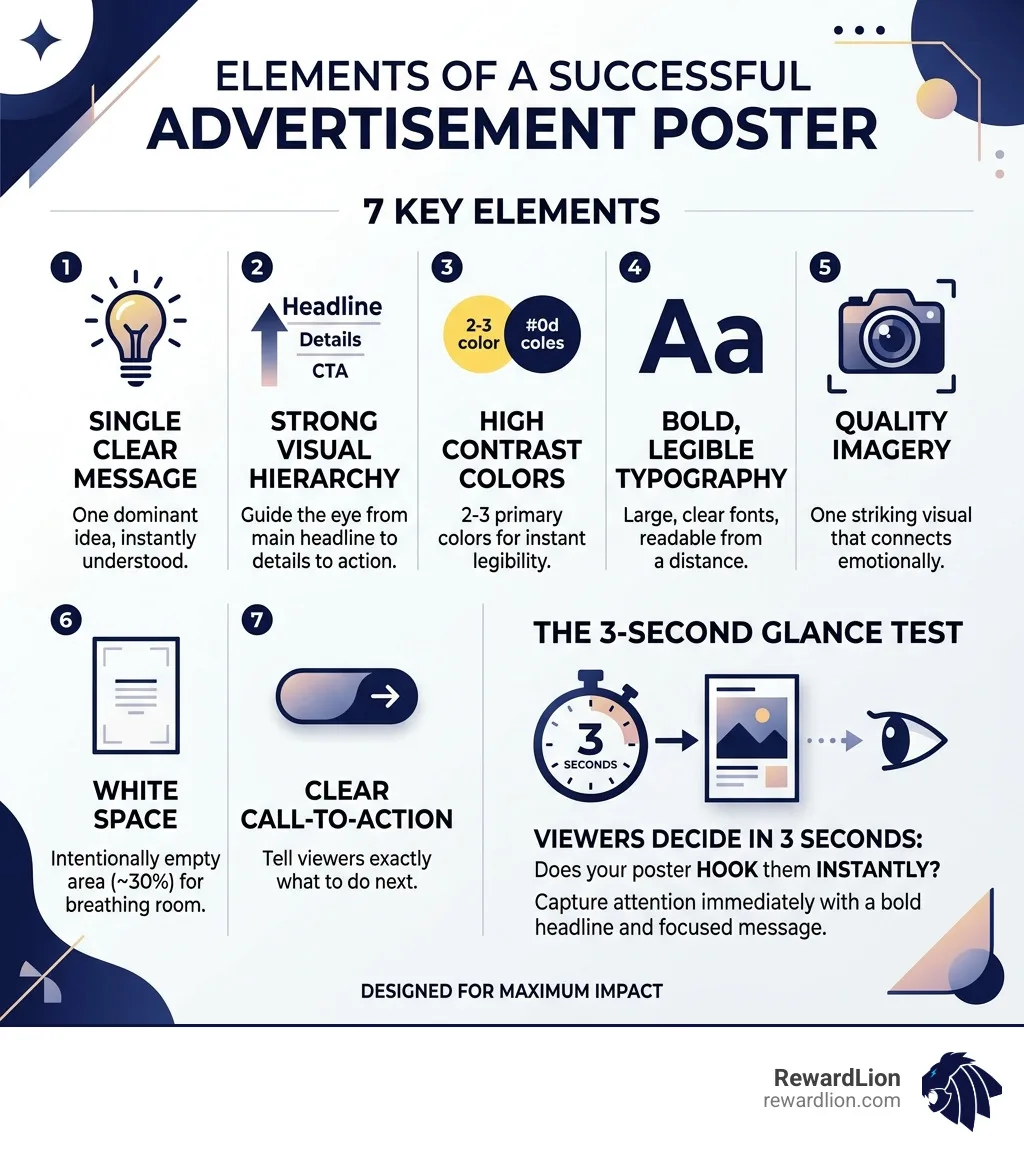
What makes a good advertisement poster comes down to seven core elements working together:
Element What It Means Single clear message One idea, not five Strong visual hierarchy Headline first, details second, CTA last High contrast colors 2-3 colors max, readable at a glance Bold, legible typography Sans-serif fonts, 48pt+ titles Quality imagery One powerful visual, 300 DPI minimum White space ~30% of the poster, intentionally empty Clear call-to-action Tell viewers exactly what to do next
Here's a hard truth: viewers decide whether to keep looking at your poster in about three seconds. That's it. No scrolling back. No second chances. If your poster doesn't hook them instantly, it's invisible.
For small business owners, that's a real problem. You've spent time and money on a promotion, printed a stack of posters — and they just don't convert. The message gets lost. The design looks cluttered. People walk right past.
The good news? Effective poster design follows clear, learnable rules. And once you know them, you can apply them every time.
I'm Mike Ibrahim, Founder and CEO of RewardLion and Marketing Director for several companies, with over a decade of experience developing high-impact marketing strategies — including mastering what makes a good advertisement poster that actually drives results. In the sections below, I'll walk you through everything you need to know to design posters that stop people in their tracks.
The Core Pillars of What Makes a Good Advertisement Poster
At its heart, an effective poster is a "colorful abstract," not a wall-mounted essay. We often see business owners try to cram their entire life story onto a 24x36-inch sheet of paper. This is the fastest way to ensure no one reads it. The primary purpose of an advertisement poster is to grab attention quickly and deliver a focused message that leads to a specific action.
To stand out in a busy environment—whether it's a storefront in Fort Lauderdale or a digital billboard in Miami—you need an emotional hook. According to Breaking Travel News, a bold headline acting as a hook with powerful, emotionally charged language is what makes someone pause.
Think of your poster as a conversation starter. You aren't closing the sale on the poster; you are opening the door. By focusing on a single message, you prevent the "cognitive overload" that happens when a viewer sees too many offers at once.
Defining the Goal and Call-to-Action
Every poster we design for our clients at RewardLion has a "job" to do. Is it to drive foot traffic to a local event? Is it to get people to scan a QR code for a discount?
A good advertisement poster must have a clear, visible Call-to-Action (CTA). In 2025, direct response is easier than ever thanks to technology. Using QR codes allows you to bridge the gap between physical print and digital conversion. Make your CTA straightforward: "Shop Now," "Book Your Appointment," or "Scan for 20% Off." If the viewer has to guess what to do next, you’ve already lost them.
Understanding the 30-40-30 Rule
Balance is the secret sauce of professional design. A common industry standard for high-impact posters suggests a specific distribution of elements:
30% White Space: This is the "breathing room" that prevents the design from feeling claustrophobic.
40% Title and Text: This includes your main hook and the essential details.
30% Graphic Images: High-quality visuals that support the message without overwhelming it.
Maintaining a minimum of 2.5-inch margins and generous space between columns ensures that the information doesn't bleed into the edges, making it look professional rather than amateurish.
Mastering Visual Hierarchy and Layout Structures
Visual hierarchy is the order in which a viewer perceives the information on your poster. Without it, the eye wanders aimlessly. We use design principles to guide the viewer’s eye intuitively, typically following a "Z-pattern" or "F-pattern" of reading.
Visual Hierarchy in What Makes a Good Advertisement Poster
The most important information—usually the headline—should be the largest and most prominent. From there, the eye should naturally move to the supporting details and finally to the CTA. You achieve this through scale (making things bigger), contrast (using different colors), and position.
One effective way to test your hierarchy is the "squint test." If you squint your eyes until the poster is blurry, the most important element should still stand out. If everything blends into a gray blob, your hierarchy is broken.
Layout Type Best Use Case Pros Grid Layout Scientific or informational posters Organized, easy to follow, professional Free-form Creative, artistic, or brand awareness Unique, high emotional impact, stands out Column Layout Event posters with many details Mimics newspaper flow, highly readable
Optimizing Flow for International Audiences
For our clients operating in diverse markets like Miami or internationally, cultural nuances matter. In Western cultures, we read from left-to-right and top-to-bottom. However, if you are designing for a global audience, universal symbols (like a location pin or a phone icon) can help navigate viewers through the information regardless of their primary language.
The Psychology of Color and Typography in Poster Design
Color isn't just an aesthetic choice; it’s a psychological trigger. A study by the Institute for Color Research shows that people make a subconscious judgment about a product within 90 seconds—and 62–90% of that decision is based on color alone.
When considering Poster Design Principles: Layout, Composition, and Visual Impact, we emphasize that color should be used sparingly. Stick to a 2–3 color palette to avoid overwhelming the viewer. High contrast is your best friend—think dark text on a light background for maximum legibility.
Typography Best Practices for What Makes a Good Advertisement Poster
Typography conveys personality more than words alone. For posters, readability is more important than "character."
Sans Serif over Serif: Fonts like Arial or Helvetica are generally easier to read from a distance than serif fonts like Times New Roman.
Font Pairing: Use no more than two different font types. One for the headline, one for the body.
Sizing: Your title should be at least 48-point font to be readable from 5 feet away. For larger street posters, titles often range from 96 to 150 points.
Word Count: Keep your total text around 800 words, and never exceed 1000. If you need more words, you need a brochure, not a poster.
Evoking Emotion Through Palette Selection
Different colors evoke different behaviors:
Red: Urgency, excitement, and hunger (great for flash sales).
Blue: Trust, peace, and intelligence (ideal for corporate or medical services).
Yellow/Orange: Warmth and attention (perfect for local community events).
Purple/Black: Luxury and sophistication.
Consistency is key. Your poster colors should align with your brand identity so that even if someone doesn't read the text, they recognize it's "you."
Technical Specifications and Common Pitfalls to Avoid
Nothing ruins a great design faster than poor production. If you are printing a poster, you must use high-resolution images. Graphics should be 300 DPI (dots per inch) or higher. Anything less will look pixelated and "cheap" when blown up to standard poster sizes.
Avoiding the "Wall of Text" Trap
Posters are not essays. Use the active voice and avoid jargon. Boil your information down into bullet points. If you have a lot of data, use a graph, but keep it simple—remove unnecessary gridlines and legends that clutter the visual space.
Testing and Iteration Strategies
Before you print a thousand copies, test your design.
Distance Testing: Can you read the headline from 10 feet away? Can you read the body text from 5 feet away?
The Squint Test: As mentioned, does the main focal point remain dominant when blurred?
A/B Testing: If you are running digital posters or social media ads, test two different headlines or color schemes to see which one gets more engagement.
Frequently Asked Questions about Poster Design
What is the ideal amount of white space for a poster?
We recommend approximately 30% white space. This doesn't have to be white—it just refers to "negative space" where there are no text or images. This space acts as a visual "pause" for the viewer, making the actual content much easier to digest.
Which font sizes are best for titles and body text?
For a standard 24x36 inch poster:
Title: 88-120 pt
Headings: 54-80 pt
Body Text: 36-52 pt
Minimum: Never go below 24 pt if you want people to read it while walking.
How do I choose between digital and print poster formats?
It depends on your audience. Interestingly, the chance of people remembering printed material is 70% higher than online advertising. However, digital posters allow for motion graphics and easier A/B testing. For maximum impact, we often recommend an omnichannel approach—using the same design principles for both physical posters in your local Florida market and digital versions on social media.
Conclusion
Designing a poster that doesn't suck requires a blend of editorial discipline and visual strategy. By focusing on a single message, mastering visual hierarchy, and respecting the 30-40-30 rule, you can create assets that drive real business growth. Remember: keep it simple, keep it bold, and always include a clear way for your audience to take the next step.
At RewardLion, we understand that most business owners don't have the time to become expert designers. That’s why our AI-powered OS is backed by a dedicated team of experts who handle everything from graphic design to programmatic billboards. Whether you need high-converting visual assets or a full-scale omnichannel marketing system, we manage the technical heavy lifting so you can focus on running your business.
RewardLion provides a comprehensive AI-powered OS and expert creative production teams to manage your high-converting graphic design and omnichannel marketing systems. From our origins in Fort Lauderdale, we serve businesses across all 50 states and internationally, ensuring your brand identity is consistent and your posters actually convert.
Ready to dominate your local market with professional design and automated growth? Visit RewardLion to see how our hybrid SaaS and expert team can scale your business.