Why the Power of Ads Still Defines Business Success
The power of ads is simple to define but hard to master: advertising shapes what people know, feel, and buy. It builds brands from scratch, drives sales on demand, and keeps businesses alive in competitive markets.
Here is a quick breakdown of what advertising actually does:
What Ads Do Short-Term Effect Long-Term Effect Build awareness People learn your brand exists Your brand becomes top-of-mind Convey information Customers understand your offer They trust your expertise Persuade and influence Drive immediate purchases Shape lasting brand loyalty Attach emotional values Create excitement or urgency Build a powerful brand identity Generate word-of-mouth Spark conversations Grow organic reputation
Advertising is not just about selling. It is about who people think of first when they are ready to buy.
And in 2025, with global ad spend approaching $1.17 trillion and digital channels capturing nearly three-quarters of every dollar spent, the stakes have never been higher - especially for small and medium businesses trying to compete without massive budgets.
I'm Mike Ibrahim, Founder and CEO of RewardLion and Marketing Director across multiple companies, with over a decade of hands-on experience navigating the power of ads across industries - from e-commerce to enterprise growth strategies. I've seen how the right advertising approach can transform a struggling business into a market leader, and that is exactly what this guide is built around.
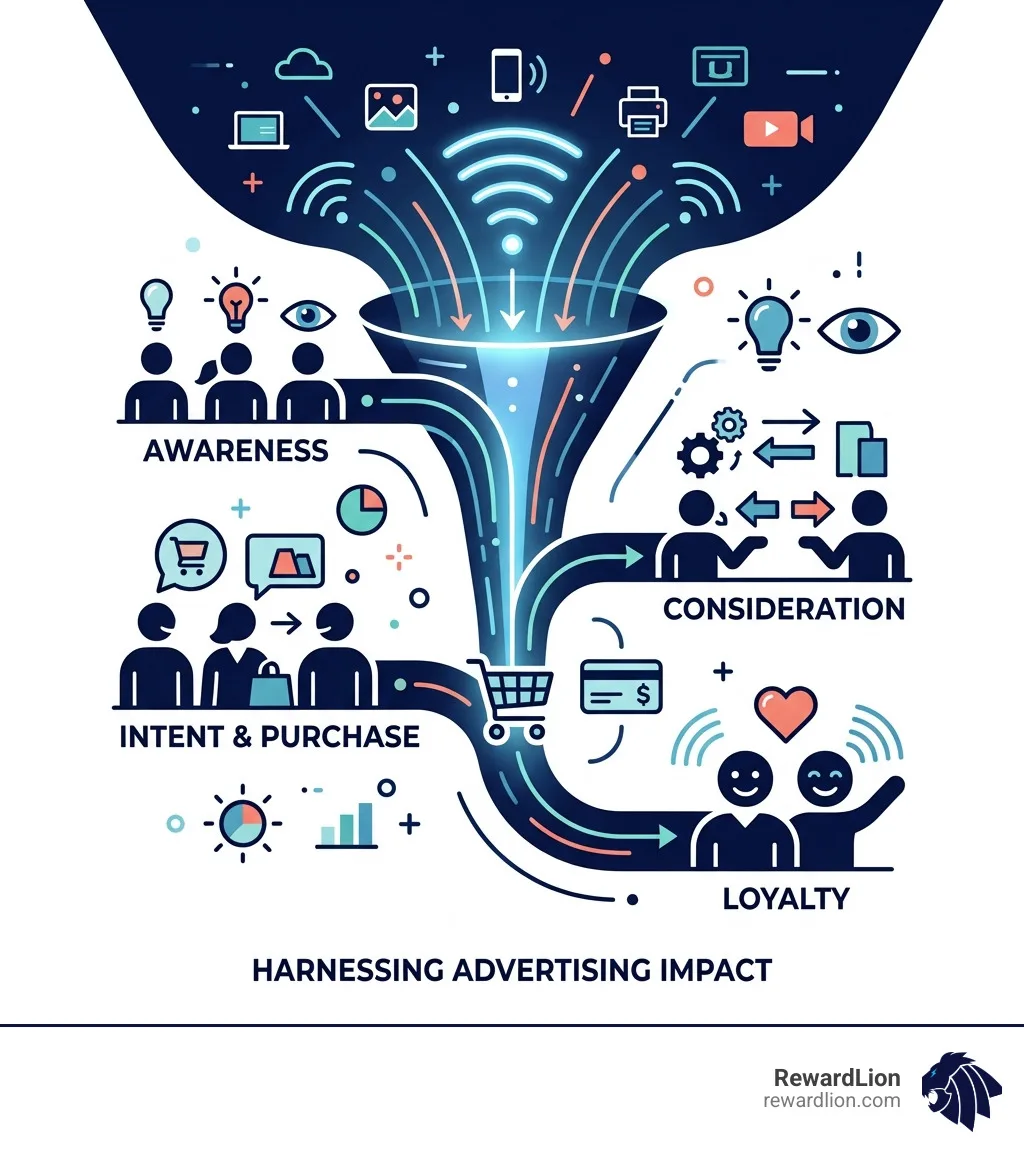
The Fundamental Power of Ads in Shaping Consumer Behavior
At its core, advertising is the engine of the modern economy. It doesn't just inform; it sets the agenda for what society deems important, trendy, or necessary. When we look at how ads influence us, we have to look at the psychological triggers they pull.

Ads work by addressing two types of needs: biogenic and psychogenic. Biogenic needs are the basics—food, water, shelter. You see a steaming pizza on a billboard in Miami, and suddenly your stomach growls. Psychogenic needs are more complex—status, power, affiliation, and self-esteem. This is where the true power of ads lies. By aligning a product with a consumer’s values or desired self-image, an ad moves from being a "sales pitch" to being a "solution" for who that person wants to be.
Research from the Kellogg School of Management suggests that the most powerful ads don't just shout for attention; they motivate action by stimulating latent needs. They tell us that we aren't just buying a watch; we are buying "success." We aren't just buying a car; we are buying "adventure."
How Advertising Drives Top-of-Mind Awareness
In the marketing world, we call this TOMA (Top-of-Mind Awareness). Imagine you are walking down Las Olas Boulevard and you realize you're thirsty. Which brand pops into your head first? That split-second thought is the result of years of "mental structure" building.
The power of ads is most evident when it creates a sense of familiarity. The human brain is wired to prefer the familiar because it feels safe and trustworthy. Consistent advertising builds these neural pathways so that when a purchase occasion arises, your brand is the first one invited to the party. This is a core focus of our branding and identity services, where we help businesses build those distinctive assets—logos, colors, and slogans—that stick in a customer's mind like a favorite song.
Impact on Purchase Decisions
Advertising influences two distinct types of buying behavior: impulsive and planned.
Impulsive Purchases: These are driven by immediate emotional triggers—urgency, excitement, or a "limited time offer." Think of a flash sale ad on Instagram that makes you click "Buy Now" before you’ve even finished your morning coffee.
Planned Purchases: For larger decisions, like hiring a marketing agency or buying a home in Boca Raton, the power of ads works through value alignment. Consumers look for brands that reflect their personal ethics, such as sustainability or community involvement.
By creating seasonal urgency or highlighting shared values, ads bridge the gap between "I might want that" and "I need that right now."
The Science of Creative Effectiveness
Is advertising an art or a science? The answer is: yes. While data tells us where to put the ad, creativity determines if the ad actually works.
Feature Rational Persuasion Emotional & Implicit Communication Primary Goal Deliver facts and features Build "Brand Fame" and affection Consumer Reaction Logical evaluation (leads to skepticism) Bypasses resistance (leads to liking) Long-term Impact Lower; easily forgotten Higher; builds "mental structures" Effectiveness 1x Baseline 7x More Effective (if awarded)
According to Adverteyes, creative elements drive between 50% and 70% of an ad’s sales impact. You can have the best targeting in the world, but if the creative is boring, you are just efficiently wasting money.
Why Creativity is the Cornerstone of the Power of Ads
Creativity isn't just about pretty pictures; it’s about narrative transportation. This is a fancy way of saying the ad "takes you somewhere." When an ad tells a story—using humor, drama, or a visual metaphor—it captures attention in a crowded digital landscape where we are bombarded by thousands of messages a day.
Effective creativity makes a message relatable. It encourages engagement and virality. If you’ve ever shared a funny commercial with a friend, you’ve participated in the power of ads. Our creative production team focuses on this exact "stop-the-scroll" quality, ensuring that every video or graphic isn't just seen, but felt.
The Superiority of Emotional Appeals
Facts tell, but stories sell. Emotional campaigns consistently outperform purely rational ones because they build brand fame.
Celebrity Endorsements: When a trusted figure aligns with a brand, that credibility rubs off.
Nostalgia: Using music or imagery from the past creates an instant, warm connection.
Humor: If you can make someone laugh, you’ve lowered their guard.
Research shows that campaigns aimed at building fame are the most effective, with 34% achieving large business effects. Emotional resonance creates a bond that a list of features simply cannot match.
Digital Transformation and the SMB Revolution
The last 25 years have seen a total shift in the power of ads. In the past, only the "big guys" with million-dollar TV budgets could play. Today, the "Global Village" is open to everyone.
Digital advertising has become the great equalizer. Small businesses in Miami or Fort Lauderdale can now target specific neighborhoods, interests, and behaviors with surgical precision. As noted by Google’s 25-year retrospective, 79% of small businesses say digital tools help them compete with larger companies.
The Role of AI and Modern Platforms
The next frontier is AI. We are moving away from "searching" for things to an era of predictive intent. AI knows you need a new lawn service before you even realize your grass is too long.
Multimodal Search: People are searching via voice, images, and natural language.
Ambient Search: Ads are becoming part of the environment, appearing in the right place at the exactly right time.
Automation: Our AI Marketing Systems use these tools to optimize campaigns in real-time, shifting budget to what works and cutting what doesn't—all without human intervention.
Key Drivers of Perceived Ad Value
What makes a consumer actually value an ad rather than find it annoying? It boils down to four factors:
Credibility: Do they trust the source?
Informativeness: Does the ad provide useful answers?
Entertainment: Is it fun to watch?
Trustworthiness: Does the brand keep its promises?
Interestingly, cultural differences play a role here. In some markets, people value information above all else; in others, the entertainment value is what drives the purchase. Understanding these nuances is key to global (and local) success.
Strategic Lessons from Iconic Campaigns and Controversies
We can learn a lot from the giants.
Coca-Cola Christmas: For over 30 years, they have used the same "Holidays are Coming" imagery. This consistency builds a massive long-term brand image.
Got Milk?: This campaign (1993–2014) showed that you don't even need to sell a specific brand; you can sell an entire category through clever, celebrity-driven storytelling.
GAP Dance Ads: By using choreography and music, GAP turned simple clothing into a cultural movement, proving that "vibe" is often more powerful than "price."
Risks and Rewards of Controversial Messaging
Sometimes, brands take a "risk" to get noticed. We’ve seen hypersexualized ads or controversial political stances spark massive backlash.
Does it work? Often, yes. Even "negative" buzz can boost brand recall and short-term sales. For example, a major denim brand saw sales "go through the roof" after a controversial campaign. However, the reward is often short-lived. While controversy generates noise, long-term loyalty is built on trust and consistent value. At RewardLion, we usually advise our clients to focus on "Authority Building" rather than "Shock Value" to ensure the brand image remains prestigious and protected.
Measuring and Optimizing Effectiveness
You can't manage what you don't measure. The power of ads is only "unleashed" when you have a feedback loop.
Pretesting: Before spending $10k on a campaign, test the concept with a small audience.
Qualitative Research: Use depth interviews to find out why people like or dislike an ad.
ROI Metrics: Track every click, lead, and sale back to the specific creative that generated it.
Our Lead Generation Systems are built on this data-first approach. We don't guess; we test, optimize, and scale.
Frequently Asked Questions about Advertising
What are the short-term vs. long-term effects of advertising?
Short-term effects focus on conveying new information, building immediate awareness, and establishing credibility. This is great for launches or sales. Long-term effects center on building a lasting brand image, attaching emotional values to a product, and fostering a sustainable reputation. Both are necessary; short-term pays the bills, while long-term builds the empire.
Why do emotional ads often outperform rational ones?
Emotional ads build "brand fame" and stronger mental structures in the consumer's brain. While rational ads provide facts, emotional storytelling bypasses conscious resistance. People will argue with a "fact," but they won't argue with a "feeling." This makes the brand more likable and memorable over time.
How has digital advertising helped small businesses?
Digital platforms have leveled the playing field by providing affordable, highly targeted tools that were once only available to large corporations. Statistics show that 79% of small businesses feel digital tools help them compete, with 82% attributing revenue growth directly to digital ads. It allows a mom-and-pop shop in Fort Lauderdale to reach the same audience as a national chain.
Conclusion: Unleashing Your Growth
The power of ads is an undeniable force in the business world. Whether you are a business administration student looking to enter a high-paying field (where marketing managers earn a median of $161,030) or a business owner in Miami looking to dominate your local market, understanding these principles is the key to success.
At RewardLion, we don't just talk about the power of ads; we harness it. Our AI-powered all-in-one OS platform unifies your marketing, sales, and automation into one cohesive system. You don't have to manage five different agencies or ten disconnected tools.
Our dedicated CAPSS team acts as your in-house marketing department, implementing everything from SEO and Paid Ads to Video Production and AI Sales Automation. We take the "creative" and the "science" and turn them into a predictable growth engine for your business.
Ready to see what the power of ads can do for your bottom line? Unleash your growth with the RewardLion platform and let's build something iconic together.