The Power of Advertisement: Why It Shapes Everything You Buy, Think, and Feel
The power of advertisement is one of the most significant forces in modern business and society. At its core, advertising shapes how people perceive brands, make buying decisions, and even how they see themselves.
Here is a quick summary of what advertising actually does:
What Advertising Does How It Works Builds brand awareness Repeated exposure creates recognition and trust Influences purchase decisions Emotional and psychological triggers drive buying behavior Shapes culture Iconic campaigns become part of shared cultural memory Drives business growth Strong ad strategies directly increase sales and loyalty Creates top-of-mind awareness Consistent messaging keeps brands first in consumers' minds
Advertising is everywhere — from the billboard you passed this morning to the personalized ad in your social media feed three minutes ago. And it is not slowing down. Digital media already accounts for 59% of all global ad spending, and consumers increasingly expect ads to feel personal and relevant.
But advertising is not just about selling products. The best campaigns sell feelings. Coca-Cola does not advertise soda — it advertises happiness. That distinction is everything.
I'm Mike Ibrahim, Founder and CEO of RewardLion and Marketing Director for several companies, with over a decade of hands-on experience studying and applying the power of advertisement across industries. In the sections ahead, I'll break down exactly how advertising works, what makes it effective, and how your business can use it to grow.
The Psychology Behind the Power of Advertisement
To understand why advertising works, we have to look under the hood of the human brain. We often like to think of ourselves as rational decision-makers who weigh the pros and cons of every dish soap or pair of sneakers. In reality, our brains are much more susceptible to suggestion than we realize.
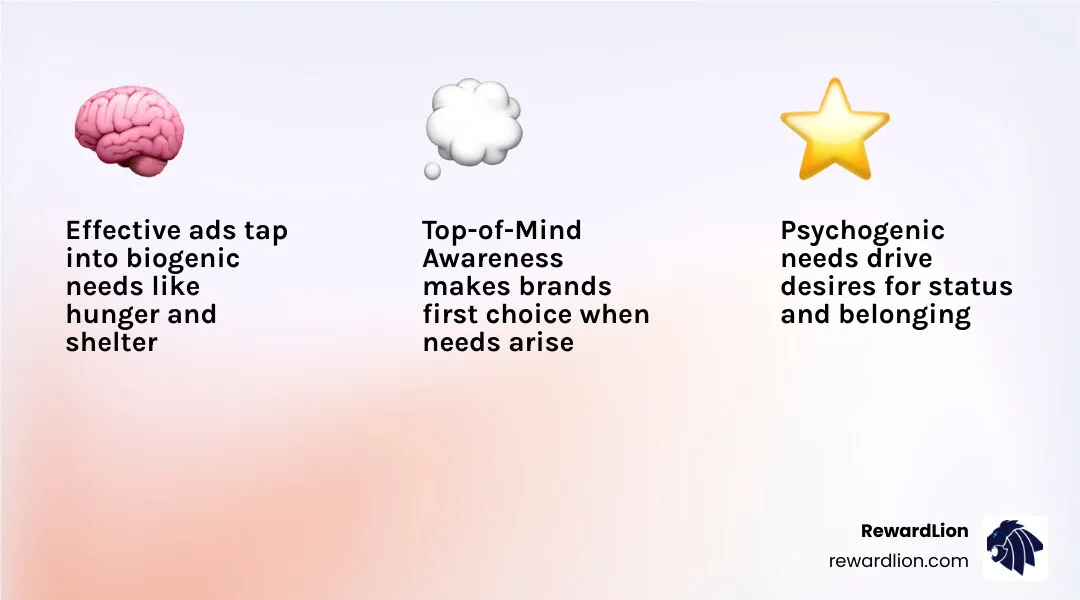
According to scientific research on ad power, effective advertising taps into two distinct types of human needs: biogenic and psychogenic. Biogenic needs are the basics—hunger, thirst, and shelter. Psychogenic needs are more complex—the desire for status, belonging, or self-esteem. When an ad successfully links a product to one of these deeper psychological needs, it creates what we call Top-of-Mind Awareness (TOMA). This means when you feel a certain need, that brand is the first thing that pops into your head.
The "power" here lies in how the message is delivered. We generally see two main paths:
Rational Persuasion Emotional Communication Focuses on facts, features, and logic. Focuses on feelings, storytelling, and values. Best for high-stakes, technical purchases. Best for building long-term brand loyalty. Requires the consumer's active attention. Works even with passive or distracted attention. Easily forgotten once the "deal" is over. Creates "mental structures" that last for years.
Interestingly, research from the Kellogg School of Management suggests that passive attention can sometimes be more effective than active attention. Why? Because when we aren't "critically" watching an ad, our subconscious mind absorbs the brand's emotional cues without raising our natural defenses against being "sold" to.
Harnessing the Power of Advertisement through Emotional Storytelling
If you want to move the needle on your business, you have to move the heart. Emotional campaigns are significantly more effective at building brand fame than purely informational ones. In fact, campaigns designed to build fame achieve large business effects about 34% of the time, ranking as the most successful strategy in marketing history.
This is where implicit communication comes into play. Instead of telling you a car has good brakes, an ad might show a father safely driving his daughter home in a storm. The brain processes this as "safety" and "love" rather than "mechanical specifications." Neuroscience shows that these emotional connections drive purchases far more than rational evaluation ever could.
At RewardLion, we understand that building this kind of brand equity is a marathon, not a sprint. Our branding and identity services are designed to help you craft these narratives from the ground up, ensuring that every touchpoint—from your logo to your video content—tells a consistent, emotionally resonant story.
The Power of Advertisement in the Digital Age
The landscape has shifted dramatically from the days of three TV channels and a morning newspaper. Today, we are in the era of hyper-personalization.
Did you ever feel like your phone was listening to you? You mention a new blender to a friend, and ten minutes later, there’s an ad for that exact blender on your feed. While it’s less about "listening" and more about sophisticated data tracking, the result is the same: 71% of consumers now prefer customized publicity. They don't want to see ads; they want to see solutions for their specific lives.
This shift is reflected in the numbers. In 2020, digital media accounted for 59% of all global ad spend. As noted by HEConomist, social media has transformed advertising into a two-way conversation. Influencer marketing, in particular, has exploded because it leverages the trust of a "friend" rather than the cold voice of a corporation. When an influencer you follow recommends a product, it feels like a suggestion, not a sales pitch.
Why Creativity and Consistency Define Iconic Brands
Why is it that some brands stay in our heads for decades while others vanish overnight? The answer lies in the marriage of creativity and consistency.
Take Coca-Cola as the ultimate example. They boast a staggering 94% global brand recognition. You can go to almost any corner of the earth, show someone a red-and-white script, and they know exactly what it is. This didn't happen by accident. Since 1931, Coca-Cola has used annual holiday ads featuring Santa Claus—standardizing the jolly, red-suited version of the character we know today—to build a permanent association between their drink and the "spirit of giving."
Their Share a Coke campaign is another masterclass in the power of advertisement. By replacing their logo with popular first names, they turned a mass-produced commodity into a personal gift. The result? Over 76,000 virtual cans shared and a reversal of declining sales among young adults.
The Role of Novelty and Relevance
To be memorable, an ad must first capture attention. Our brains are hardwired to ignore the mundane and notice the "new." This is why creatively awarded ads are seven times more effective than those without creative recognition.
Creativity isn't just about being "weird"; it's about presenting a familiar message in a fresh, relevant way. This creates "mental structures"—strong associations in the consumer’s memory that make the brand easier to recall at the point of purchase. These are built using distinctive assets: a specific jingle, a unique color palette, or a recurring character. Think of the Dutch insurance company Centraal Beheer and their "Even Apeldoorn bellen" (Just call Apeldoorn) tagline. By using humor and consistent storytelling, they became a market leader without ever having to explain the details of their insurance policies.
Risks, Rewards, and Cultural Impact
With great power comes great risk. Some brands try to capture attention through controversy or hypersexualization. While this can lead to "negative buzz," it’s a double-edged sword. Research shows that negative buzz often has a short shelf life and can actually boost brand recall and sales in the short term—as seen with some denim brands’ provocative campaigns. However, it can also alienate core customers and damage long-term brand equity.
Then there are the cultural icons—ads that transcend selling and become part of our language. The "Got Milk?" campaign didn't just sell a drink; it made milk "cool" by using celebrity mustaches and witty skits. Similarly, Gap’s viral dance commercials have historically used visual art and choreography to stay relevant with younger generations, proving that advertising can be as much about entertainment as it is about commerce.
Measuring Success and Career Opportunities in Advertising
If you're reading this and thinking, "I want to be the one pulling these strings," you're in luck. The advertising industry is not only powerful but also incredibly lucrative. Marketing managers earned a median salary of $161,030 in 2024, and the field is projected to grow 6% through 2034—faster than the average for all occupations.
But how do we know if an ad is actually working before we spend millions on it? We use advanced research tools and pretesting systems. Companies like Decision Analyst have spent decades refining how they measure the "power" of an ad before it hits the airwaves.
Research Tools and Pretesting Systems
Modern advertising is as much a science as it is an art. We use several systems to predict effectiveness:
CopyScreen: This ranks batches of early-stage ad concepts to see which ones resonate most with a target audience.
Depth Interviews: Instead of focus groups (which can suffer from "groupthink"), depth interviews allow researchers to explore the subconscious emotional triggers of individual consumers.
Predictive Analytics: By looking at historical data, we can forecast the ROI of a campaign with surprising accuracy.
At RewardLion, we take the guesswork out of the equation. Our AI-powered marketing systems integrate these analytical tools directly into your growth strategy. Whether it's Paid Advertising on Meta and Google or Programmatic Billboards in South Florida, we use data to ensure your message hits the right person at the right time.
Frequently Asked Questions about Advertising Impact
Can a business survive in a world without advertising?
Technically, a business could exist, but it would struggle to grow. Without advertising, consumers would have no way of knowing about new products or innovations. A world without advertising would set business back decades, as brands rely on these channels to build the trust and awareness necessary for survival in a competitive market.
Why do emotional ads outperform rational or informational approaches?
Because humans are emotional creatures who use logic to justify their feelings. Emotional ads build long-term "mental structures" and brand fame, whereas rational ads are often filtered out by our conscious minds. Emotional campaigns are 7x more effective at driving long-term business results.
How does social media personalize advertisements using consumer data?
Social media platforms use "lookalike audiences," tracking pixels, and search history to build a profile of your interests. When you see a "personalized" ad, it's because an AI has determined that your past behavior makes you a high-probability buyer for that specific product.
Conclusion
The power of advertisement is undeniable. It is the engine of the global economy and the storyteller of our modern culture. But for a business owner, managing this power can be overwhelming. You shouldn't have to be a psychologist, a data scientist, and a creative director all at once.
That is why we built RewardLion. We provide an AI-powered, all-in-one OS platform that unifies your marketing, sales, and analytics. You don’t hire multiple disconnected agencies; you get a dedicated CAPSS team—your fractional in-house marketing agency—to manage everything from SEO and Paid Ads to Video Production and AI Sales Automation.
Whether you are looking to dominate the local market in Fort Lauderdale, Miami, or Boca Raton, or you want to scale your brand across all 50 states and internationally, we have the systems to make it happen.
Ready to harness the power of advertisement for your business? Explore our platform and services today and let’s start building your brand’s legacy.