Why Marketing Automation Consulting Services Pay for Themselves
Marketing automation consulting services are worth hiring when your tools are connected but your lead flow, reporting, or sales handoffs still feel broken. The right consultant does more than build emails and workflows. They audit your system, find data leaks and duplicate logic, set clear lifecycle rules, and help your team use automation to create measurable pipeline.
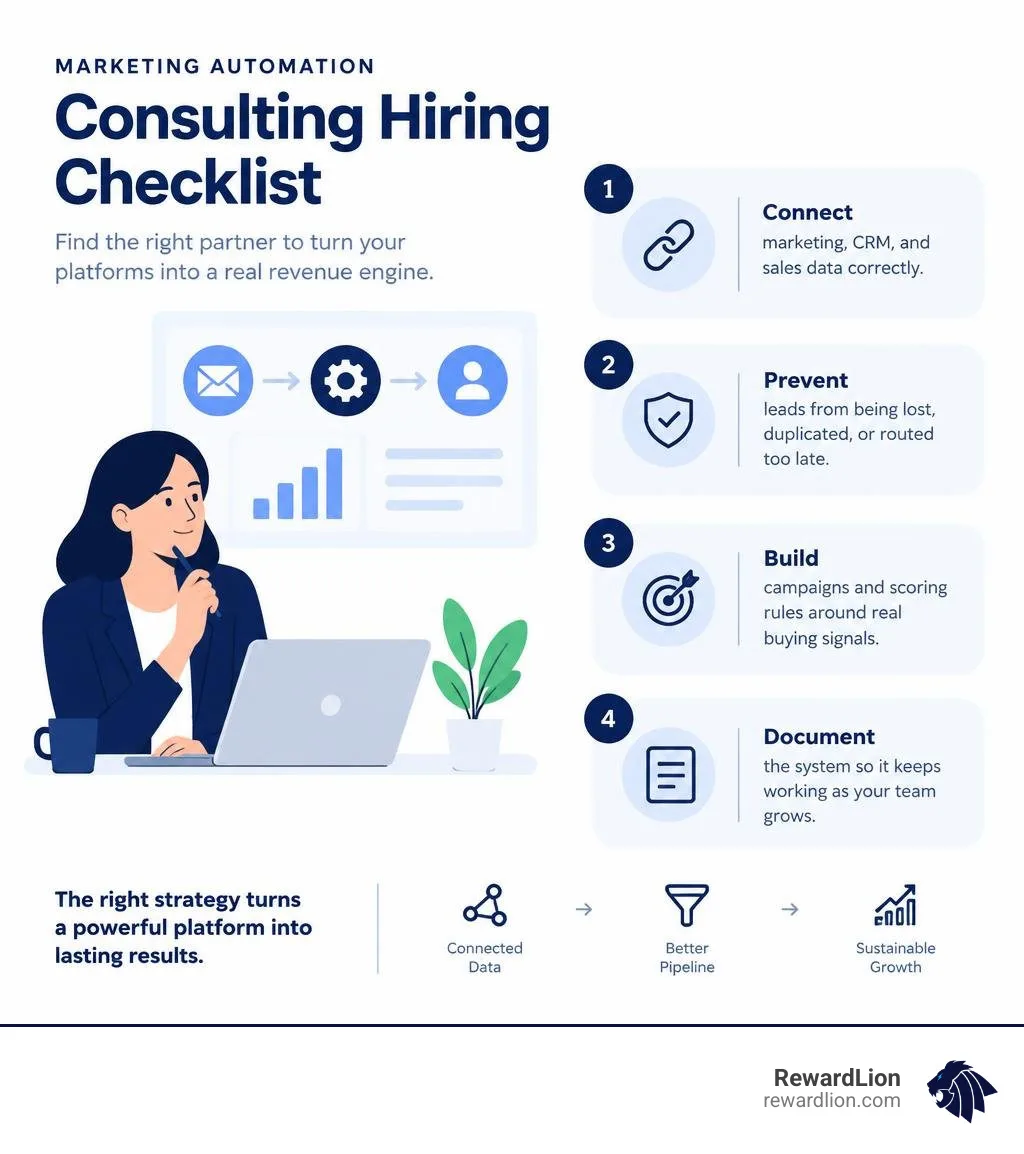
For a small or midsize business, the practical goal is simple:
Connect marketing, CRM, and sales data correctly.
Stop leads from being lost, duplicated, or routed too late.
Build campaigns and scoring rules around real buying signals.
Document the system so it keeps working as your team grows.
Without that strategic layer, platforms can appear healthy while problems build underneath: outdated segments, conflicting automations, poor deliverability, and CRM sync errors that quietly damage results. A consultant helps turn a stack of disconnected tools into an operating system your team can manage with confidence.
I’m Mike Ibrahim, Founder and CEO of RewardLion, with more than a decade in sales, marketing strategy, e-commerce, and business technology. My work with marketing automation consulting services focuses on helping growing businesses unify operations, improve customer experiences, and build repeatable revenue systems.
What are marketing automation consulting services and why do you need the strategic layer?
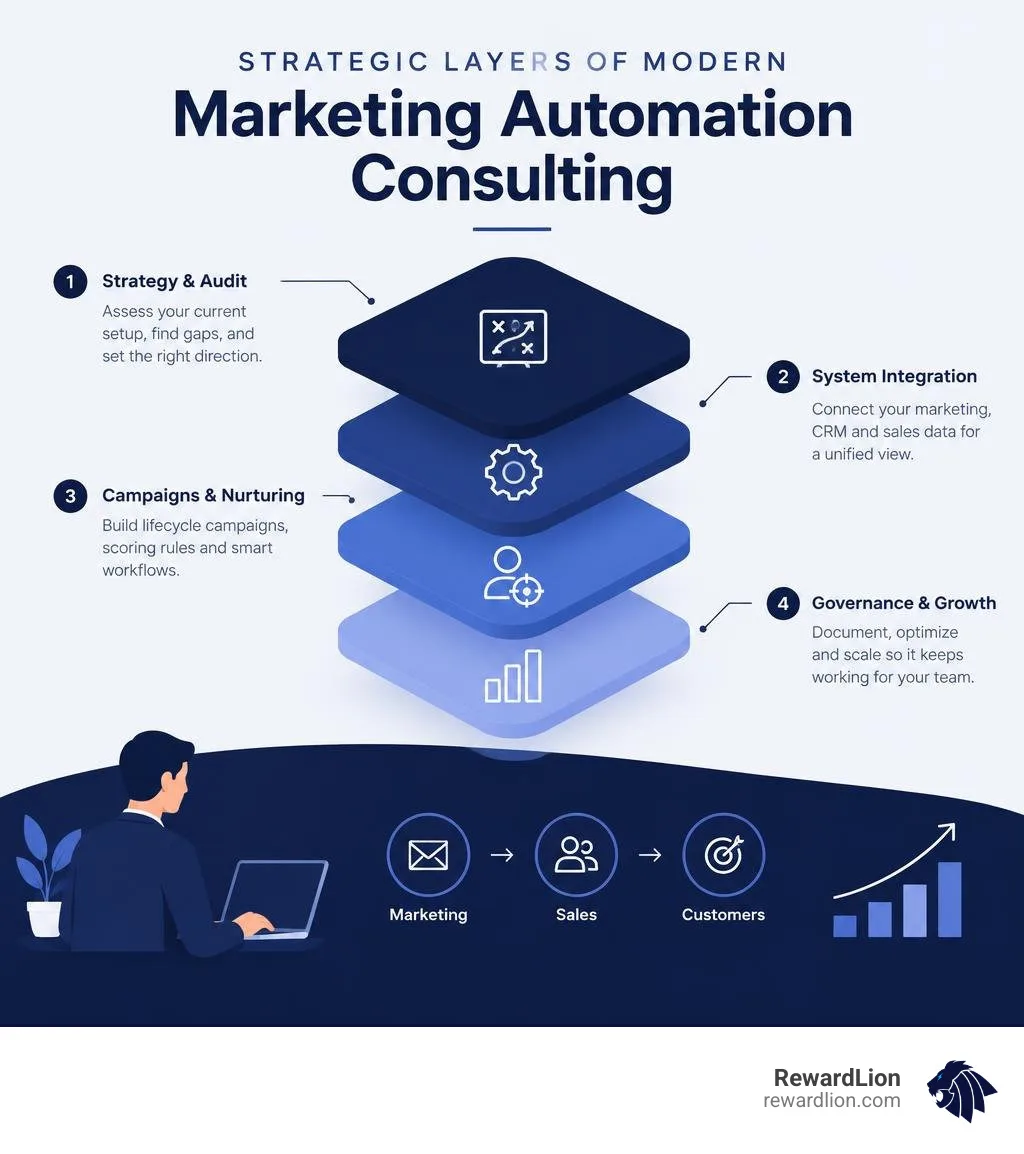
Marketing automation platforms are powerful engines, but an engine without steering or an experienced mechanic quickly runs off course. Investing in marketing automation services provides the high-level architecture, strategic roadmap, and operational governance required to turn complex software into sustainable revenue pipelines.
Many businesses purchase market-leading software expecting immediate efficiency. Instead, they run into feature underutilization. Organizations frequently use less than a fraction of their platform's native capabilities, treating enterprise-grade platforms like glorified email dispatchers.
Without strategic oversight, systems accumulate technical debt. Triggers clash, unmonitored workflows fire duplicate emails, and integrations quietly desynchronize. Understanding marketing automation services at an architectural level means designing a unified operational model where marketing, sales, and customer success operate on a single source of truth.
Automation specialist vs. strategic consultant: Choosing the right marketing automation consulting services
Understanding the distinction between an automation specialist and a strategic consultant prevents costly hiring mistakes:
Automation Specialist: Focuses on tactical execution and day-to-day configuration. A specialist builds specific email templates, creates individual landing pages, sets up basic drip sequences, and monitors daily batch sends.
Strategic Consultant: Operates at the structural layer. A consultant designs the overarching data schema, defines lifecycle transition boundaries, establishes bi-directional CRM integration guardrails, audits technical debt, and aligns automation systems directly with revenue attribution targets.
Responsibility Area | Marketing Automation Specialist | Strategic Automation Consultant |
|---|---|---|
Primary Focus | Tactical execution & workflow setup | System architecture & revenue strategy |
Data Schema | Populates custom fields | Establishes field mapping & sync governance |
Workflow Logic | Builds isolated drips and branching paths | Prevents circular loops & trigger collisions |
Integration | Connects standard platform plugins | Manages bi-directional sync APIs & error handling |
Lifecycle Design | Tags leads based on static actions | Defines multi-criteria MQL models & sales SLAs |
Documentation | Follows existing guidelines | Writes governance standards & runbooks |
Relying solely on tactical execution leads to "campaign sprawl"—a messy platform filled with conflicting automations that no one fully understands.
When in-house teams outgrow basic workflow execution
As an organization grows, marketing operations naturally become more intricate. What worked for a seed-stage team quickly collapses under mid-market or enterprise demands. Teams realize they need architectural consulting when they encounter:
Instance Maturity and Sprawl: Hundreds of active workflows, legacy tags, and outdated forms operating without clear naming conventions.
Custom Field Limits and Schema Bloat: Hitting platform caps because every campaign manager created custom properties without central governance.
Deliverability Degradation: Spiking unsubscribe rates, spam complaints, and missing domain authentication protocols damaging inbox placement.
Complex Multi-Channel Routing: Leads slipping through the cracks when transitioning between ad platforms, conversational chat interfaces, and CRM pipelines.
Implementing scalable systems for complex operations—such as marketing automation for professional services—requires strict change controls and deliberate architecture to handle high-value, long-cycle transactions without data loss.
The four-layer audit: How consultants uncover silent platform decay
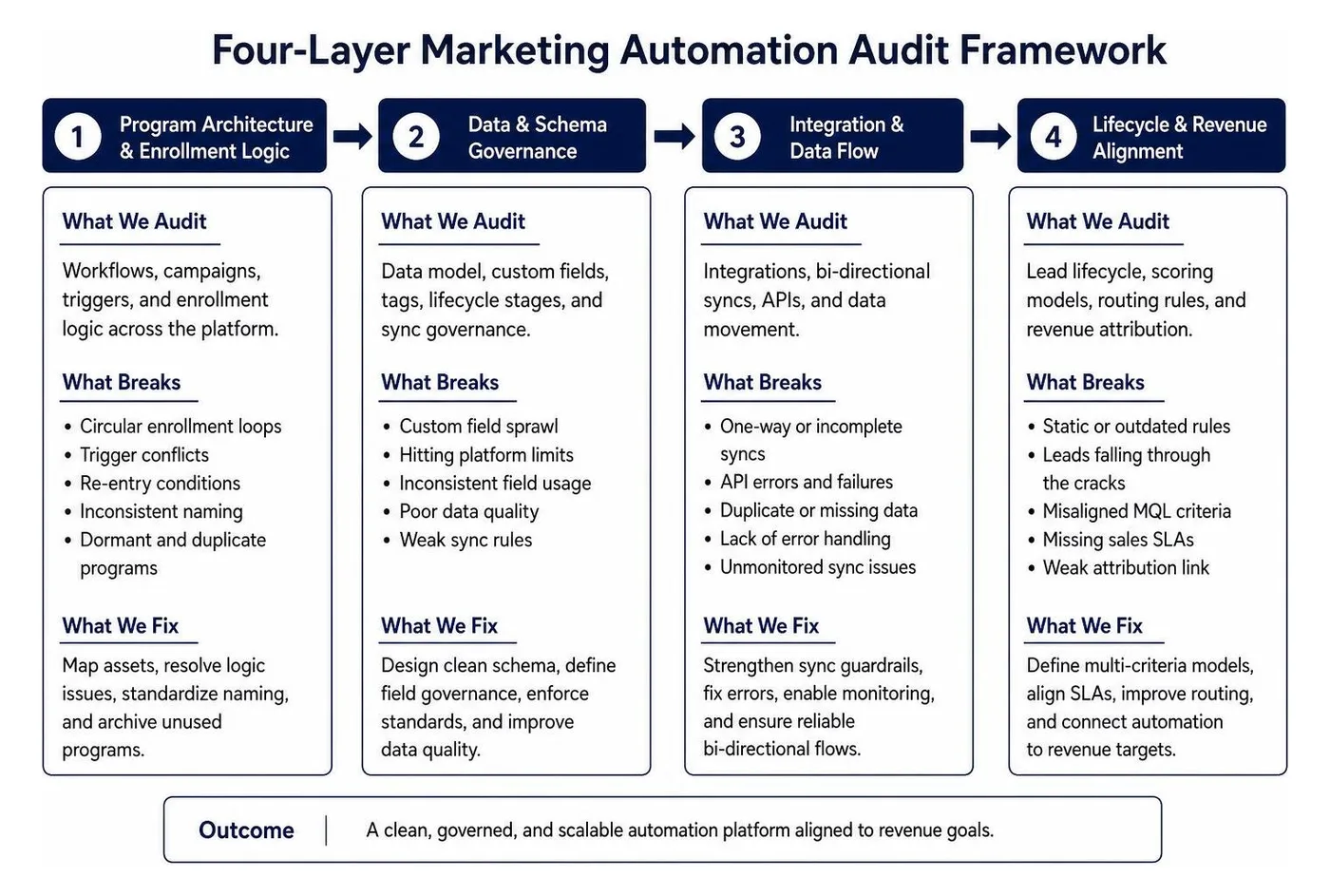
Platforms can look green on the status dashboard while silently failing underneath. A strategic engagement begins with a comprehensive diagnostic review that examines every operational layer.
Program architecture and broken enrollment logic
The first audit layer evaluates how workflows and campaigns are structured. Over years of unmanaged edits, systems develop circular enrollment loops—where a contact repeatedly triggers opposing automations—or trigger conflicts where two automations overwrite each other's status updates.
Consultants map every live asset, resolve re-entry conditions, establish uniform naming conventions, and archive dormant programs. Implementing a clean automated marketing system ensures workflows execute smoothly without wasting computing resources or annoying leads.
Data schema, sync mismatches, and CRM integration leaks
The most damaging platform failure is sync logic mismatch. When your marketing platform and CRM do not share unified rules for record updates, leads are dropped or overwritten silently.
Consultants audit custom field mapping, API call volumes, and bi-directional sync filters. Proper CRM setup & automation prevents sales reps from reaching out to stale leads or missing high-intent prospects due to integration lag.
Deliverability, segmentation hygiene, and multi-touch attribution
The third and fourth audit layers tackle deliverability and reporting accuracy. Consultants verify technical sender authentication—enforcing SPF, DKIM, and DMARC protocols—while cleaning decayed databases to maintain sender reputation.
Simultaneously, they establish standardized UTM tracking taxonomies to enable dependable multi-touch attribution, showing executive leadership precisely which channels generate real pipeline.
Aligning marketing, sales, and full lifecycle revenue operations
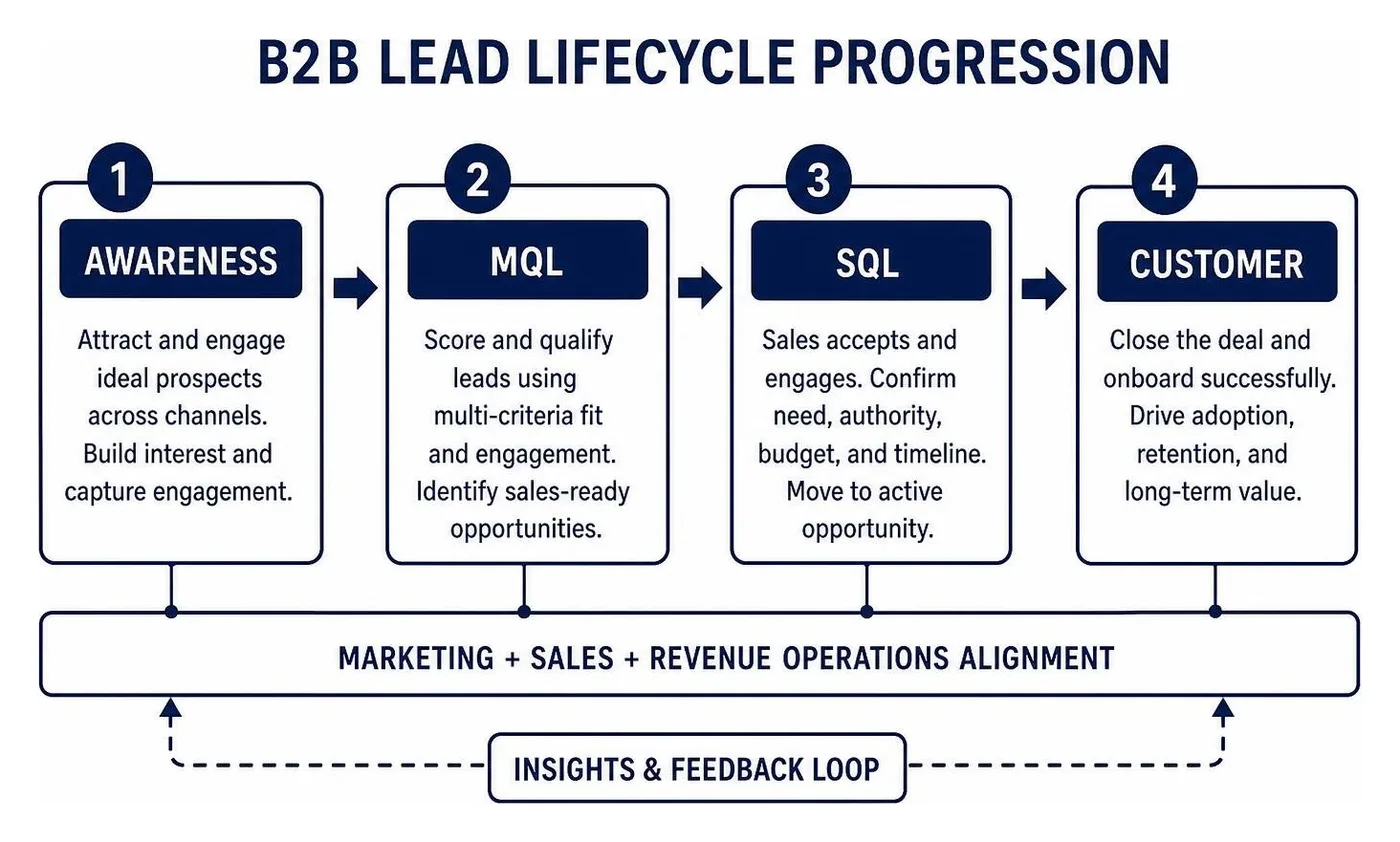
Marketing automation creates the greatest value when bridging the gap between demand generation and closed deals. Without alignment, marketing celebrates lead volume while sales complains about low quality.
Multi-criteria MQL scoring and intelligent lead routing
Basic lead scoring often relies on vanity metrics, such as a single whitepaper download triggering an aggressive sales outreach. Strategic consultants build multi-criteria scoring frameworks combining:
Explicit Demographic/Firmographic Fit: Company size, industry, geography, and job role.
Implicit Behavioral Intent: High-intent website visits (pricing pages, case studies), product demo views, and email engagement velocity.
Negative Scoring Filters: Deducting points for student domains, career page visits, or prolonged inactivity.
Once qualified, leads route instantly through automated sales automation services, setting clear sales service level agreements (SLAs) for rapid follow-up.
Evaluating platform trajectory: Matching team capability to long-term costs
Choosing or refining your software stack requires balancing feature depth against organizational capability and 5-year total cost of ownership. Different systems cater to distinct operating models, from all-in-one ecosystems designed for fast deployment to highly customizable enterprise platforms requiring dedicated marketing operations teams. The right fit depends on your internal bandwidth, integration requirements, and long-term growth trajectory.
Evaluating the right marketing automation software for small business ensures you do not overpay for enterprise bloat your team lacks the internal bandwidth to run.
Anatomy of an engagement: From remediation to long-term governance
A structured consulting engagement moves systematically through distinct phases over six to ten weeks:
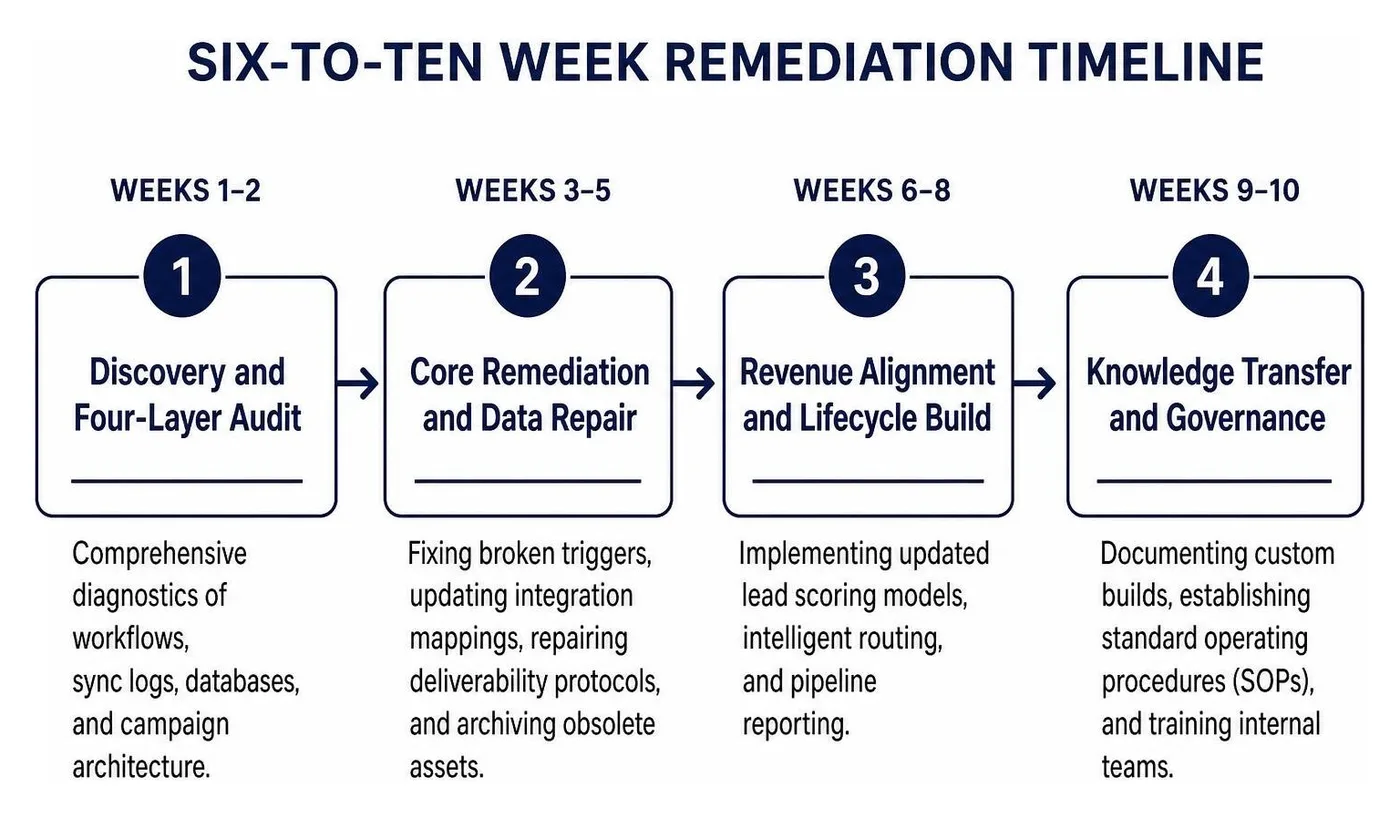
Weeks 1–2: Discovery and Four-Layer Audit: Comprehensive diagnostics of workflows, sync logs, databases, and campaign architecture.
Weeks 3–5: Core Remediation and Data Repair: Fixing broken triggers, updating integration mappings, repairing deliverability protocols, and archiving obsolete assets.
Weeks 6–8: Revenue Alignment and Lifecycle Build: Implementing updated lead scoring models, intelligent routing, and pipeline reporting.
Weeks 9–10: Knowledge Transfer and Governance: Documenting custom builds, establishing standard operating procedures (SOPs), and training internal teams.
How to maximize ROI from marketing automation consulting services
To maximize ROI, focus on business outcomes over vanity platform metrics. Modern engagements deploy AI marketing automation solutions that handle routine qualification and content variation dynamically, freeing your internal team to focus on strategic execution.
Knowledge transfer, change control protocols, and ongoing enablement
A successful engagement leaves your team fully enabled, not dependent on external help for simple updates. Consultants deliver version-controlled system documentation, standard operating procedures, and clear change-management frameworks to ensure system stability long after the initial engagement concludes.
Frequently Asked Questions about marketing automation consulting
How long does a standard marketing automation consulting engagement take?
A standard audit-and-repair engagement runs between six and ten weeks. This provides sufficient time to audit existing assets, repair database integration issues, rebuild core scoring models, and train your team. After initial remediation, many organizations transition to a monthly retainer for ongoing optimization.
What is the most common issue discovered during an automation audit?
The most widespread issue is sync logic mismatches between the automation platform and the CRM. This drift causes unrouted leads, duplicate records, and conflicting lifecycle stages that hide lead activity from sales teams.
Should we hire a freelance consultant or an integrated consulting firm?
While freelance consultants handle specific tactical tasks, an integrated consulting firm provides architectural redundancy, multi-platform expertise, and cross-functional governance across data, deliverability, and CRM development. This eliminates single-point-of-failure risks.
Conclusion
Marketing automation platforms should be powerful engines of predictable revenue, not black boxes of confusing workflows and hidden technical debt. Partnering with seasoned advisors transforms disconnected tools into an integrated growth engine. If your organization is ready to modernize its stack, eliminate data silos, and implement hands-off growth systems, explore the all-in-one RewardLion growth OS to build scalable revenue operations today.