Why Managing Local Marketing Without Automation Is Holding Your Business Back
Local marketing automation software helps businesses automatically manage their local online presence — from Google listings and customer reviews to hyperlocal ads and follow-up messages — all from one central platform.
Here's a quick look at what it does and who it's for:
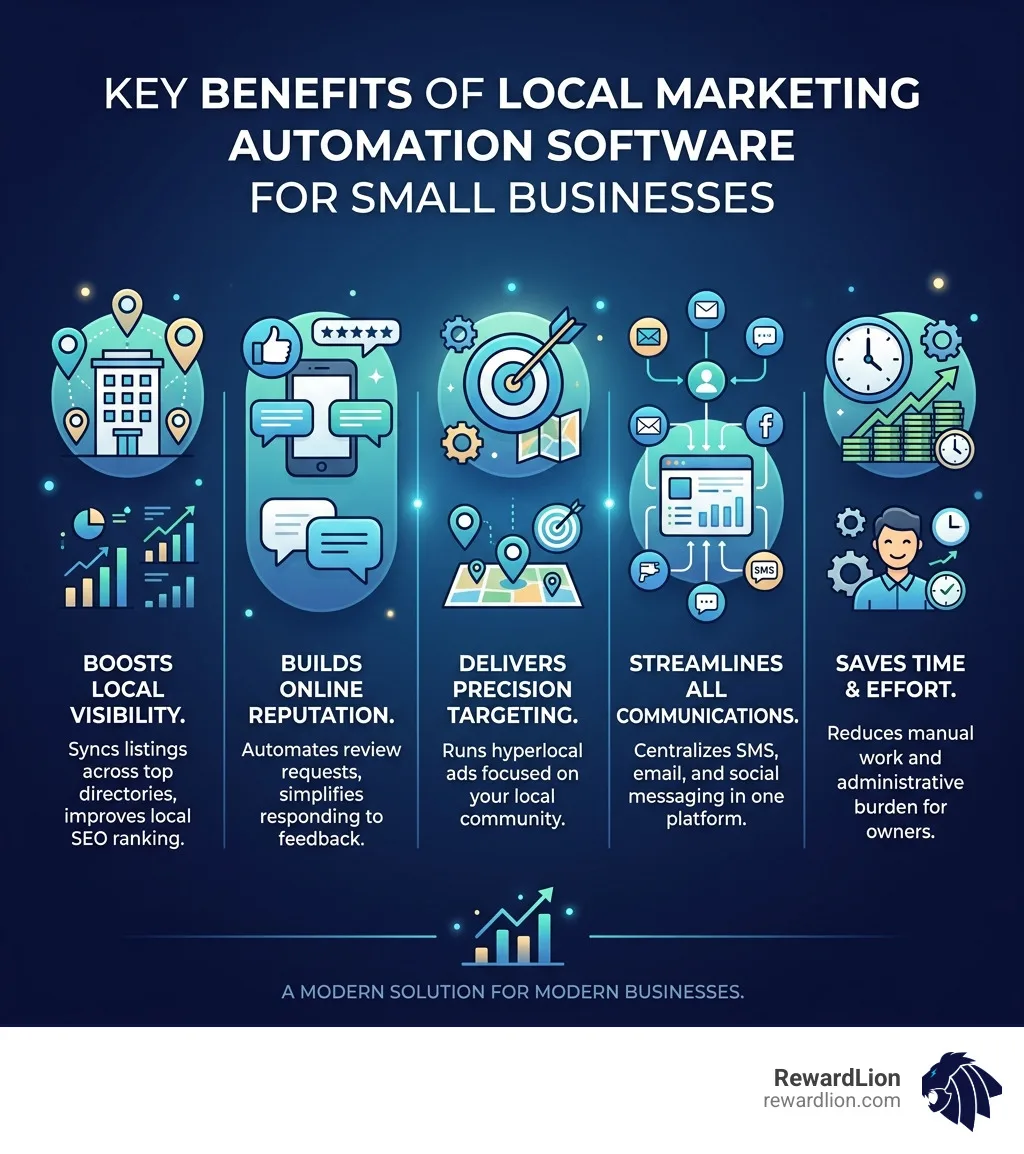
What It Does Who It's For Syncs business listings across 60+ directories Small and medium local businesses Automates review requests and AI-powered replies Multi-location brands and franchises Manages geo-targeted ads and hyperlocal campaigns Local service providers and retailers Centralizes SMS, email, and social messaging Community organizations and agencies Tracks local SEO rankings and campaign performance Anyone replacing fragmented, manual tools
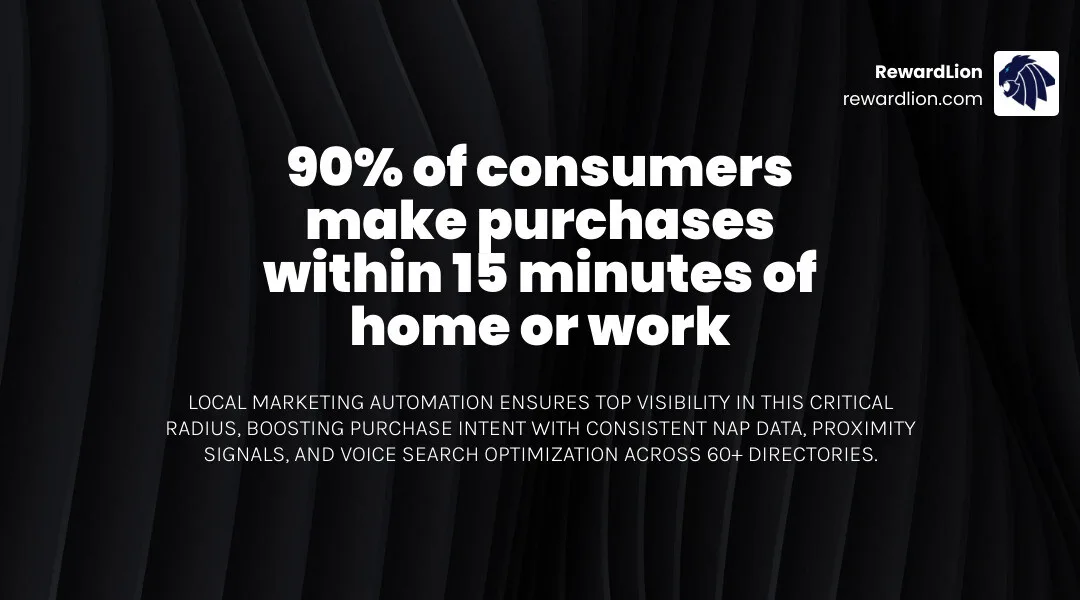
Running a local business in 2026 means competing in a very small geographic window. Research shows that 90% of consumers make most of their purchases within 15 minutes of their home or work. Yet most small business owners are still juggling separate tools for email, reviews, social media, and listings — losing time, leads, and local visibility every single day.
To make things harder, 73% of brand engagement happens off your own website — on Google Maps, Yelp, Facebook, and local directories. That means your presence on those platforms matters just as much as your website, if not more. Managing all of that manually simply isn't scalable.
That's exactly where local marketing automation software steps in.
I'm Mike Ibrahim, Founder and CEO of RewardLion and a marketing director with over a decade of hands-on experience building and scaling marketing systems — including local marketing automation software strategies — across multiple industries. In that time, I've seen how the right automation platform can transform a fragmented local marketing effort into a consistent, revenue-generating engine.
Why Your Business Needs Local Marketing Automation Software in 2026
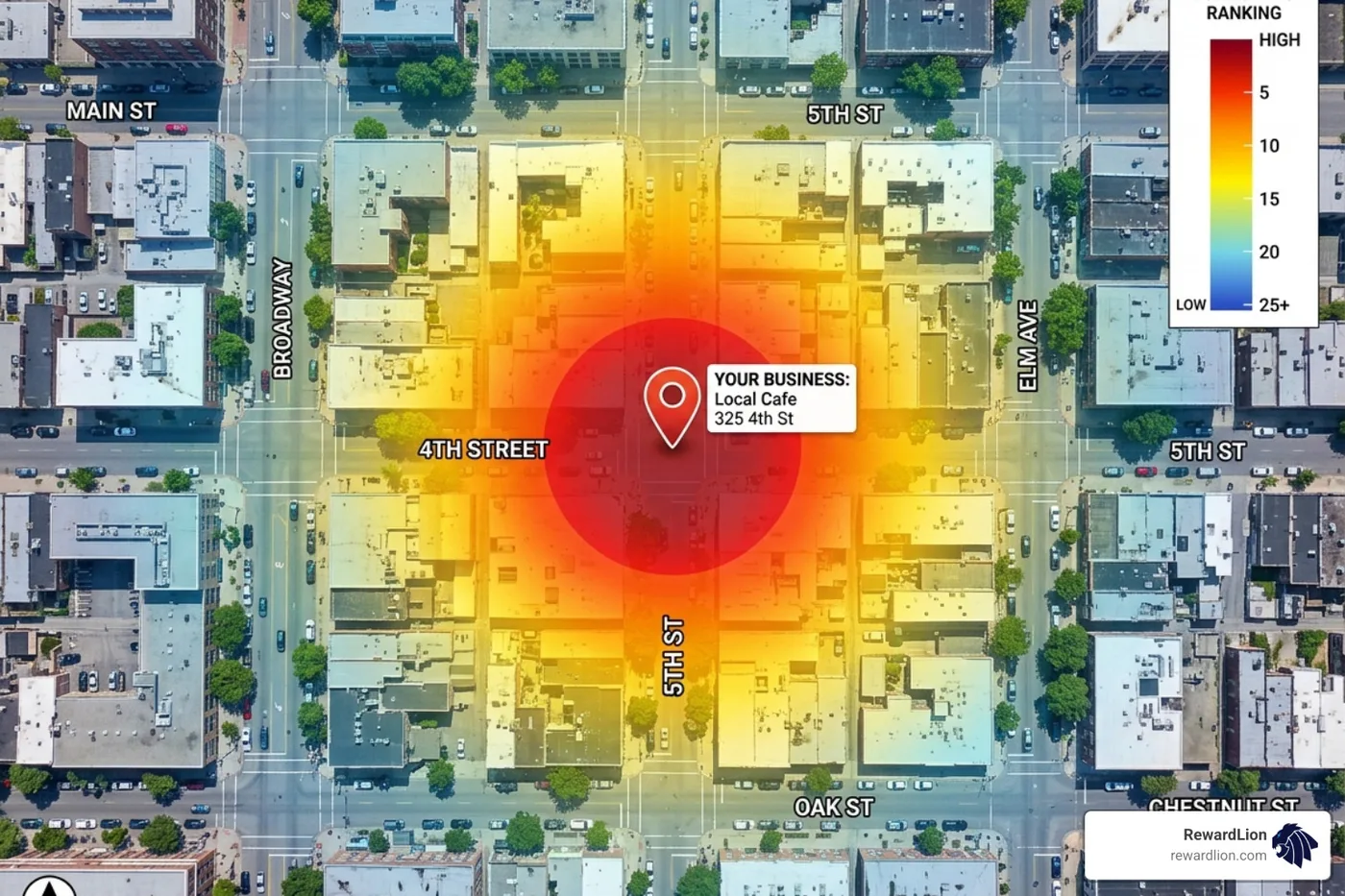
In the current landscape of 2026, the "15-minute radius" isn't just a convenience; it's a hard boundary for consumer behavior. If your business doesn't appear at the top of a search result when a customer is three blocks away, you effectively don't exist to them. This is the reality of proximity signals.
We know that 90% of purchase intent is localized. When someone searches for "marketing automation near Las Olas" or "marketing automation in Boca Raton," they aren't looking for a global conglomerate; they are looking for a solution right now, right where they are.
The Shift to Off-Site Engagement
As we mentioned, 73% of brand interaction happens on sites other than your own. This means your Google Business Profile (GBP), your Apple Maps listing, and your Yelp reviews are doing the heavy lifting. If your Name, Address, and Phone number (NAP) are inconsistent across these platforms, search engines lose trust in your data, and your rankings tank.
The Rise of Voice and AI Search
Over 50% of people now use voice search on devices like Amazon Alexa or Google Home. These assistants don't read out a list of ten websites; they usually provide the top one or two local results. Local marketing automation software ensures your data is structured so these AI platforms can find and recommend you. Without automation, keeping up with the "near me" search intent and voice optimization becomes a full-time job that most business owners simply can't afford to do manually.
Core Features of a High-Performing Local Platform
When we look for the best local marketing automation software, we aren't just looking for a scheduler. We are looking for a "single source of truth" that unifies your brand. A high-performing platform should offer Digital Asset Management (DAM) so that every local branch or partner has access to the right logos and images without needing a design degree.
One of the most powerful features in modern platforms is DNA personalization. This technology allows a central office to create one template that automatically adjusts the address, phone number, and even local pricing based on the user's profile. This is a massive leap forward for small business automation software, allowing for "set it and forget it" workflows.
Key Features of Local Marketing Automation Software
Listing Synchronization: Automatically push your business data to 60+ platforms simultaneously to ensure 100% NAP consistency.
AI-Generated Replies: Use sentiment analysis to understand how customers feel and generate professional, keyword-rich responses to reviews.
Geo-fencing: Trigger ads or notifications when a customer enters a specific geographic area.
Automated Communication: Use sms automation software to send appointment reminders or "thank you" notes instantly.
Real-time Analytics: View heatmaps of where you rank in specific neighborhoods, not just general cities.
Advanced Personalization and Brand Compliance
For franchises and multi-location brands, the "Canva Trap" is a real danger. This happens when local managers create their own flyers or graphics that don't match the brand guidelines, often using images that aren't ADA-compliant or mobile-friendly.
A professional platform provides a Template Studio where the creative is locked in, but the local details remain dynamic. You can even integrate direct mail automation software to send physical postcards to neighbors of a recent job site, all triggered by a simple status change in your CRM.
Feature Manual Workflow Automated Workflow Review Management Checking 5+ sites daily, typing manual replies. Instant alerts, AI-drafted replies for approval. Listing Updates Logging into each directory one by one. One-click sync across 60+ directories. Lead Response Replying when you have a free minute (hours later). Immediate lead acknowledgment within seconds. Social Posting Posting to each platform individually. Centralized calendar with cross-platform distribution.
How to Scale Community Growth with Hyperlocal Automation
Scaling doesn't mean doing the same thing bigger; it means doing it smarter. For businesses with multiple locations in Florida—from Miami to Boca Raton—distributed marketing support is essential. You want your local partners to feel empowered, not restricted.
By providing a library of branded assets, you eliminate design bottlenecks. If a local shop in Fort Lauderdale needs a promotion for a community event, they shouldn't have to wait two weeks for a graphic designer. They should be able to pull a template, add their local event details, and hit "publish."
The 2-Hour Response Rule
In local services, speed is the ultimate currency. Research shows that businesses often lose more money from slow lead responses than from a lack of leads. We recommend a strict 2-hour response rule, though, with drip email marketing software and AI assistants, that response should actually be instantaneous.
Automation ensures that when a lead comes in through a website chat or a Google Business Profile message, they get an immediate acknowledgment. This keeps the lead from clicking on the next competitor in the search results.
Community Content Engines
Platforms like Locable have pioneered the "Community Content Engine" approach. This involves a "publish once, distribute everywhere" philosophy. When you update a community calendar or a local directory, that information should automatically sync with your social media, your email newsletter, and your website. This reduces "busywork" and keeps the local community engaged without requiring you to manually update five different places.
Measuring Success and ROI in Local Markets
How do you know if your local marketing automation software is actually working? You look at the data, but you have to look at the right data. We aren't just looking for "likes" or "impressions." We are looking for "Get Directions" clicks, "Call" button presses, and actual revenue.
The Power of Clean Data
Before you can measure ROI, you need clean data. Many businesses suffer from "automated chaos"—where they automate a messy process and just get faster, messier results. By using sales automation software saas to clean your database and remove duplicate contacts, you ensure your predictive modeling is accurate.
Real-World ROI Examples
Consider a local service provider who implemented a simple lead response automation. By ensuring every lead was contacted within seconds, they managed a $270k pipeline from a very modest ad spend. This is the power of not letting leads fall through the cracks.
Tools like a Repeat Transaction Calculator can also help you predict when a customer is due for their next service—whether it's an oil change or a dental cleaning—and send an automated reminder. This shifts the focus from expensive customer acquisition to high-margin customer retention.
Is It Worth the Cost?
According to industry statistics:
47% of businesses find local marketing automation software to be fairly priced.
22% say it's "pricey but worth it."
Only 11% find it too expensive.
When you factor in the hours of manual labor saved and the increase in lead conversion, the ROI usually speaks for itself.
Frequently Asked Questions
How much does local marketing automation software typically cost?
Pricing for local marketing automation software is generally flexible to accommodate different business sizes. Most platforms offer tiers ranging from $20/month for basic listing management to $199+ per month for full-scale automation suites that include AI assistants, CRM integration, and multi-channel messaging. The key is to look for scalability; you want a platform that grows with your business without requiring a total overhaul of your systems.
Is local marketing automation software right for small businesses?
Absolutely. In fact, small businesses often benefit the most because they have the fewest "human" resources to spare. While a large corporation can hire a team to manage social media and reviews, a small business owner in Fort Lauderdale is often the CEO, the technician, and the marketer all at once. Automation allows them to compete with larger brands by maintaining a professional, responsive presence 24/7. Whether you choose a "DIY" software approach or a "Done-for-you" service, streamlining these operations is the only way to scale effectively in 2026.
How does automation improve local SEO and reputation?
Search engines like Google prioritize three things: Relevance, Prominence, and Recency.
Relevance: Automation ensures your profile is filled with keyword-rich posts and accurate data.
Prominence: By automating review requests, you build a steady stream of 5-star feedback, which signals to Google that you are a trusted leader.
Recency: Regular automated updates and replies to reviews show that your business is active. Together, these signals help you dominate the "Map Pack" and local search results, while AI-powered webchat ensures those visitors turn into leads.
Conclusion
At RewardLion, we believe that local businesses are the heartbeat of our communities in Florida and beyond. But we also know that you shouldn't have to spend your entire day fighting with disconnected tools or manual spreadsheets.
Our AI-powered operating system is designed to be your Local Growth Engine. We don't just give you the software; we provide a hybrid solution where our expert CAPSS team manages the automation, the SEO, and the creative production for you. This means you get the power of a full-scale marketing agency with the efficiency of high-end SaaS.
From managing your reputation to dominating local search and automating your sales follow-ups, we install one fully connected growth system that works while you sleep.
Start growing your local presence today and see how RewardLion can help you own your local market.