Why Most Ads Fail — and What Makes an Ad Effective
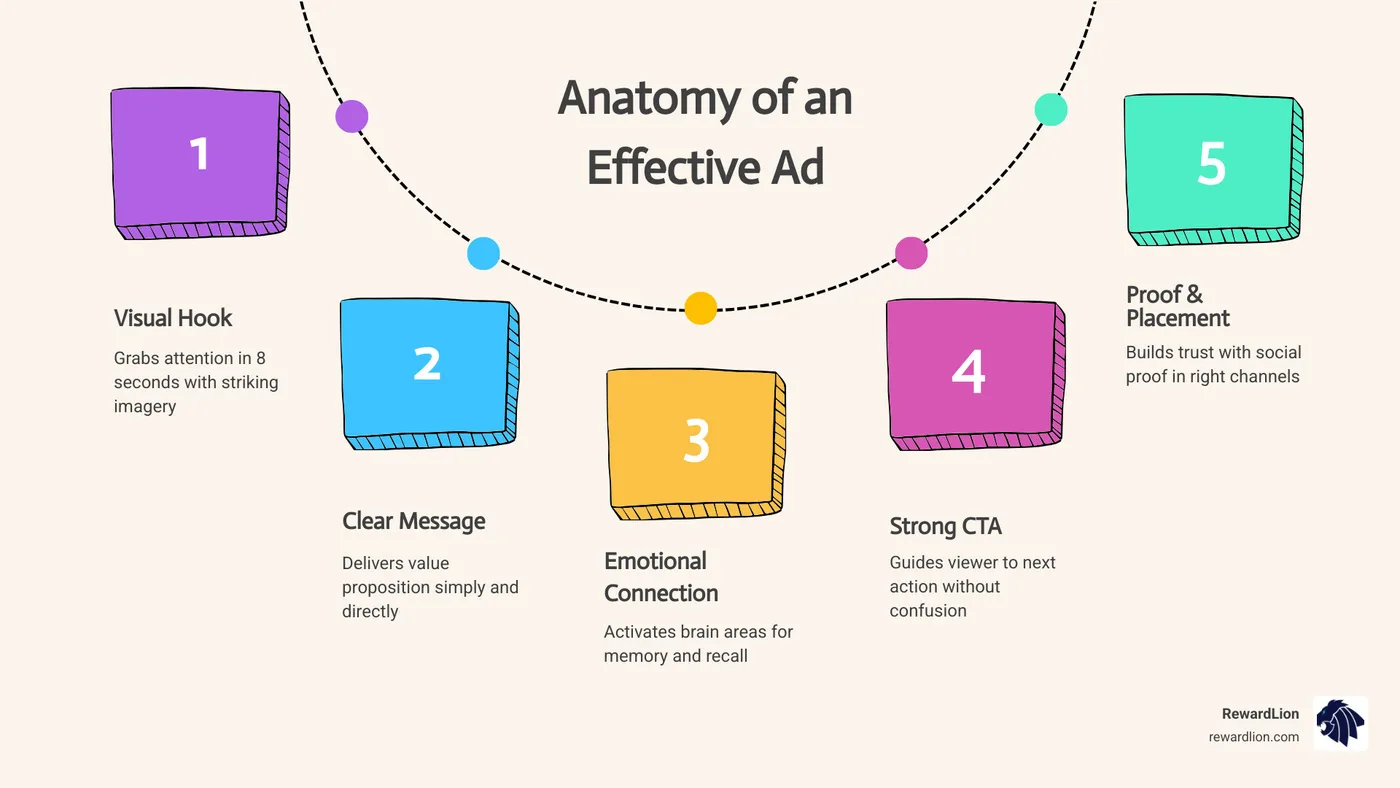
What makes an ad effective comes down to a handful of core elements working together:
Element Why It Matters Clear message Viewers decide in seconds whether to keep watching Strong visual hook Grabs attention before words can Target audience fit Relevant ads outperform generic ones every time Emotional connection Emotions drive recall and purchase decisions Clear call to action Tells the viewer exactly what to do next Right placement and timing Even great ads fail if shown to the wrong people Credibility and social proof Builds trust and reduces buyer hesitation
Global ad spend crossed $1 trillion in 2024 — yet most businesses still struggle to get results. Only 8 out of 15 Facebook campaigns in one study produced a measurable sales lift. That gap between spending and results is exactly what this guide addresses.
The truth is, effective advertising isn't about big budgets or flashy production. It's about understanding your audience, delivering the right message, and making it easy for people to act.
I'm Mike Ibrahim, Founder and CEO of RewardLion and Marketing Director for several companies, with over a decade of hands-on experience helping businesses crack the code on what makes an ad effective — from copy and creative to targeting and ROI tracking. In this guide, I'll walk you through the proven elements that separate ads that convert from ads that get ignored.
Defining Success: What Makes an Ad Effective in 2026?
As we look toward 2026, the landscape of advertising is more crowded than ever. Consumers are scrolling faster, their attention spans have leveled off at roughly eight seconds, and they have developed a "filter" for anything that feels generic. To understand what makes some ads so powerful, we have to look beyond the surface level of "pretty pictures."
In 2026, success is defined by cultural relevance and neuroscience. Research shows that emotional narratives activate significantly more areas of the brain than simple lists of facts or features. This brain activation leads to better memory retention and a stronger association with the brand. When an ad feels authentic—perhaps by addressing a real-world struggle or a shared social purpose—it transcends being a "commercial" and becomes a cultural moment.
High-performing ads today focus on visual immersion. Whether it’s through cinematic production quality or clever minimalism, the goal is to create a sense of brand prestige. In a world of "fast content," taking the time to invest in artistic value signals to your audience that your brand is a leader, not a follower. We’ve seen that 79% of consumers now believe it is important for brands to take action during humanitarian crises or natural disasters, proving that "effectiveness" now includes how well a brand aligns with human values.

The Core Pillars of High-Converting Advertisements
If you want to move the needle on your sales, you need to follow a proven structure. At RewardLion, we often look at the AIDAS framework: Attention, Interest, Desire, Action, and Satisfaction. If your ad misses any of these steps, the chain breaks.
Metric Emotional Storytelling Ads Factual/Feature-Based Ads Brand Recall 30% Higher Baseline Customer Engagement 80% Recall Rate 20-30% Recall Rate Purchase Intent High (Driven by connection) Moderate (Driven by price)
One of the most critical 15 characteristics of effective advertising is the Unique Selling Proposition (USP). Why should someone choose you over a competitor in Miami or Fort Lauderdale? Is it your price, your specialized expertise, or a specific problem you solve that no one else touches?
Simplicity and memorability are your best friends. We use the KISS principle: "Keep It Simple, Stupid." An effective ad delivers a single, focused message. If you try to tell the viewer ten things, they will remember zero. If you tell them one thing powerfully, they might just click.
Credibility is the final pillar. In an era of skepticism, social proof—like testimonials, reviews, or third-party endorsements—can increase purchase likelihood by up to 70%. Interestingly, revealing a minor flaw in a product can actually boost credibility because it makes the ad feel more truthful and less like a "too good to be true" sales pitch.
Understanding Your Audience: The Foundation of What Makes an Ad Effective
You cannot hit a target you haven't defined. Effective advertising begins with deep customer segmentation. This goes beyond simple demographics like age or location. While 65% of people appreciate seeing diverse age groups in ads, the real magic happens with interest-based targeting.
Data shows that video advertisers who use both age-based and interest-based audiences see a 2.2x increase in page views compared to those using age alone. At RewardLion, we help businesses build detailed buyer personas that dig into psychographics—what are your customers' fears, hobbies, and daily routines?
When your messaging is highly relatable and personalized, it doesn't feel like an interruption; it feels like a solution. Whether you are running a local plumbing business or a high-end boutique in Boca Raton, your ad must speak directly to the "pain points" of your local audience.
Clear Messaging and Strong Visuals: The Key to What Makes an Ad Effective
You have about three seconds to stop the scroll. This is where the visual hook comes in. Whether it’s a bold splash of color, an unexpected image, or a high-quality video, your visual must do the heavy lifting before the user even reads your headline.
Your Call to Action (CTA) must be unmistakable. "Shop Now," "Book a Consultation," or "Get the Guide" tells the user exactly what the next step is. Ambiguity is the enemy of conversion. Furthermore, the quality of your production matters. High-quality graphic design and professional video production signal that you are a legitimate, trustworthy business.
Strategic Execution: Timing, Placement, and Channels
Even the most brilliant ad will fail if the timing is off. A back-to-school sale ad is useless in November. Strategic execution requires an omnichannel strategy—being where your customers are, whether that’s scrolling TikTok, watching Connected TV (CTV), or driving past a programmatic billboard in South Florida.
Media buying is the science of placing your ads where they will get the most "bang for the buck." For example, research shows that online display and paid search are often more effective at driving both online and in-store sales than traditional mass media alone. However, TV still holds a massive 4x higher ROI for many brands because of its reach and authority.
Don't overlook the power of word-of-mouth and low-cost digital strategies. A strong Google Business Profile and local SEO ensure that when someone searches for your service, your "ad" (in the form of a top ranking) is there to meet them at the exact moment of need.
Measuring Impact: Metrics That Matter
If you aren't measuring, you aren't marketing—you're gambling. To determine what makes an ad effective, you must look at the hard data.
Key metrics to track include:
ROAS (Return on Ad Spend): Are you making more than you are spending?
CTR (Click-Through Rate): Is your creative actually enticing people to click?
Sales Lift: Did the ad actually cause a statistically significant increase in sales? (Note: In one study, only about half of Facebook campaigns actually produced a significant lift).
Conversion Tracking: Following the customer from the first click to the final purchase.
Tracking ROI to Determine What Makes an Ad Effective
To truly master ROI, we use field experiments and econometric models. One fascinating insight from recent research is the "retargeting trap." While retargeted ads (showing an ad to someone who already visited your site) often show 6x higher effectiveness, they can sometimes underperform generic ads for broader audiences because they are only reaching people who were already likely to buy.
We also look at Customer Lifetime Value (CLV) and repeat purchase rates. For instance, brands using specialized ad systems have seen repeat purchase rates jump from a 60% average to 75%. This long-term view is what builds a sustainable business.
Frequently Asked Questions about Ad Effectiveness
How can small businesses create effective ads on a limited budget?
You don't need a Super Bowl budget to win. Focus on low-cost advertising like word-of-mouth, email marketing, and organic social media. Use tools like Canva for professional-looking graphics and focus on a very narrow, local audience to ensure your budget isn't spread too thin. Authenticity—like a business owner speaking directly to the camera—often outperforms a polished, expensive commercial.
What are the most common mistakes to avoid in ad creation?
The biggest mistake is trying to be "everything to everyone." When you broaden your message too much, it becomes "noise." Other common pitfalls include:
Lacking a clear CTA: Never assume the customer knows what to do next.
Ignoring the data: Don't keep spending money on an ad that isn't converting just because you "like" the creative.
Weak Headlines: Five times as many people read the headline as the body copy. If your headline doesn't promise a benefit, the rest of the ad is wasted.
Why is emotional storytelling more effective than listing product features?
Features tell, but emotions sell. Neuroscience proves that stories create a human connection that facts simply cannot. When you tell a story of how your product solved a real person's problem, the viewer "self-inserts" into that story. This builds a much deeper level of trust and brand recall than a list of technical specifications ever could.
Conclusion
Mastering what makes an ad effective is a journey of constant testing, learning, and refining. In 2026, the brands that win will be the ones that combine timeless persuasion psychology with cutting-edge AI technology and authentic storytelling.
At RewardLion, we’ve built an AI-powered platform designed to take the guesswork out of growth. We don't just give you the tools; we provide a dedicated "CAPSS" team to implement, optimize, and manage your entire marketing system. From high-converting sales funnels and paid advertising to TV commercials and local SEO, we unify your growth strategy into one seamless operating system.
If you're ready to stop "trying" ads and start deploying a predictable lead generation system, we're here to help you dominate your market. Whether you're in Fort Lauderdale, Miami, or anywhere across the United States, let's build something that actually works.
Ready to see the RewardLion platform in action? Click here to learn more.