Why the Power of Facebook Ads Remains Unmatched in 2026
Despite the emergence of newer platforms, the data from early 2026 confirms that the power of Facebook ads is not just surviving; it is thriving. With over 3 billion monthly active users, Meta provides access to nearly 75% of all ad-eligible internet users. This isn't just a "social" platform anymore—it is a massive engine for demand generation.
Statistics show that the average Facebook ad conversion rate sits at a healthy 8.95% across all industries. In specific sectors like fitness, we see conversion rates climbing as high as 14.29%. For businesses focused on retail, Facebook remains the dominant force, with 41% of marketers claiming it provides the best return on ad spend (ROAS) compared to any other social platform.
But why does it work so well? Unlike search engines where users must already be looking for a solution, Facebook allows us to create demand. We can place a product in front of someone who didn’t even know they needed it yet. Research indicates that 78% of American consumers have discovered products they eventually bought through Facebook. When you combine this with a median ROAS of 2.19x—and top-tier retargeting campaigns hitting 3.61x—it becomes clear why Meta’s advertising revenue reached a staggering $122 billion recently. Whether you are a local shop in Fort Lauderdale or an international e-commerce brand, the platform’s mobile-first audience and sophisticated algorithm make it an essential pillar of any growth strategy.
To understand the current landscape, recent data highlights how the platform has transitioned from a simple social network into a precision-engineered sales tool.
Precision Targeting: How the Power of Facebook Ads Reaches Your Ideal Customer
The true "secret sauce" behind the power of Facebook ads is its granular targeting system. We are no longer limited to broad categories like "people who like sports." Today, we can use micro-targeting to reach users based on specific life events, behaviors, and deep-seated interests.

While Apple’s iOS 14.5 privacy update in 2021 initially disrupted tracking, the platform has pivoted toward using first-party data and advanced AI to fill the gaps. By installing the Meta Pixel and using the Conversions API (CAPI), we can track user behavior directly on your website and feed that data back into the system. This allows for hyper-efficient retargeting—showing ads to people who have already interacted with your brand, added items to a cart, or watched your videos.
For those looking to scale beyond their local borders, the platform's ability to mirror successful domestic audiences in new territories is a game-changer for growth.
Leveraging Lookalike Audiences for Scale
Once we identify a "seed audience"—such as your 1,000 highest-spending customers—we can instruct Facebook to find the "1% Lookalike." This tells the algorithm to analyze millions of profiles and find the people who most closely mirror your best customers' traits. It’s like having a digital bloodhound that finds new leads who are statistically predisposed to love your brand.
The Role of AI in the Power of Facebook Ads
In 2026, we don't have to do all the heavy lifting manually. Meta’s Advantage+ suite uses machine learning to handle everything from automated bidding to real-time creative optimization. The AI can test hundreds of variations of an ad, shifting the budget toward the one that is actually generating sales, often before a human marketer would even notice the trend.
Structuring for Success: The Power 5 and AI Automation
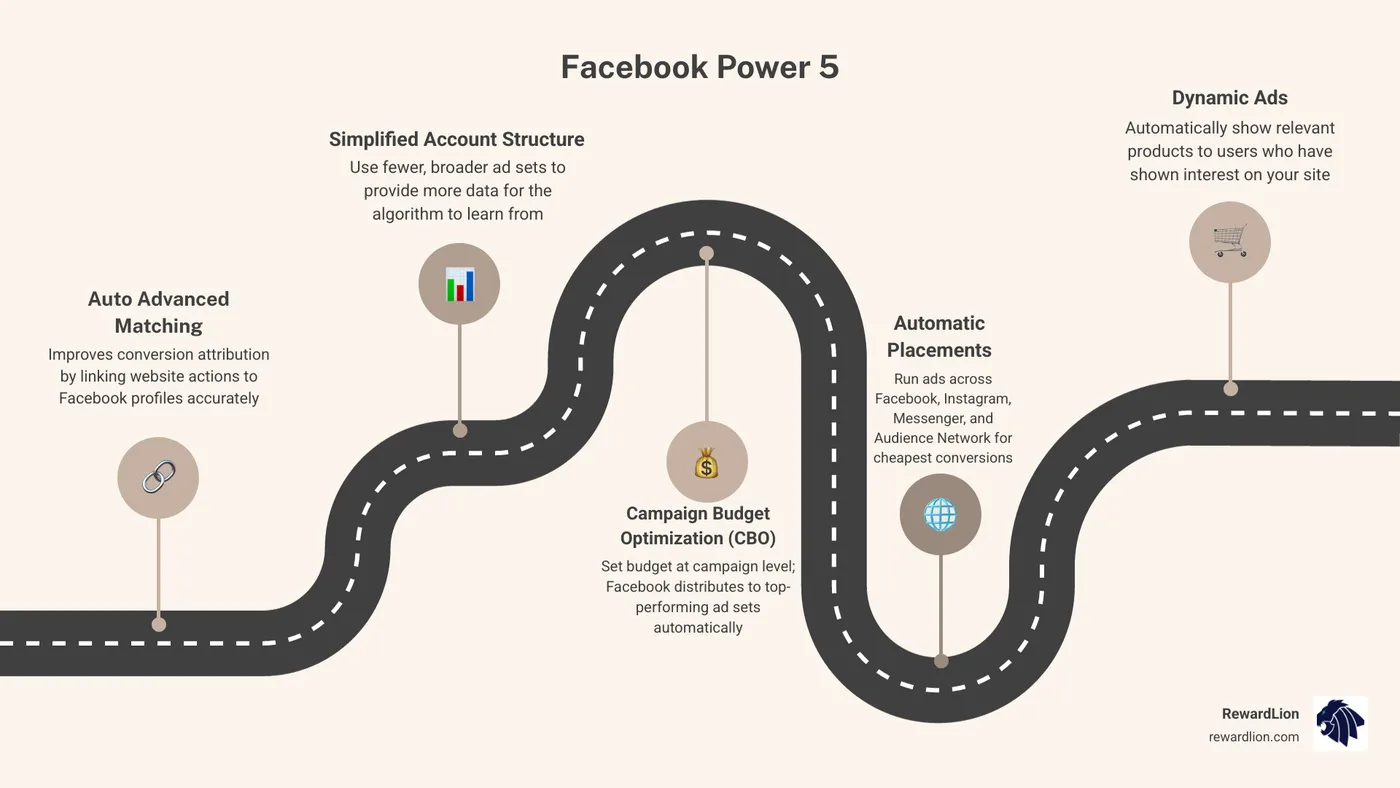
To truly harness the power of Facebook ads, you have to stop "hacking" the system and start working with it. Meta recommends a framework known as the Facebook Power5: Improve Business with Automated Ad Performance. This set of automated tactics is designed to let the machine learning do what it does best.
Auto Advanced Matching: Improves conversion attribution by accurately linking website actions to Facebook profiles.
Simplified Account Structure: Instead of 50 different ad sets, we use fewer, broader sets. This gives the algorithm more data to learn from.
Campaign Budget Optimization (CBO): You set the budget at the campaign level, and Facebook automatically distributes it to the top-performing ad sets.
Automatic Placements: This allows your ads to run across Facebook, Instagram, Messenger, and the Audience Network, finding the cheapest conversions wherever they exist.
Dynamic Ads: These automatically show the right products to people who have expressed interest on your site or elsewhere on the internet.
One critical rule we always follow: the "Learning Phase." An ad set needs roughly 50 conversions per week to stabilize. If you tinker with the ads too much or set the budget too low, the algorithm never learns, and your costs stay high. Patience is a prerequisite for profit.
Measuring the Power of Facebook Ads: Benchmarks and ROI
How do we know it's working? We look at the hard numbers. Case studies across the industry show that when strategy meets spend, the results are explosive, often reaching over 3x ROAS.
At RewardLion, we focus on three primary metrics:
ROAS (Return on Ad Spend): The total revenue generated for every dollar spent.
CPA (Cost Per Acquisition): How much it costs to get one new customer.
LTV (Lifetime Value): The total value a customer brings over their lifetime. Even if your CPA is $50, it's a massive win if that customer spends $500 over the next year.
While the average click-through rate (CTR) is around 1.7%, top-performing "thumb-stopping" creatives can easily double or triple that.
Creative Strategies for High-Performing Ads
The "creative" is the new targeting. In 2026, video content reigns supreme. Instagram Stories, for instance, deliver 61% higher CTRs than traditional Feed placements. We recommend a mix of:
User-Generated Content (UGC): Real people using your product.
Carousel Ads: Great for showcasing multiple products or a step-by-step process.
Collection Ads: A mobile-first format that allows users to browse your shop without leaving the app.
Comparing the Power of Facebook Ads to Search PPC
It’s often a question of "Facebook vs. Google." The truth is, they serve different purposes.
Feature Facebook Ads (Demand Gen) Google Ads (Search Intent) User State Browsing/Socializing Actively Searching Primary Goal Creating Awareness/Desire Capturing Existing Demand Targeting Interests & Behaviors Keywords & Intent Visuals Critical (Photos/Videos) Secondary (Text-heavy) Best For New Products, Brand Building High-Intent Purchases, Services
Strategic Execution: Budgets, Timelines, and Common Pitfalls
We often get asked, "How much do I need to start?" For most businesses, a starting budget of $25 to $50 per day is enough to begin testing. This allows the algorithm to gather enough data to see what works. We typically recommend a 30-to-90-day testing window before making major pivots.
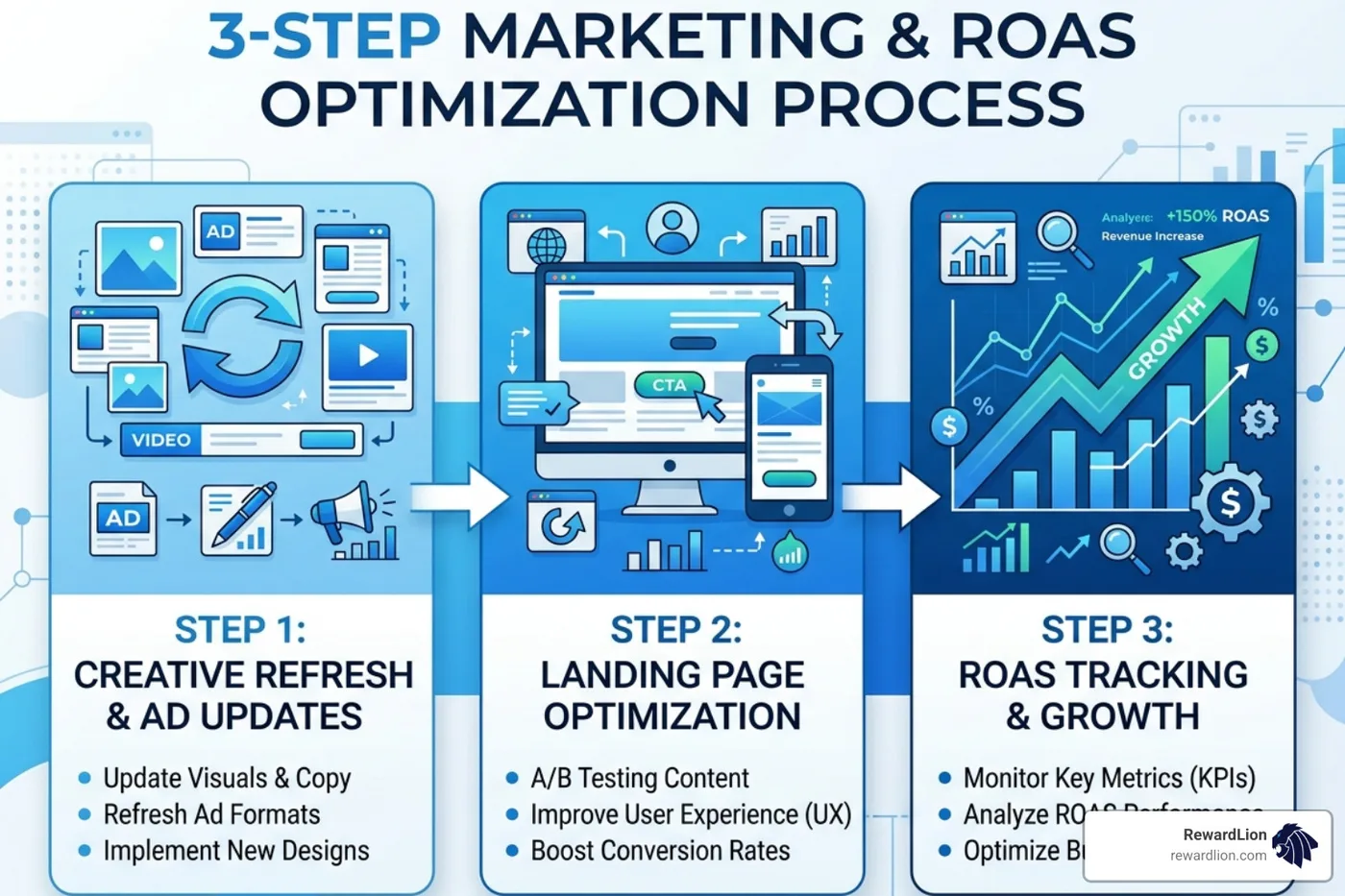
A common mistake is "ad fatigue"—running the same image for six months until people stop seeing it. Successful campaigns require a regular creative refresh. Furthermore, ensure your landing page matches the ad's promise. If your ad is funny and bright, but your website is corporate and dull, you will lose the conversion.
For those operating specifically in the Sunshine State, local trends are shaping performance in markets like Miami and Fort Lauderdale, making it essential to tailor creative to the Florida 2026 landscape.
Frequently Asked Questions about Facebook Advertising
Does Facebook advertising still work for B2B companies?
Absolutely. While many think Facebook is only for "socks and skincare," it is incredibly effective for B2B lead generation. By using lead forms directly within the app, we can capture professional emails in exchange for whitepapers or webinar registrations. Because business owners are people too, they spend time on Facebook and Instagram just like everyone else.
Is Facebook Ads suitable for small businesses with low budgets?
Yes. In fact, 90 million small businesses use the platform. With hyper-local targeting, a salon in Boca Raton can spend as little as $5 a day to reach every woman within a 5-mile radius. It is one of the few platforms that allows you to scale at your own pace.
How long does it take to see results from a new campaign?
You will see data within 24 hours, but you shouldn't judge a campaign for at least 7 days. The first 3 to 7 days are the "stabilization" period where the algorithm is testing different pockets of your audience. A 30-day baseline is usually required to determine a true ROAS.
Conclusion
Understanding the power of Facebook ads is the first step toward transforming your business's growth trajectory. But as we've seen, the platform is complex, and the "rules" change almost monthly. Managing pixels, APIs, creative refreshes, and AI bidding is a full-time job.
That’s where we come in. At RewardLion, we provide an AI-powered all-in-one operating system that unifies your marketing, sales, and analytics. We don't just give you the software; we provide a dedicated CAPSS team—your own fractional in-house marketing agency—to manage the entire process for you. From high-converting video production in our Florida studios to advanced programmatic media buying, we handle the technical heavy lifting so you can focus on running your business.
Whether you are in Fort Lauderdale, Miami, or operating internationally, we install a fully connected growth system that is powered by AI and executed by experts.
Ready to stop guessing and start growing? Master your growth with the RewardLion Platform and let us turn the power of Facebook ads into a predictable revenue engine for your brand.