Introduction
Top Sales Automation AI Tools for 2025-2026
The landscape of sales automation ai tools has shifted from simple "if-this-then-that" rules to sophisticated systems that think, learn, and execute. In 2025 and 2026, the focus isn't just on sending more emails; it’s about "execution infrastructure"-systems that manage the entire sales motion so humans only step in when a relationship needs building.
Modern platforms now fall into several specialized categories:
Revenue Workflow Platforms: Systems that orchestrate the entire lifecycle from prospecting to expansion.
Conversation Intelligence: Platforms that record, transcribe, and analyze every interaction to find "winning" patterns.
Data Enrichment Engines: Solutions that provide the raw fuel (verified contact data) for outreach.
Autonomous Agents: New-age tools that can actually conduct discovery calls or manage CRM admin without a human prompt.
For readers who want a broader technical definition of how these systems operate, sales automation is a useful starting point for understanding the underlying workflow concepts that now power modern AI-assisted selling.
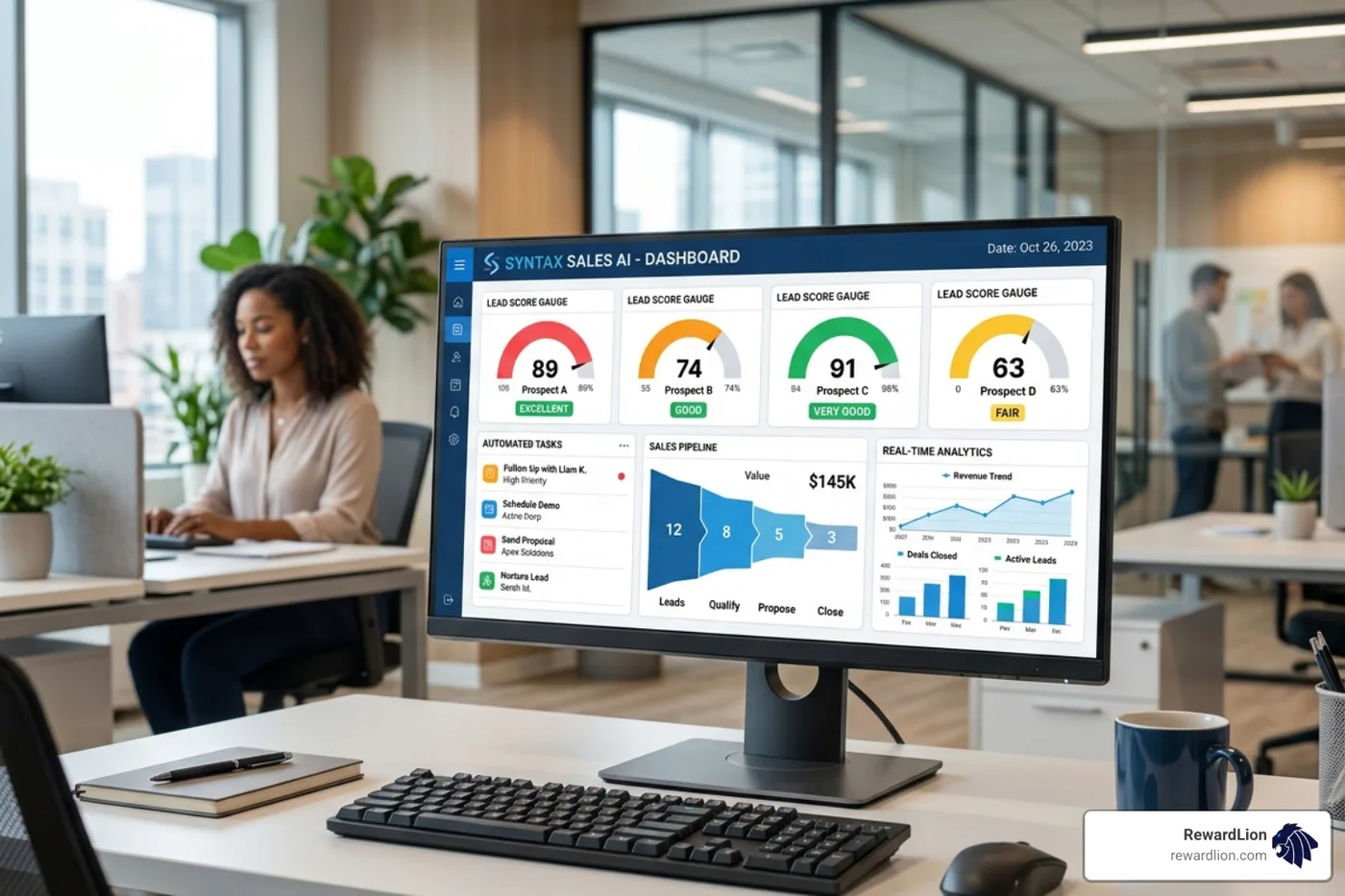
Maximizing ROI with Sales Automation AI Tools
Investing in these tools isn't just about "being tech-forward"; it’s about the bottom line. Research shows that companies automating lead enrichment and follow-up cadences typically see a 20-40% improvement in efficiency. For example, high-performance automation has helped teams increase seller productivity by 60% through AI-driven workflows.
The financial impact can be massive. We've seen cases where consolidating a fragmented tech stack into a single AI-powered platform saved over $600,000 per year in licensing fees alone. Furthermore, advanced AI agents are helping reps prepare for meetings 33% faster, leading to a 10% average increase in win rates. When your team isn't bogged down by manual data entry, they can focus on the millions of opportunities that modern automation platforms help close every single month.
Pros and Cons of Leading AI Sales Assistants
While the benefits are clear, every tool has its trade-offs.
The Pros:
Predictive Analytics: AI can tell you which lead is most likely to close based on historical patterns, not just gut feeling.
Automated Research: Tools can scrape LinkedIn and company websites to find "hooks" for personalized emails in seconds.
24/7 Availability: AI agents don't sleep; they can respond to inbound leads in Miami or internationally at 3 AM.
The Cons:
Deliverability Risks: If you automate too much without "human-in-the-loop" oversight, your email domain reputation can suffer.
The "Uncanny Valley": If an AI sounds too robotic, it can alienate high-value prospects who expect a personal touch.
Setup Complexity: While some tools are fast to deploy, enterprise-grade systems often require weeks of configuration to align with your specific sales stages.
Key Features of Modern Sales Automation AI Tools
To choose the right sales automation ai tools, you need to look past the marketing jargon and focus on the core capabilities that actually move the needle.

Lead Enrichment and Data Accuracy
A sales tool is only as good as the data you feed it. Leading platforms now offer access to massive B2B databases that boast over 210 million verified contacts.
Key features to look for include:
Real-Time Verification: Ensuring an email address is still active before you hit send.
Waterfall Enrichment: Using multiple data providers simultaneously to find the most accurate mobile number or personal email.
Intent Signals: Identifying companies that are currently searching for your solution so you can strike while the iron is hot.
AI-Driven Coaching and Call Analysis
One of the most powerful uses of AI today is "Conversation Intelligence." Advanced tools act as a silent observer in your meetings. They don't just transcribe the call; they analyze sentiment, flag when a competitor is mentioned, and highlight pricing objections.
This leads to real-world results:
Faster Onboarding: New hires can listen to the "best" calls from top performers to learn the ropes.
Better Forecasting: AI can flag "deal risk" if a prospect hasn't mentioned a timeline or budget during a call.
Live Coaching: Some tools provide real-time prompts to reps during a live call, suggesting the best rebuttal for a common objection.
Evaluating Sales Automation AI Tools for Your Team
Selecting a tool requires a balance between power and usability. You don't want to buy a Ferrari if you only need to drive across the street.
Security Standards for Sales Automation AI Tools
When you give an AI access to your CRM and customer emails, security is non-negotiable. Enterprise-grade tools should meet the following standards:
SOC 2 Type II: The gold standard for data security and privacy.
GDPR & CCPA: Essential for any business operating in the US or internationally to ensure data rights are respected.
ISO 27001: An international standard for managing information security.
Pricing and Implementation Timelines
Pricing for sales automation ai tools varies wildly based on your team size and volume.
Pricing Model Typical Cost Best For Starter/SMB $25 - $99 /user/mo Small teams needing basic email sequences. Execution-Based $50+ /month (per task) Teams using AI agents for specific tasks. Enterprise $500+ /user/mo Large orgs needing deep CRM integration and forecasting.
Implementation can range from "plug-and-play" extensions for your inbox to 3-month rollout plans for global organizations. For teams that want a more "done-for-you" approach, exploring a unified platform like the RewardLion Platform can eliminate the headache of managing multiple disconnected subscriptions.
The Role of AI Agents in the Sales Workflow
The newest frontier in sales is the "AI Agent." Unlike basic automation, an agent can make decisions. It doesn't just send a follow-up; it reads the prospect's reply, checks your calendar, and suggests a meeting time—all without you lifting a finger.
Can AI Replace Human Sales Representatives?
The short answer is: No. The long answer is: It replaces the tasks, not the person.
AI is incredible at:
Researching 500 prospects in 5 minutes.
Updating CRM fields accurately (leading systems claim 95% accuracy without manual entry).
Sending 1,000 personalized emails.
However, AI still struggles with:
Complex Negotiation: Navigating the politics of a buying committee.
Deep Relationship Building: Creating the trust required for high-ticket enterprise deals.
Strategic Judgment: Knowing when to "break the rules" to win a deal.
The most successful teams use a hybrid model where AI handles the "grunt work," giving reps 30-40% more time to actually talk to customers.
Future Trends in Sales Automation
As we look toward 2026, several trends are emerging:
Compounding Intelligence: Systems that get smarter with every deal closed, automatically refining their own outreach scripts.
Multimodal Engagement: AI agents that can switch seamlessly between text, voice, and even video demos.
24/7 Discovery: AI "receptionists" that qualify inbound leads via live chat or phone calls instantly, ensuring no lead ever goes cold.
Frequently Asked Questions
What key features should an AI sales automation tool have for effective outbound outreach?
For effective outbound, look for multi-channel support (Email, LinkedIn, and Phone), deliverability tools (like email warming), and AI-driven personalization that goes beyond just "Hi [First_Name]". The tool should be able to scrape recent news or social posts to create a relevant "hook" for each prospect.
How do enterprise AI sales automation solutions differ from those designed for SMBs?
Enterprise solutions focus on governance, security, and complex workflows. They allow managers to set strict rules for how data is handled and provide deep forecasting analytics. SMB tools are usually more focused on ease of use and quick lead generation, often prioritizing a lower price point over deep CRM customization.
Can AI sales automation tools fully replace human sales reps?
No. While they can automate up to 70% of a rep's weekly tasks (like data entry and scheduling), the "human touch" remains the deciding factor in B2B sales. AI serves as a "force multiplier," allowing one rep to do the work of three, rather than replacing the rep entirely.
Conclusion
The era of the "manual" salesperson is coming to an end. By leveraging sales automation ai tools, your team can stop acting like data entry clerks and start acting like strategic advisors. Whether you choose a standalone tool or a comprehensive revenue engine, the goal is the same: move faster, stay organized, and close more deals.
At RewardLion, we take this a step further. We don't just give you a login to a tool; we install a fully connected growth system. Our AI-powered OS unifies your marketing, sales, and automation into one "Local Growth Engine." From SEO and lead generation to custom CRM setups and AI assistants that work 24/7, we provide the expert team to manage it all for you.
Ready to see how a unified AI sales system can transform your revenue? Explore the RewardLion Platform today and let us build your predictable, scalable lead flow.