Why Most B2B Software Companies Struggle to Scale Their Lead Pipeline
Lead generation for B2B software companies is one of the hardest growth challenges a founder or marketing team will face. Unlike B2C, you're not selling to one person who can buy in a click. You're selling to committees, across long cycles, in crowded markets, where buyers do most of their research before they ever talk to you.
Here's a quick breakdown of what actually works:
Strategy Best For Speed to Results SEO & Content Marketing Long-term inbound pipeline 3-6 months Cold Email & LinkedIn Outreach Targeted outbound leads 2-4 weeks Google Ads & LinkedIn Ads Paid demand generation Immediate Free Trials & Freemium (PLG) Product-qualified leads (PQLs) 2-8 weeks Account-Based Marketing (ABM) High-value enterprise accounts 1-3 months Webinars & Case Studies Mid-funnel nurturing 4-8 weeks
The stakes are real. B2B SaaS companies typically spend anywhere from $200 to $1,000+ to acquire a single customer. And with 98% of website visitors leaving without identifying themselves, most companies are bleeding potential revenue without even knowing it.
The good news? There are proven systems that fix this — and they don't require a massive budget or a 20-person team.
I'm Mike Ibrahim, Founder and CEO of RewardLion and Marketing Director for several companies, with over a decade building and scaling sales and marketing systems — including hands-on work with lead generation for B2B software companies across diverse industries. In this guide, I'll walk you through the exact frameworks, tools, and tactics that build a pipeline that actually grows.
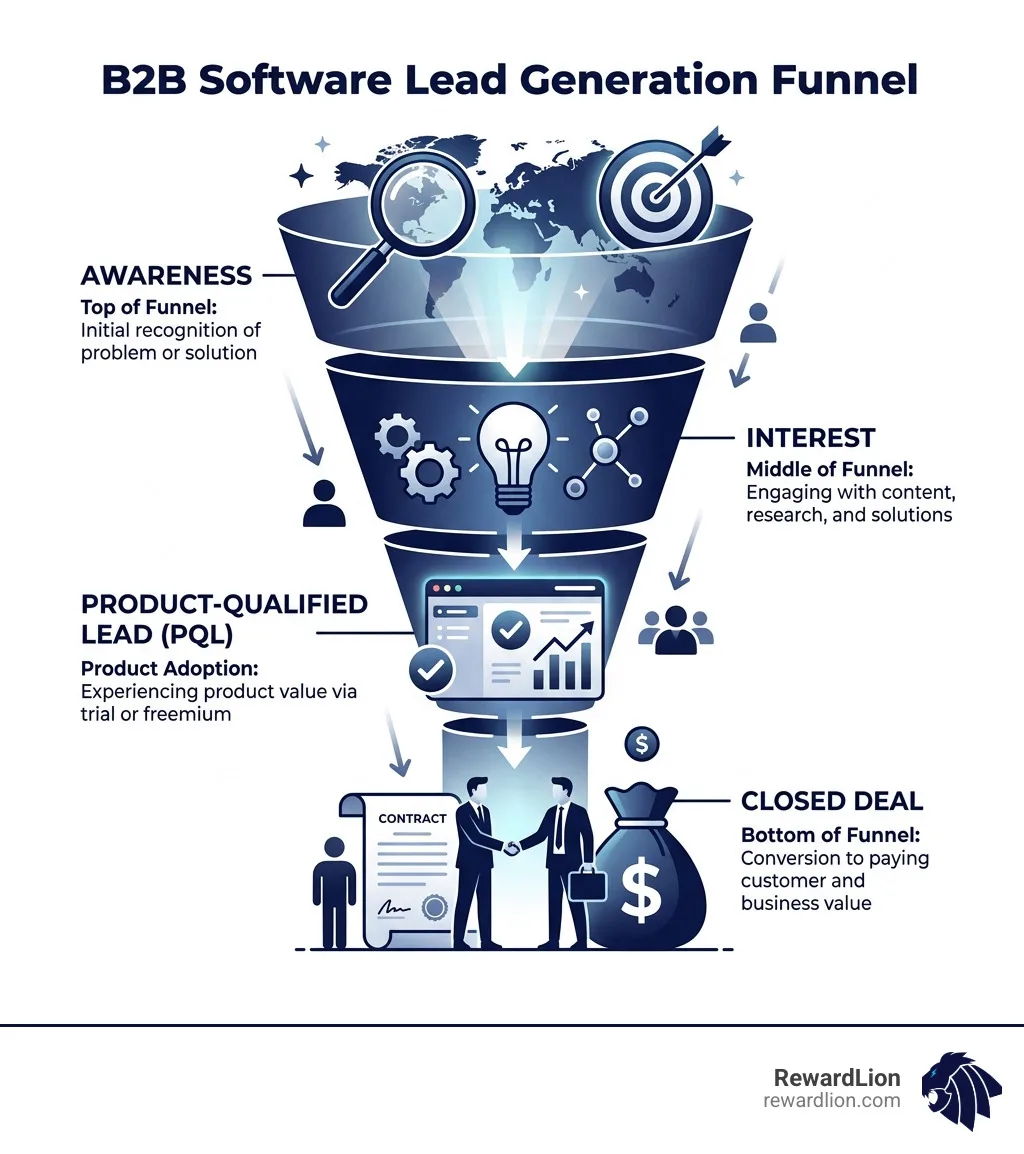
The Unique Landscape of Lead Generation for B2B Software Companies

Generating leads in the software world isn't like selling a pair of shoes. When we talk about lead generation for B2B software companies, we are dealing with a complex ecosystem. If you treat it like a simple transactional sale, your CAC (Customer Acquisition Cost) will skyrocket while your conversion rates plummet.
The Challenge of the Long Sales Cycle
In B2B SaaS, the average sales cycle ranges from 4 to 6 months. Why? Because software usually requires integration, data migration, and a change in workflow. Buyers don't just "buy"; they evaluate, demo, and compare. Research shows that 47% of B2B buyers consume three to five pieces of content before they even engage with a sales representative.
Multi-Stakeholder Decision Making
Gone are the days when one manager made the call. Today, B2B software deals involve an average of 6 to 10 decision-makers. You aren't just selling to the "Head of IT"; you're selling to the end-user who needs ease of use, the CFO who needs ROI, and the security officer who needs compliance.
The Power of the ICP and Buyer Personas
To scale, you must move beyond "anyone with a computer." Understanding your Ideal Customer Profile (ICP) and buyer personas is critical. This involves looking at firmographics—company size, revenue, industry, and tech stack. According to industry data, identifying potential customers accurately can help your company grow by up to 30%.
We recommend narrowing your niche. If your product is "nerdy" or complex, your audience needs to be even more specific. As noted in Lead Generation for Software Companies: Proven Tactics That Work, chasing lead volume over quality is a common self-inflicted mistake that wastes sales resources.
Inbound Mastery: SEO and Content Marketing for SaaS
Inbound marketing is the engine of sustainable growth. Organic search leads close at a staggering 14.6%, compared to just 1.7% for traditional outbound. For B2B software, inbound isn't just about traffic; it's about authority.
Intent-Based Content and Long-Tail Keywords
We focus on "buyer intent" keywords. Instead of targeting "HR software" (which is expensive and broad), target "best HR software for remote tech startups with 50-200 employees." This targets users who are actively looking for a solution to a specific problem.
The Role of Case Studies and Video Marketing
Case studies now rank as the third most effective type of B2B sales content. They provide the social proof necessary to push a lead from "interested" to "ready to demo." Similarly, video marketing on platforms like YouTube (the world's second-largest search engine) allows you to show, not just tell, how your software solves a pain point.
For more information on how we can help you build this authority, check out our marketing services.
Optimizing Inbound Lead Generation for B2B Software Companies
Getting people to your site is only half the battle. You need to convert them.
Landing Pages: Every landing page should have one clear goal. Use minimal forms—the more fields you add, the lower your conversion rate.
Gated Assets: Offer high-value "lead magnets" like original research or proprietary templates. 80% of your content should be free, but 20% can be gated to capture contact info.
A/B Testing: We constantly test headlines, CTAs, and images. A famous A/B test for a campaign once boosted conversions by 18.6% just by changing button text.
Webinar Funnels: Webinars are fantastic for mid-funnel nurturing. They allow you to demonstrate expertise and answer live questions from high-intent prospects.
Outbound and Account-Based Marketing (ABM) Frameworks
Outbound isn't dead; it just evolved. Modern lead generation for B2B software companies uses "warm" outbound triggered by data.
Cold Email and Social Selling
Cold email works when it’s personalized and stays under 125 words. Don't pitch in the first email; offer value. LinkedIn is also a powerhouse, with 70% to 80% of B2B marketers stating it helps them reach their goals. Social selling involves building a brand and engaging with prospects' content before sending a DM.
Intent Data and Trigger Events
The secret to high-response outbound is timing. Trigger events—like a company receiving funding, hiring a new VP, or installing a competitor's software—can boost response rates by 10x to 50x. By using intent data, you reach out to people who are already researching your category.
If you're looking for a tailored approach to these high-value prospects, explore our custom solutions.
Scaling Outbound Lead Generation for B2B Software Companies
To scale outbound without becoming a spammer, you need a system:
Sales Navigator: Use advanced filters to find your exact ICP.
Email Verification: Real-time verification is a must. High bounce rates will kill your domain's sender reputation.
Multi-Touch Sequences: It takes 7 to 13 touchpoints to get a B2B buyer to engage. A mix of email, LinkedIn, and even direct mail ensures you stay top-of-mind.
CRM Synchronization: All outbound activity must sync with your CRM to prevent duplicate outreach and ensure a smooth handoff to sales.
Product-Led Growth and Paid Acquisition Strategies
In the software world, the product itself is often your best lead generator. This is the core of Product-Led Growth (PLG).
Product-Qualified Leads (PQLs)
A PQL is a lead who has experienced the value of your product through a free trial or freemium model. These leads are gold. They close at 3x the rate of traditional marketing-qualified leads (MQLs). If a user in your free trial hits a "success milestone" (like inviting three team members), that’s a signal for your sales team to reach out.
Paid Acquisition: Google and LinkedIn Ads
Paid ads are the "gasoline" you pour on a working funnel.
Google Ads: Best for capturing high-intent searchers (e.g., "CRM for real estate").
LinkedIn Ads: Best for targeting specific job titles and company sizes. While the CPL (Cost Per Lead) is higher—often exceeding $110—the quality is usually superior for B2B.
According to 4 Lead Generation Tactics for B2B Software Companies | Leadpipe, combining visitor identification with paid ads can help you identify the 97% of visitors who leave your site without filling out a form, effectively doubling your lead pool from the same ad spend.
Measuring Success and Essential Tools for 2026
You cannot manage what you do not measure. In 2026, the tech stack for lead generation for B2B software companies must be unified.
Key Metrics to Track
CAC (Customer Acquisition Cost): The total cost to acquire a customer.
LTV (Lifetime Value): How much a customer is worth over their entire relationship with you. Ideally, your LTV should be 3x your CAC.
Pipeline Velocity: This measures how fast leads move through your funnel and how much revenue they represent per day.
Lead Scoring: Assign points based on firmographics (company size) and behavior (downloading a pricing guide).
Comparison of Lead Types
Lead Type Definition Conversion Potential MQL Marketing Qualified: Showed interest (e.g., downloaded an ebook) Low to Medium SQL Sales Qualified: Ready for a direct sales conversation High PQL Product Qualified: Active user of trial/freemium showing high intent Very High
Essential Tools for 2026
To stay competitive, your stack should include:
AI Chatbots: For 24/7 lead qualification and instant response.
Marketing Automation: To run nurture sequences while you sleep.
Visitor Identification: To unmask anonymous traffic.
CRM (like RewardLion OS): To unify all these data points into one source of truth.
For companies looking to simplify this entire process, our software services provide the foundation you need.
Frequently Asked Questions about B2B Software Lead Gen
How long does it take to see results from B2B lead generation?
It depends on the channel. Outbound tactics like cold email can generate meetings in 2 to 4 weeks. Inbound strategies like SEO typically take 3 to 6 months to gain significant momentum. A balanced "hybrid" approach usually sees initial pipeline growth within the first 60 days.
What is a typical CAC benchmark for B2B SaaS companies?
For B2B SaaS, the blended Customer Acquisition Cost typically ranges from $200 to over $1,000. Higher-priced enterprise software (high ACV) will naturally have a higher CAC, sometimes reaching $5,000+, while lower-priced PLG tools aim for a much lower CAC.
Should software companies prioritize lead quality or lead volume?
In B2B, quality always wins. A hundred low-quality leads will just burn out your sales team and clutter your CRM. Ten high-quality leads that match your ICP and show real intent are worth far more to your bottom line.
Common Mistakes to Avoid
Slow Speed-to-Lead: If you wait two days to call a lead, they’ve already moved on to your competitor. Aim for a response time of under 5 minutes.
Applying B2C Tactics: B2B is about logic, ROI, and risk mitigation, not just emotional impulses.
Ignoring Churn: Lead generation is useless if your "bucket" is leaking. Ensure your product and onboarding are solid.
Conclusion: Scale Your Software Company with RewardLion
Building a predictable pipeline for lead generation for B2B software companies shouldn't feel like a guessing game. You shouldn't have to manage five different agencies or ten disconnected tools.
At RewardLion, we provide an AI-powered all-in-one OS platform that unifies your marketing, sales, and analytics. But we don't just give you the software and wish you luck. Our dedicated CAPSS team acts as your fractional in-house marketing department. We implement the SEO, manage the ads, write the authority articles, and build the automation for you.
Whether you are based in Fort Lauderdale, Miami, Boca Raton, or anywhere across the United States, we help you dominate your market with a "done-for-you" growth system.
Ready to stop hunting for leads and start scaling? Learn more about the RewardLion platform and how we can install a fully connected growth system into your business today.