Why Most Businesses Waste Their Advertising Budget (And How to Stop)
Effective advertising strategies are structured plans that connect your message to the right audience, on the right channel, at the right time — without burning through your budget.
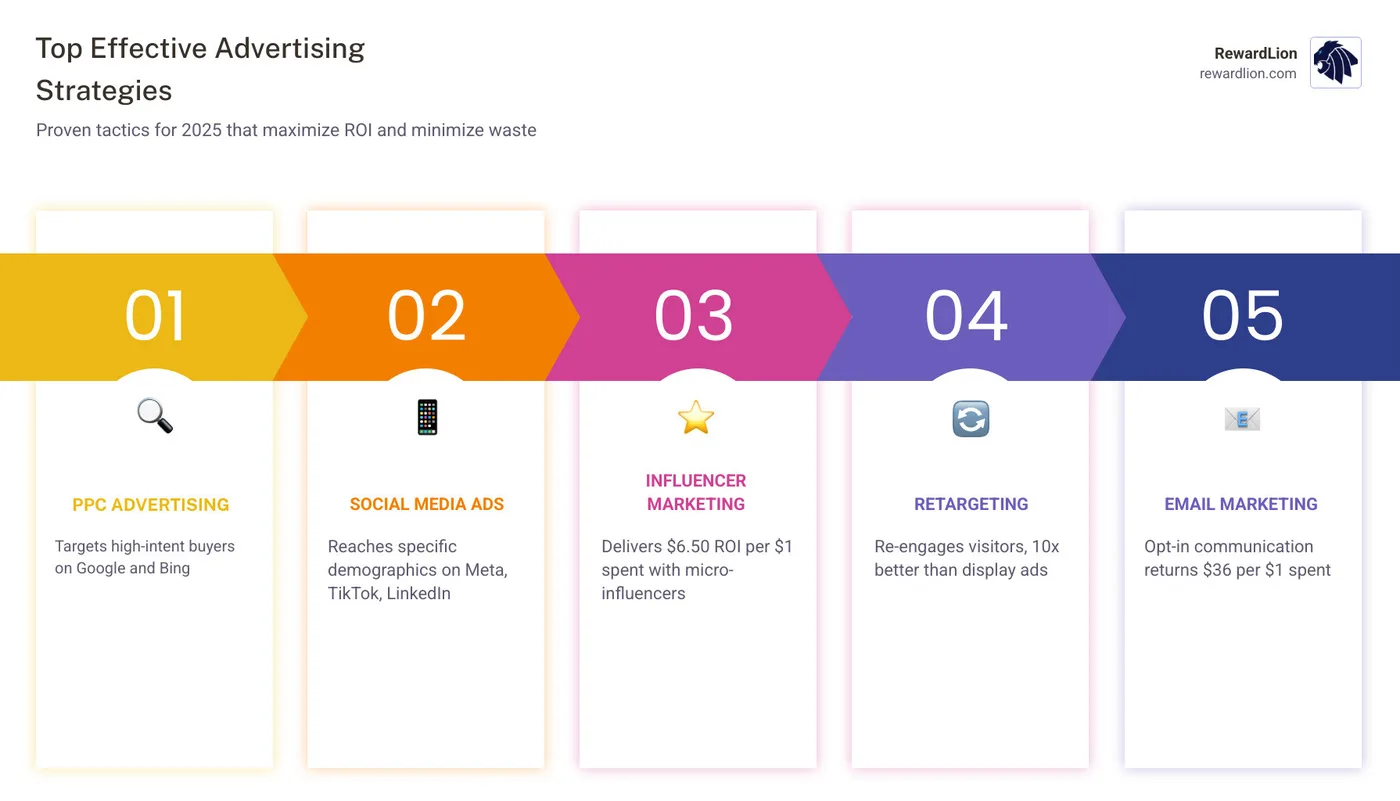
Here are the most effective advertising strategies to know in 2025:
Pay-per-click (PPC) advertising — targets high-intent buyers on Google and Bing; top 3 paid spots get 46% of all clicks
Social media advertising — reaches specific demographics on Meta, TikTok, and LinkedIn; over 80% of American adults have a social profile
Influencer marketing — delivers an average ROI of $6.50 for every $1 spent, especially with micro-influencers
Retargeting/remarketing — re-engages past visitors and performs up to 10x better than standard display ads
Email marketing — direct, opt-in communication that returns $36 for every $1 spent on average
Content marketing and SEO — blogging alone drives 55% more website visitors over time
Video advertising — used by 86% of marketers, with 78% reporting a direct increase in sales
Programmatic advertising — uses AI to automate media buying for precise, real-time audience targeting
Omnichannel marketing — connects your brand across every touchpoint for a seamless customer experience
Traditional advertising (TV, radio, print, direct mail) — still effective for broad reach and emotional brand-building
Every day, the average person is exposed to over 4,000 ads. Most get ignored. The businesses that win aren't necessarily spending more — they're spending smarter.
The problem for most small and medium businesses isn't a lack of effort. It's fragmented tools, disconnected channels, and campaigns that run without a clear strategy behind them. Money goes out, results stay murky.
I'm Mike Ibrahim, Founder and CEO of RewardLion and Marketing Director for several companies, with over a decade of hands-on experience designing and scaling effective advertising strategies across industries. In this guide, I'll walk you through exactly what works — from foundational tactics to the AI-powered approaches reshaping advertising in 2025.
The Core Components of Effective Advertising Strategies

To build a campaign that actually moves the needle, we have to look past the "flashy" creative and focus on the structural integrity of the plan. An advertising strategy is a long-term blueprint that outlines how your brand will reach its target audience, encompassing everything from product positioning to final conversion.
Understanding Advertising Tactics
While a strategy is your "big picture" goal (e.g., "becoming the #1 eco-friendly soap in Miami"), advertising tactics are the specific, strategic actions we take to get there. These are the "how-to" steps, such as using retargeting emails for abandoned carts or partnering with local influencers for a product launch. These tactics are vital because they differentiate you from competitors. When everyone is shouting for attention, a unique and memorable approach -- like using emotional appeals or specific facts and statistics -- is what makes a consumer stop scrolling.
Market Research and Consumer Behavior
You cannot sell to someone you don't understand. Effective strategies begin with deep market research. We need to identify:
Demographics: Who are they? (Age, location, income)
Psychographics: What do they care about? (Values, pain points, hobbies)
Behavioral Data: Where do they hang out online? Do they start their product searches on Amazon (where over 50% of searches now begin) or Google?
Setting SMART Goals
We never launch a campaign without SMART goals: Specific, Measurable, Achievable, Relevant, and Time-bound. Instead of saying "we want more sales," we say "we want to increase online conversions by 20% in the next three months." This allows us to track key performance indicators (KPIs) and ensure a positive return on investment.
Balancing Traditional and Digital Advertising Channels
In the rush to go digital, many businesses abandon traditional media too quickly. The most effective advertising strategies in 2025 often use a "hybrid" approach.
Print Ads: While digital is king, print remains highly effective for local businesses in Florida -- from Las Olas to Boca Raton -- targeting specific demographics who still value physical media.
TV and Radio: Broadcasting offers mass reach and the ability to build deep emotional connections through storytelling. A catchy jingle or a heartwarming commercial can stick in a consumer's mind for years.
Direct Mail: In an era of overflowing inboxes, a well-designed physical mailer can have a higher "open rate" than an email, especially when it includes a personalized offer.
The key to traditional media is using it for brand awareness and emotional brand-building, then bridging the gap to digital using QR codes or specific vanity URLs.
Digital Channels for Effective Advertising Strategies
Digital advertising has revolutionized how we target customers by providing real-time analytics and precision.
Social Media Ads: With more than 80% of American adults having a social profile, platforms like Meta and TikTok allow us to target by very specific interests. 60% of marketers agree that social media ads are the most effective digital form.
Pay-Per-Click (PPC): This is often the most effective strategy for immediate ROI because it captures "high-intent" traffic. When someone searches for "best marketing agency in Fort Lauderdale," they are ready to buy. Remember: the top three paid spots in Google results receive 46% of all clicks.
Email Newsletters: Email is far from dead. It offers direct, personal communication with an audience that has already opted in. Segmenting your lists based on behavior ensures your message stays relevant.
Influencer Marketing: This has become a powerhouse tactic, offering an average ROI of $6.50 for every $1 invested. Consumers trust recommendations from real people -- 84% of people trust peer recommendations more than brand advertising.
Video Advertising: 93% of marketers report that video generates a positive ROI. Whether it's a 15-second YouTube pre-roll or a long-form brand story, video pairs narrative clarity with high engagement.
For those looking to scale these efforts without the headache of managing ten different platforms, our marketing services provide a unified approach to digital execution.
Modern Tactics: AI, Automation, and Immersive Media
As we move through 2025, the "cutting edge" has become the "standard." If you aren't using AI and automation, you are likely overpaying for your leads.
Programmatic Advertising and AI
Programmatic advertising uses AI-driven digital media buying to purchase ad space in real-time auctions. This ensures your ad is shown to the right person at the lowest possible price. We use AI to analyze predictive behavior, allowing for hyper-personalization that manual management simply can't match.
Retargeting: The Secret to Conversion
Did you know that remarketing campaigns perform 10 times better than traditional display ads? Retargeting allows us to follow a user who visited your site but didn't buy, showing them specific ads for the products they viewed. This can increase conversion rates by more than 160%.
Emerging Tech: AR, Geofencing, and CTV
Augmented Reality (AR): Retailers are using AR for virtual "try-ons," which significantly reduces return rates and increases buyer confidence.
Geofencing: This creates a virtual perimeter around a specific location (like a competitor's store or a local event in Miami). When a user enters that area, they receive a targeted ad on their mobile device.
Connected TV (CTV): This brings the precision of digital targeting to the big screen in the living room, allowing us to serve ads on streaming services like Hulu or Roku.
Building a Comprehensive Marketing Plan and Measuring Success
A strategy without a plan is just a wish. A comprehensive marketing plan should include your target market, competitive advantage, sales goals, and a detailed budget breakdown.
Measuring What Matters: KPIs and ROI
To stop wasting budget, you must track your data. Key Performance Indicators (KPIs) tell the story of your campaign's health:
ROAS (Return on Ad Spend): How much revenue did you make for every dollar spent on ads?
CAC (Customer Acquisition Cost): How much does it cost to get one new customer?
Conversion Rate: What percentage of people who saw the ad actually took action?
Metric Traditional Advertising Digital Advertising Targeting Broad / Demographic Precise / Behavioral Tracking Estimated Reach Real-time Analytics Cost High Upfront Flexible / Scalable ROI Long-term Brand Equity Immediate & Measurable
We recommend updating your marketing plan at least annually and using A/B testing—testing two versions of an ad to see which performs better—to continuously optimize your spend.
Low-Cost yet Effective Advertising Strategies for Startups
You don't need a million-dollar budget to see results. Startups and small businesses can leverage:
Micro-Influencers: These creators have smaller but highly engaged audiences (5k–50k followers) and often convert better than "celebrity" influencers for a fraction of the cost.
Content Amplification: Blogging leads to 55% more website visitors. Repurposing one great blog post into social snippets, emails, and videos maximizes your effort.
Local SEO: Dominating local search results is free if you optimize your Google Business Profile and gather consistent reviews.
User-Generated Content (UGC): Encourage your customers to share photos or videos of your product. It’s free content that builds immense social proof.
Frequently Asked Questions about Advertising
What is the most effective advertising strategy for 2025?
While it varies by industry, a combination of PPC for high-intent capture and Social Media for brand awareness is generally the most effective. However, the true "winner" is an omnichannel strategy that uses AI to unify these touchpoints so the customer sees a consistent message everywhere.
How do I measure the ROI of my advertising efforts?
The simplest way is to compare your total marketing costs against the revenue generated from those specific campaigns. Use tracking pixels (like the Meta Pixel or Google Tag Manager) to see exactly which ad led to which sale. Our pricing models are built around transparency, so you always know where your investment is going.
Why is omnichannel advertising important for small businesses?
Customers rarely buy the first time they see an ad. They might see a programmatic billboard in Fort Lauderdale, find you on Google later, and then finally click a retargeting ad on Instagram. Omnichannel ensures you are present at every stage of that journey, making your business appear larger and more established than it may be.
Conclusion: The RewardLion Advantage
The biggest mistake businesses make is hiring five different agencies or trying to manage twenty disconnected tools. This leads to "data silos," where your email marketing doesn't talk to your Facebook ads, and your CRM is a mess.
At RewardLion, we do things differently. We provide an AI-powered all-in-one OS that unifies your marketing, sales, automation, and analytics. You don't just get software; you get a dedicated CAPSS team (your fractional in-house marketing agency) to manage it for you.
From our origins in Fort Lauderdale, Florida, we’ve built a system that handles:
Local Growth: SEO, reputation management, and high-converting websites.
Lead Generation: Managed paid ads across Meta, Google, and TikTok.
Authority Building: Getting your brand featured on major networks like NBC, CBS, and FOX.
Automation: AI assistants that close deals on autopilot 24/7.
Stop managing tools and start managing growth. Our hybrid approach of expert human management plus AI power ensures your effective advertising strategies are executed perfectly, every time.
Ready to see how one connected system can transform your business? Explore our RewardLion solutions and let’s start building your predictable growth engine today.