Understanding Product Video Ads: Formats and Strategic Value
To create product video ads that convert, start with a clean, high-resolution packshot, choose a platform-specific aspect ratio such as 9:16 for TikTok or Reels, and use an AI image-to-video tool to generate motion from that still photo. Then add a benefit-driven script, voiceover, and bold captions, and finish with a direct call to action. This concise, high-impact format is designed specifically for digital conversion. Ranging from 5 to 120 seconds, it showcases an item in motion, communicates a compelling value proposition, and ends with a direct call to action. While broad commercial video advertising builds top-of-funnel brand equity across varied media channels, and a traditional tv product commercial relies on long-form storytelling suited for linear television, digital product video ads focus entirely on stopping the scroll and securing clicks.
Similarly, product ads differ fundamentally from unboxing videos. An unboxing focuses on the authentic customer discovery experience—packaging, tactile impressions, and pacing. Product video ads, by contrast, are punchy direct-response engines engineered to drive sales on platforms like TikTok, Instagram Reels, and YouTube Shorts.
Format | Average Duration | Primary Goal | Production Approach | Key Placement |
|---|---|---|---|---|
Product Video Ad | 5–60 seconds | Direct conversion & sales | Single-photo AI or lean studio capture | Paid Social, Reels, TikTok, Feeds |
TV Commercial | 30–60 seconds | Brand awareness & reach | Full narrative production crew | Linear TV, Connected TV, Streaming |
Unboxing Video | 2–10 minutes | Organic trust & social proof | Creator/UGC handheld filming | YouTube, TikTok, Product Pages |
Why Modern Brands Create Product Video Ads at Scale
Creative fatigue is one of the biggest hurdles facing direct-to-consumer and e-commerce brands today. Digital ad platforms burn through creative rapidly; an ad set delivering stellar returns in week one can see performance dip sharply by week three.
To maintain healthy return on ad spend (ROAS), modern businesses must produce dynamic product promotion videos at velocity. Traditional production models—requiring weeks of coordination, set design, physical camera crews, and editing—simply cannot keep up with the appetite of modern ad algorithms. By leveraging modern frameworks, brands can iterate rapidly, testing fresh hooks and angles to keep campaigns profitable. For broader context on how these assets fit into paid media, see Video advertising on Wikipedia.
Step-by-Step Guide to Create Product Video Ads with AI
Modern AI models have changed the economics of creative generation. Today, you do not need a dedicated soundstage to generate studio-grade footage. E-commerce teams and growth marketers can transform raw digital assets into polished commercial assets in minutes rather than weeks.
Here is the exact step-by-step workflow we use to generate high-performing video ads:
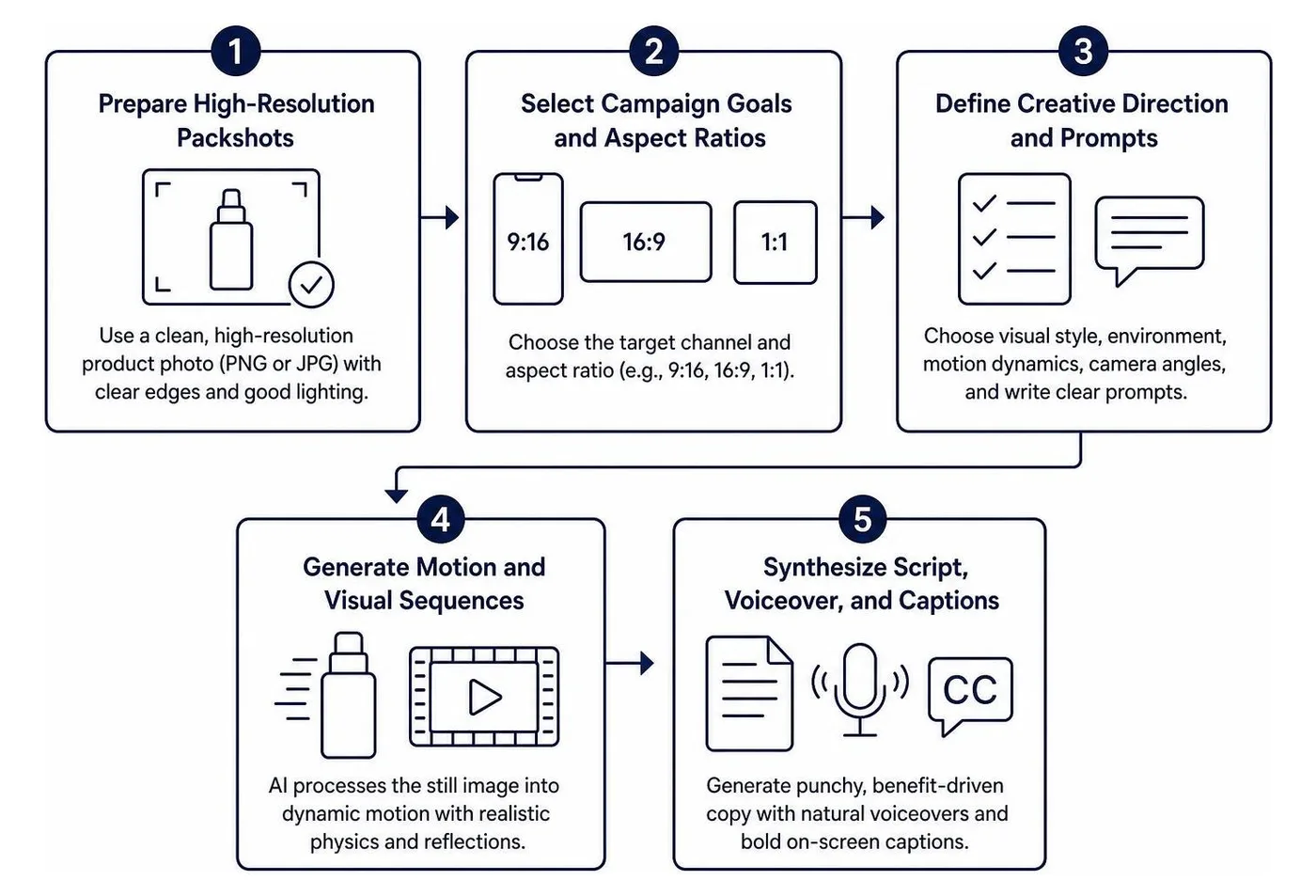
Prepare High-Resolution Packshots: Start with a clean, high-resolution product photo (PNG or JPG). Images with clear edges, good lighting, or clean backgrounds provide the AI with the structural detail needed for realistic generation. Remove distracting artifacts or uneven shadows beforehand so the rendering model can cleanly isolate product geometry.
Select Campaign Goals and Aspect Ratios: Determine the target channel (e.g., 9:16 for TikTok/Reels, 16:9 for YouTube, 1:1 for Meta feeds). Aligning your canvas size early prevents awkward cropping and ensures text safe zones are respected.
Define Creative Direction and Prompts: Choose your visual style, environment, motion dynamics, and camera angles. Focus on natural movement that highlights the core selling points of your physical merchandise.
Generate Motion and Visual Sequences: Let generative engines process the still image into dynamic motion, simulating realistic physics, liquid dynamics, particle effects, and accurate reflections.
Synthesize Script, Voiceover, and Captions: Generate punchy, benefit-driven copy paired with natural voiceovers and bold on-screen captions. Synchronize pacing so key selling points land precisely as dynamic camera angles reveal key product attributes.
Review and Polish: For brands requiring bespoke refinement, pairing automated workflows with professional video production ensures polished final cuts that match brand guidelines.
Best Prompt Formulas to Create Product Video Ads
Achieving cinematic results from AI video tools comes down to prompt structure. Vague prompts yield generic results. A well-engineered prompt balances five core elements:
Subject: The exact product and material details (e.g., matte black stainless steel insulated bottle with brushed metallic cap).
Action & Physics: What the product or environment is doing (e.g., condensation slowly beading down the exterior surface as ice cubes gently swirl inside).
Camera Movement: Cinematic direction (e.g., slow 360-degree orbital sweep, smooth dolly in with gentle upward tilt).
Setting & Lighting: Atmosphere and environment (e.g., sunlit modern oak kitchen counter, warm golden-hour rim lighting, soft bokeh background).
Visual Style: Production grade (e.g., 8k resolution, photorealistic commercial grade, shallow depth of field, color graded for luxury lifestyle commercial).
Winning Formula:
[Subject Details] + [Action/Dynamic Element] + [Camera Path] + [Environment/Lighting] + [Style/Aesthetic Grade]
Multi-Platform Formats, Ratios, and Commercial Licensing
Publishing across digital channels requires format flexibility. Leading AI video engines generate native aspect ratios up to 4K resolution, eliminating awkward cropping and resolution loss:
9:16 Vertical: The mandatory format for TikTok, Instagram Reels, YouTube Shorts, and Stories. Vertical creative captures full-screen mobile real estate and demands , thumb-stopping hooks.
1:1 Square: Ideal for Instagram and Facebook in-feed placements, balancing visual weight with caption text and comment previews.
16:9 Widescreen: Essential for standard YouTube pre-roll ads, connected TV placements, desktop landing pages, and website hero headers.
Regarding commercial use: assets created through enterprise-tier AI video pipelines are cleared for commercial marketing, giving brands full ownership over ad distribution and intellectual property across every digital touchpoint. For a deeper look at the underlying technology, see Generative artificial intelligence on Wikipedia.
Production Techniques: Lighting, Motion, and Brand Consistency
The difference between amateur AI clips and conversion-ready video ads lies in physics, lighting fidelity, and brand consistency. Advanced generative platforms use hyperframe technologies to maintain product integrity—preventing logos from warping, text from blurring, or dimensions from shifting across camera angles.
To achieve studio-quality realism without a physical camera crew, master these three creative pillars:
Three-Point Digital Lighting: Balance key lights that illuminate your product's primary silhouette, subtle fill lights that soften harsh shadows, and directional rim lighting that separates the item from its backdrop.
Physical Material Simulation: Ensure reflective surfaces such as polished chrome, brushed aluminum, transparent glass, or textured leather react accurately to simulated environmental light sources.
Controlled Camera Trajectories: Avoid erratic, artificial camera pans. Use grounded cinematic movements such as slow tracking shots, macro push-ins, or gentle crane elevations that mimic high-end motorized gimbal systems.
To elevate visual appeal further, combining generative output with custom product advertisement motion graphics creates a seamless bridge between dynamic footage and brand identity. Layering branded typography, animated kinetic badges, promotional pricing stickers, and polished animation motion graphics ensures that every variant aligns strictly with your brand standards. For additional guidance on lighting and motion principles, see Cinematic techniques on Wikipedia.
High-Velocity A/B Testing and Cross-Channel Scaling
The true power of AI-assisted production is iteration speed. Traditional workflows often restrict marketing teams to one or two creative bets per quarter due to budget constraints and extended turnaround times. With modern tools, you can generate 10 distinct creative hooks from a single product photo in an afternoon, testing diverse angles across demographics simultaneously.
When scaling campaigns, systematically A/B test these core variables:
The First 2 Seconds (The Hook): Test an unboxing reveal versus an immediate problem statement, an unexpected dynamic explosion effect, or an extreme product macro shot. Your hook determines your thumbstop rate and cost per impression.
The Core Value Driver: Test a convenience-led message against a durability, aesthetic, or price-led message to discover what resonates with high-intent buyers.
The Visual Setting: Compare lifestyle aesthetic backdrops (such as a sunlit living room or bustling city street) with minimalist, high-contrast studio looks designed for luxury positioning.
Call to Action (CTA): Test direct conversion offers ("Claim 20% Off Today") against urgency-based prompts ("Shop Before Sold Out") and curiosity-driven prompts ("Discover Why 10,000+ Switched").
Monitor performance indicators such as 3-second video view rates, hold rates past the 50% mark, and outbound click-through rates. When an ad creative demonstrates breakout efficiency, quickly generate secondary iterations using slight prompt variations to fight creative burnout before ROAS decays.
For brands scaling enterprise campaigns, combining rapid AI generation with dedicated studio production and full-scale commercial production creates a balanced creative pipeline that dominates both paid feeds and broadcast channels. For more on testing methodology, see A/B testing on Wikipedia.
Frequently Asked Questions About Video Ad Creation
What is the difference between a product ad, TV commercial, and unboxing video?
A product video ad is a short, direct-response asset designed to convert viewers quickly on digital platforms. TV commercials focus on broad brand awareness through long-form narrative pacing, while unboxing videos provide organic social proof by showing real-time packaging discovery.
Can AI-generated product video ads be used commercially?
Yes. Videos generated through reputable commercial AI platforms grant commercial usage rights, allowing brands to deploy them across paid ad channels, landing pages, and social feeds without copyright conflicts.
Do you need a studio shoot or physical filming to make product ads?
No. Using modern image-to-video AI pipelines, a single high-resolution product photograph can be transformed into fully animated, cinematic video ads complete with dynamic lighting, motion, voiceover, and sound design. For more on the underlying technology, see Artificial intelligence on Wikipedia.
Scale Your Video Creative with RewardLion
Producing high-converting video creative consistently does not require juggling multiple disjointed agencies or wrestling with disconnected design tools.
At RewardLion, we install an all-in-one AI-powered growth operating system backed by a dedicated, expert CAPSS team. We manage your creative production, paid media campaigns, omnichannel distribution, and lead capture systems under one unified framework—driving hands-off, scalable growth for your business.
Ready to elevate your marketing creative? Explore our breakdown of a proven product advertisement video example and discover how unified AI growth systems can transform your conversion rates today.