Why a Branding Package Matters for Small Businesses
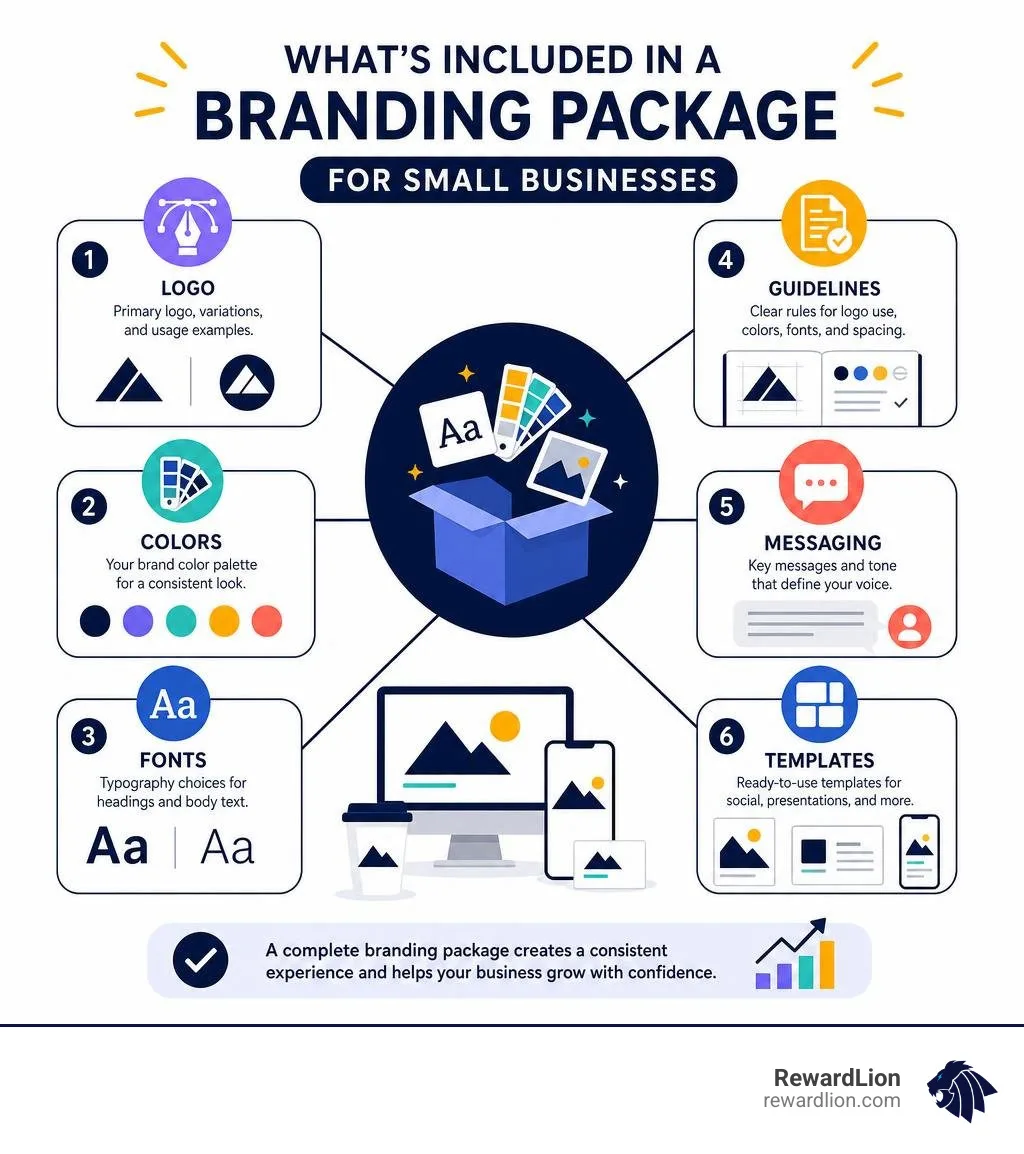
A branding package for small businesses is a coordinated set of brand assets and rules that helps customers recognize and trust your company wherever they find it. At minimum, it should include a logo system, color palette, typography, and clear usage guidelines. Stronger packages also add messaging, social media templates, stationery, packaging, or website-ready visuals.
The goal is not simply to make your business look polished. It is to make every customer touchpoint feel like it comes from the same company. Research shows that brand image elements, including names, logos, colors, and packaging, can shape perceived quality, value, and purchase intent. Color also supports brand memory and recall.
A good package prevents the common small-business problem of disconnected materials: one look on social media, another on the website, and a third on printed flyers. It gives your team, vendors, and marketing tools a shared system to follow as you grow.
I’m Mike Ibrahim, founder and CEO of RewardLion and a marketing leader with more than a decade of experience helping businesses improve customer relationships, sales, and growth systems. In the sections ahead, I’ll break down how to evaluate a branding package for small businesses, avoid surprise costs, and invest at the level that fits your goals.
What Is Included in a Core Branding Package for Small Businesses?
When building a recognizable brand, many founders fall into the trap of purchasing a standalone logo file and calling it a day. A logo without a supporting system, however, cannot carry the full weight of your visual communication. A complete branding package establishes an operational blueprint that aligns your visual identity, voice, and market positioning across every consumer touchpoint.
When your touchpoints align, consumer recall increases. Recent marketing benchmarks reveal that brand consistency across physical and digital channels can elevate overall revenue growth by up to 23%. By deploying structured agency frameworks, your business avoids the disjointed customer journeys that undermine trust.
Core Visual Identity Assets
The foundation of any design system begins with flexible, responsive graphics designed for cross-channel use. Whether displayed on a massive storefront banner or squeezed into a tiny smartphone browser favicon, your visual marks must remain legible and balanced.

Primary Logo: The hero mark of your company, featuring your full business name and signature icon.
Secondary Marks and Submarks: Horizontal, vertical, or simplified alternative layouts suited for tight email headers, responsive mobile navigation bars, or profile pictures.
Brand Icons and Favicons: Compact visual insignias stripped down to their simplest form to maintain clarity at 16x16 pixels.
Color Palette Systems: A deliberate set of primary, secondary, and accent colors defined with exact digital (HEX, RGB) and print (CMYK, Pantone) values. Color is scientifically proven to enhance brand memory and boost retention among prospective buyers.
Typographic Hierarchy: Carefully paired primary headline fonts, secondary subhead fonts, and accessible body copy typefaces that balance personality with digital readability.
Developing these assets together through dedicated branding and visual identity services ensures you do not waste time attempting to resize mismatched graphic files down the road.
Brand Guidelines and Messaging Architecture
A polished design system falls apart without strict governance. Your brand style guide acts as the instruction manual for internal teams, outsourced agencies, and software platforms.
A solid brand guide includes:
Voice and Tone Guidelines: Rules that dictate how your brand speaks—whether authoritative, playful, clinical, or empathetic—across social content, email sequences, and customer service chats.
Positioning Narrative and Mission: Clear articulation of your core values, target audience profiles, and market differentiators.
Spacing and Clearspace Rules: Minimum margins required around your logo to prevent clutter from overlapping graphics.
Usage Prohibitions: Concrete examples of what not to do, such as stretching the mark, altering colors, or applying outdated drop shadows.
For a full breakdown of identity deliverables, review our comprehensive list of branding deliverables to ensure your package leaves no operational gaps.
Brand Kit vs. Branding Package: Key Distinctions
It is common to hear the terms brand kit and branding package used interchangeably, but they serve different purposes.
A brand kit is typically a lightweight collection of static assets—your finished logo variations, a color swatch sheet, and font files. In contrast, a branding package represents the complete strategic and tactical service engagement. It encompasses market research, audience positioning, collaborative concept discovery, full brand guidelines, and actionable collateral templates ready for deployment.
Feature | Lightweight Brand Kit | Full Branding Package |
|---|---|---|
Primary Focus | Immediate visual assets | Long-term market positioning and systems |
Strategy & Research | Minimal to none | Deep audience and competitor discovery |
Collateral Creation | Not included | Custom stationery, social kits, presentations |
Typical Turnaround | 1 to 7 days | 3 to 8 weeks |
Ideal For | Bootstrapped solo operators | Growth-oriented small businesses |
Real Costs and Pricing Tiers of Small Business Branding Packages
Small business owners frequently encounter wildly divergent quotes for branding services. A freelance marketplace might offer a visual kit for under $500, while a traditional creative agency might quote $50,000 for an enterprise overhaul.
Understanding what drives these price variations helps you allocate your budget effectively without overpaying for unnecessary deliverables or underinvesting in foundational strategy.
Basic vs. Comprehensive Branding Package for Small Businesses
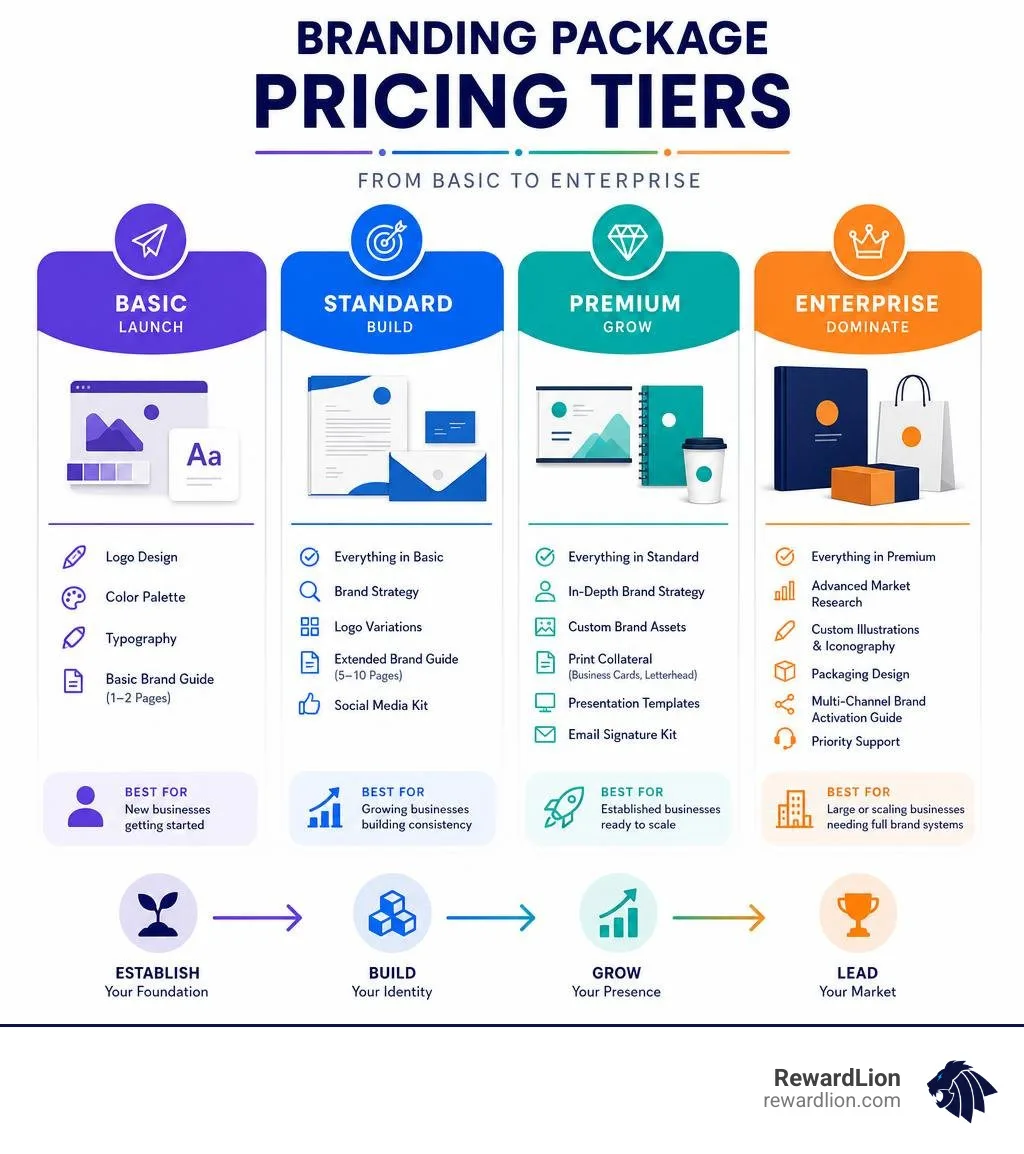
To choose the right investment level, examine how deliverables scale across different service tiers.
Package Tier | Typical Price Range | Core Inclusions | Ideal Business Stage |
|---|---|---|---|
Starter / Basic | $295 – $1,500 | Primary logo, basic color codes, standard font pairings, simple 1–3 page style sheet | Early-stage testing, side ventures, micro-local services |
Growth / Mid-Tier | $2,000 – $8,000 | Full logo system (primary, secondary, submarks), 10–20 page brand guide, social templates, stationery suite, core messaging | Scaling small businesses, local retail leaders, funded seed startups |
Comprehensive / Enterprise | $10,000 – $50,000+ | Deep market research, extensive voice architecture, custom packaging, pitch decks, multi-channel rollout | Multi-location brands, high-growth e-commerce, competitive mid-market firms |
Mid-range packages often hit the sweet spot for growing companies, providing the strategy required to stand out without enterprise-level overhead.
Agency vs. Freelancer Rate Breakdown
When shopping for branding solutions, your primary choice is between independent freelance designers and full-service growth agencies.
Freelance Designers: Freelancers typically bill between $15 and $300 per hour, depending on their technical mastery, geographic location, and reputation. A project-based freelance brand package usually ranges from $1,000 to $5,000. While cost-effective, freelancers often focus purely on visual execution rather than downstream marketing automation, sales funnel integration, or full-scale lead generation.
Full-Service Agencies & Integrated Platforms: Traditional design agencies bill project rates starting around $5,000 and easily exceeding $50,000. Alternatively, modern hybrid models combine expert creative execution with automated marketing infrastructure, giving you an entire creative and technical department without the overhead of disparate vendors.
To see how end-to-end creative and marketing execution aligns with predictable budgets, check out our transparent pricing breakdowns.
Hidden Expenses and Scope Creep to Watch For
The upfront quote for a branding package does not always represent your final invoice. Unplanned expenses can strain your budget if you do not clarify terms before signing an agreement.
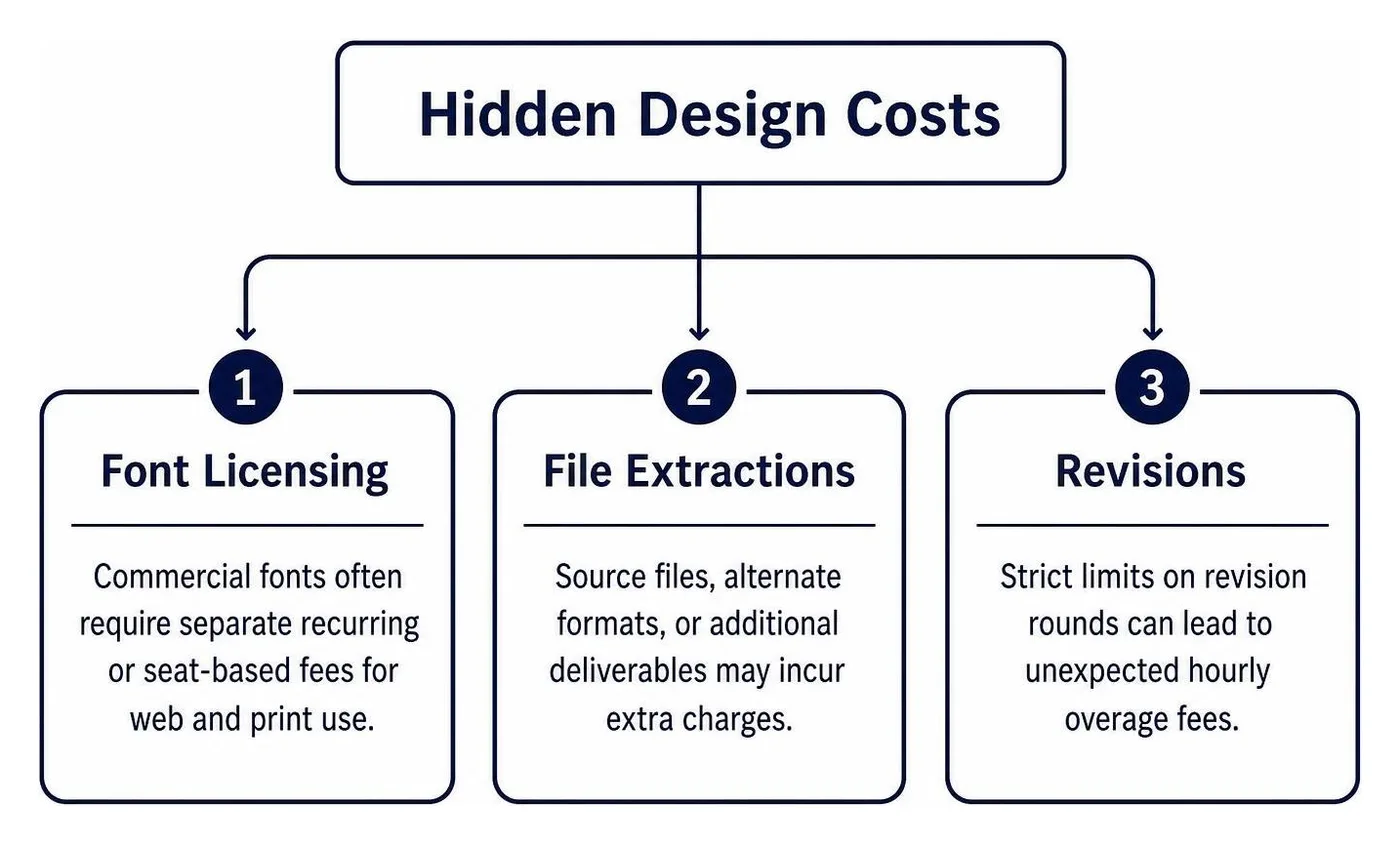
Watch out for these common hidden costs:
Commercial Font Licensing: Many boutique typography designers charge separate recurring or seat-based fees for web and print font licenses, which can add hundreds of dollars per year.
Stock Media and Photography Fees: Custom illustrations or mockups may require commercial licenses that are billed on top of creative fees.
Strict Revision Limits: Agreements that offer only one or two feedback rounds can lead to unexpected hourly overage fees when minor adjustments are requested.
Source Vector Extraction: Ensure your contract explicitly guarantees full ownership and delivery of editable, print-ready vector formats (AI, EPS, SVG, PDF) alongside web-optimized PNGs and JPGs.
How to Choose the Right Branding Package for Small Businesses
Selecting the right branding partner requires evaluating your operational workflow, your industry's competitive landscape, and your near-term growth goals.
Step-by-Step Process to Select a Branding Package for Small Businesses
Navigating a branding engagement should follow a structured, collaborative roadmap to produce assets that drive measurable business outcomes.
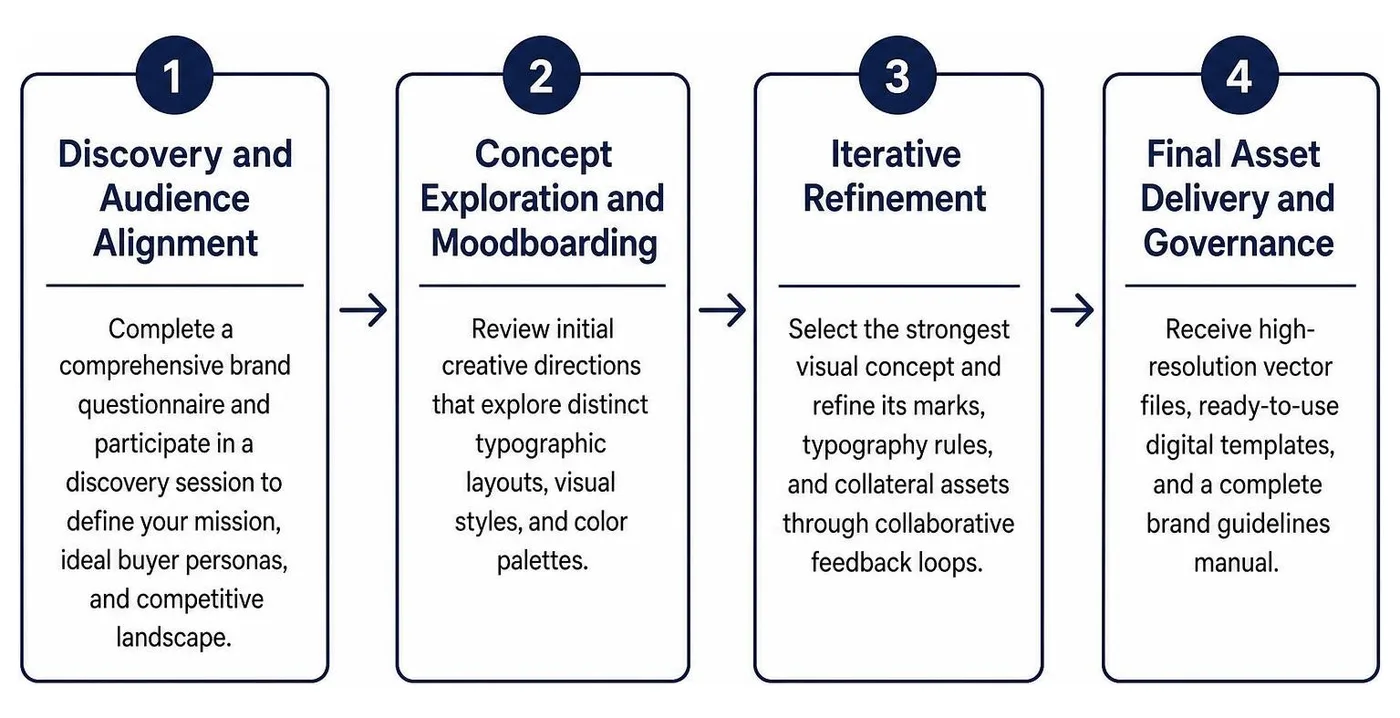
Discovery and Audience Alignment: Complete a comprehensive brand questionnaire and participate in a discovery session to define your mission, ideal buyer personas, and competitive landscape.
Concept Exploration and Moodboarding: Review initial creative directions that explore distinct typographic layouts, visual styles, and color palettes.
Iterative Refinement: Select the strongest visual concept and refine its marks, typography rules, and collateral assets through collaborative feedback loops.
Final Asset Delivery and Governance: Receive high-resolution vector files, ready-to-use digital templates, and a complete brand guidelines manual.
For founders launching new ventures, following a structured startup branding roadmap for 2026 ensures your visual identity directly supports downstream customer acquisition.
Budget-Friendly Strategies for Bootstrapped Startups
If upfront capital is limited, you do not need to settle for generic, amateurish designs that damage credibility. Consider these budget-conscious approaches:
Phased Visual Rollouts: Focus your initial budget on core essentials—a versatile primary logo, an adaptable submark, defined brand colors, and clear typography. Add custom packaging, vehicle wraps, and presentation decks as your cash flow grows.
Customizable Template Ecosystems: Use professional Canva or Figma brand templates configured with your approved fonts and colors, allowing internal staff to produce professional marketing collateral without ongoing graphic design bills.
Hybrid Done-for-You Systems: Rather than hiring multiple disconnected agencies for design, web development, and digital ads, partner with an integrated service platform.
Leveraging an all-in-one done-for-you marketing ecosystem eliminates fragmented retainer fees by uniting branding, sales funnels, and automated operations within a single connected system.
Measuring the ROI and Brand Equity of Your Investment
A visual identity package is not merely an aesthetic expense; it is a long-term capital investment designed to build recognizable brand equity and improve conversion rates across all channels.
A recent case analysis published in Heliyon highlights that a coordinated brand identity positively impacts perceived product quality, consumer trust, and final purchase decisions. Furthermore, over 43% of established online merchants cite overall brand reputation as their primary competitive differentiator in saturated markets.
Short-Term Key Performance Indicators vs. Long-Term Brand Equity
Evaluating your branding investment requires monitoring both immediate campaign metrics and multi-year brand equity indicators.
Short-Term Marketing Metrics (1 to 6 Months):
Higher Conversion Rates: Professional visual hierarchies on landing pages and digital ads reduce friction and boost conversion rates.
Lower Paid Acquisition Costs: Memorable visual marks and unified color schemes improve ad recall, lowering cost-per-click (CPC) and cost-per-acquisition (CPA) on paid channels.
Increased Email Engagement: Branded, beautifully styled email templates improve open and click-through rates.
Long-Term Brand Equity Indicators (12 to 36 Months):
Direct & Branded Organic Search Volume: An increase in users searching for your company name directly indicates growing market presence.
Customer Lifetime Value (LTV): Cohesive, professional customer experiences foster retention and lower churn over multi-year cycles.
Pricing Power: Established brand recognition allows you to command premium rates compared to generic local competitors.
Combining cohesive visual assets with high-converting integrated marketing services turns your brand identity into an active growth driver.
Avoiding Common Mistakes in Small Business Rebranding
When refreshing or launching a brand, steer clear of these common pitfalls:
Chasing Fleeting Aesthetic Trends: Adopting hyper-trendy design fads often leaves your visual assets looking outdated within two years. Focus on timeless typography and clean layout principles.
Designing Without Audience Alignment: Creating visuals based solely on your personal artistic preferences rather than the expectations of your target demographic leads to disengaged prospects.
Skipping Brand Governance: Failing to enforce consistent usage across social channels, customer invoices, and print collateral dilutes your brand authority.
Frequently Asked Questions About Small Business Branding
Is a branding package necessary before launching a website?
Yes. Creating your brand system before designing a website saves substantial development time and money. Your visual identity establishes the color hierarchy, typography styles, button layouts, and core messaging required to structure high-converting web pages. Building a website without these foundations often leads to costly design revisions down the road.
How long does it typically take to complete a full branding package?
A standard branding package for small businesses typically requires 3 to 6 weeks from initial intake to final delivery. This allows adequate time for competitor analysis, concept development, iterative client feedback rounds, and final production across all required file formats.
Can small businesses update or modify their brand identity later?
Absolutely. A strong brand identity is built to evolve. As your product lines expand or market conditions shift, you can add sub-brands, refresh typography hierarchies, or expand collateral templates without discarding your core logo marks.
Scale Your Small Business with RewardLion
Creating an exceptional visual identity is only the first step toward long-term market dominance. A world-class logo and style guide cannot generate revenue if they remain isolated from your sales funnels, paid advertising, and automated lead nurturing systems.
At RewardLion, we eliminate the complexity of managing disconnected creative agencies, freelance designers, and fragmented software tools. Our unified growth operating system combines expert creative branding with:
Local Search and AI Platform Domination: Custom SEO systems to capture local search visibility on Google, ChatGPT, and Perplexity.
Predictable Lead Generation: High-converting sales funnels, landing pages, and multi-channel paid ad campaigns.
AI-Powered Sales Automation: 24/7 automated lead response, conversational AI assistants, and CRM pipeline management.
Turnkey Omnichannel Execution: Unified digital marketing, social media management, and video production managed by your dedicated in-house team.
Ready to transform your visual identity into an automated revenue engine? Explore AI-driven growth platforms and discover how full-scale execution works with RewardLion today.